Showing posts with label English Civil War. Show all posts
Showing posts with label English Civil War. Show all posts
August 05, 2022


January 30, 2021
January 30, Humpty Dumpty and The Siege of Lynn

The nursery rhyme "Humpty Dumpty" is said to be a concise folk account of the English Civil War. In some interpretations Humpty Dumpty is that fallen would-be Absolute Monarch (Charles I) himself, whom all his cavalry and men couldn't restore. In others it is a piece of fallen royalist artillery on the walls of Colchester during the siege of 1648. We wonder if the rhyme immortalised the moment when the Humpy Dumpty of Absolute Monarchy was forever broken in these islands as not even the Restoration of 1660 could put Humpty together again or prevent him developing back into the Parliamentary model.
January 30 1649 was the day Englishmen took the rather un-English step of chopping off a Head of State ("Chop off his head with the crown upon it," as Cromwell put it) and January 30 1661 was the day the only English republic was symbolically beheaded in the posthumous exhumation and beheading of Cromwell's corpse, until then honourably buried in Henry VII's tomb. (Cromwell's head now resides secretly in Sidney Sussex College, Cambridge, the college he himself attended but had to leave on his father's death.) So it seems a fitting day to release our gothic musical comedy about a decisive early action in the Civil War, the Siege of Lynn of 1643.
It makes a nice tourist-story to suggest Lynn was a valiant Royalist town holding back the tide but in fact the backwoods Cavaliers who stormed and held it for a month had as much legitimacy as the thugs who stormed the Capitol in the last days of Trump. The royalist coup, against the two legitimately elected Parliamentarian MPs and a Parliamentary mayor, was led by a Sir Hamon Le Strange of Hunstanton Hall (a large painting of him still has pride of place in the elegant Town Hall) anxious for his large but precarious personal fortune if the Parliamentarians won the war and started to address corruption. He was right to be anxious. His, and his son Roger's, passionate Royalism was indistinguishable from their financial self-interest and the deaths, destruction and terror their month-long coup brought down upon the strategically vital port were ultimately in that very cavalier and not very noble cause.
It's also important to remember that the King was not the constitutional monarchy of today, which most of the Parliamentarians would have fought for themselves, but a deluded tyrant. It would be a much better heritage story to explain that in 1643 a key victory for the future progression of Britain was fought and won across the great Ouse between West Lynn and Lynn. Parliament would never have won the War without its naval supremacy and the port of Lynn, along with its supply route into London and ten counties, was essential to retaining this at the start. Once Lynn was re-secured, the War could be fought on other frontiers. But if Lynn had remained in the hands of unelected cavaliers long enough for the royalist Duke of Newcastle to relieve the town, the whole course of the war might have been different.
Credits:
A Phezant's Tail-John Charlton composition.
(Words and bridge: The Phezant's Tail
Melody on the verses and chorus: John Charlton)
Produced by The Phezant's Tail
We are indebted to John Charlton for his work on this track, the first in a two way collaboration between us. His melody helped us marry those mutual exclusives: poetry sung and poetry acted (a long ambition of ours). He also sang with us and played acoustic and bass on the chorus and verse. And a very good time was had by all.
Pic of Lynn from West Lynn by Bhas Allan, taken in January 2019. Cromwell's Parliamentary artillery bombarded Lynn from this side while its navy blockaded from the Wash. The stained glass (west) window 'shot all to hell' was in the double towered church pictured (St Margaret's, Lynn Minster) and happened on September 3, a spookily recurring date in Cromwell's career. (The date of his three decisive victories in Ireland, Scotland and England 1649-1651 and the day he died in 1658.)
May 30, 2017
INSTALLATION OF CIVIL WAR CANNONBALL AT MARRIOTT'S WAREHOUSE TRUST SAT. JUNE 3 10.30am.
(Part of Local History Day)
 The cannonball in all its glory, now on permanent public display at Marriott's Warehouse
 The Ballad of the Backwoods Cavalier (lyrics at end of this blogpost)
 The Ballad of Freeborn John (lyrics at end of this blogpost)

"'I spilled my blood so I need a voice,'/ Said Freeborn John at Putney..."
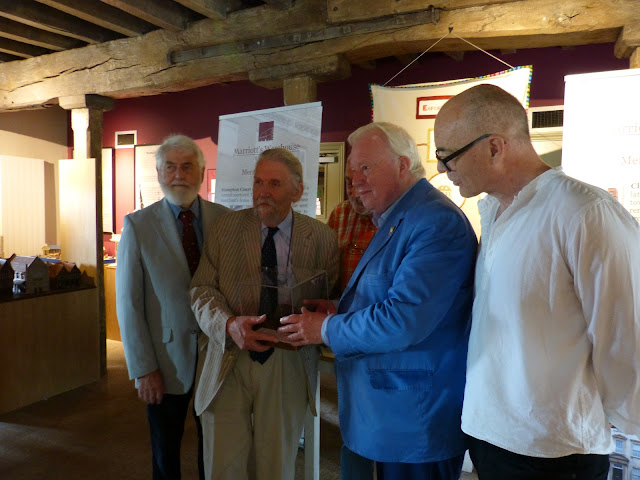


Dr Paul Richards, who gave an excellent talk about the Siege, with the other Marriott's Warehouse Trustees, along with performers on the day Andy (hidden) and Gareth

The cannonball as presented to Gareth by Veronica Lane
This 17th century
cannonball dates from the Civil War and was
found in a field near King’s Lynn. It was given to Gareth Calway by Veronica
Lane whilst he was touring with his Oliver Cromwell show. Gareth then presented
the cannonball to Marriott’s Warehouse Trust in 2016. During the Civil War the
town suffered a three-week siege from 28th August to 15th September
1643 following a Royalist coup. Parliamentarian forces blockaded the town to
the east and by sea, while cannons were fired across the River Ouse from West
Lynn. On 3rd September 1643 one cannonball went through St.
Margaret’s Church’s west window.
The Siege of Lynn was very
important in terms of the Civil War and also because of its impact on the
population of Lynn. To mark the
occasion, Gareth will join with Andy Wall director of Ely Folk Festival to perform
"The Ballad of Freeborn John" their song about the issues at stake in
the Civil War and declaim his comic ballad "The Ballad of The Backwoods
Cavalier" which tells the story of the Siege as PG Wodehouse might have
told it! Dr Paul Richards will deliver a short talk about the impact of the
Siege on Lynn's population.
The Ballad of The Backwoods Cavalier
My father leapt upon his high horse
And galloped it hard into Lynn,
“I seize this Parliamentary town,
Declare it for the King!”
“You have no mandate!” cried Mayor and MPs
Laughed Dad, “Arrest those knaves!
Cavalier bravado has come to town
Which you from yourselves I’ll save.”
Though Cromwell’s preachies at the Gate
Of Lynn as at Heaven knock,
Our stained glass windows shoot all to hell,
Our royal passage block,
We are the laughing cavaliers
And we need a royal 'we'
Now it's weeing down with cannonballs
And the last laugh is on me.
Say I “Great king, your
royal East
And loyal Lynn, I’ll re-seize ’em,
They’re rebels for Your Majesty
And I’m the man to lead ’em!”
The king he writes a broad letter
And thrusts it into my hand,
“Roger L’Estrange shall rule in Lynn
With phantoms I command.”
We live and die a chevalier’s
life,
And we spend a royal p.
On a black marble floor for our horse's hooves
And a falconer and a fool for me.
We are the laughing cavaliers
And we need a royal 'we'
Now it's weeing down with cannonballs
And the last laugh is on me.
.
From Oxford Town to Norfolk woods
The four winds see me ride
And show my fine letter to a Jack
His poor coat to turn or bribe.
‘Captain Leaman’ is that seaman,
Cries he, ‘Er, we’ll talk anon,
I must now to Lynn awhile but will
Return here to Appleton.”
He rides to Colonel Walton and brings
Six redcoats in disguise,
“Show us His Royal Traitor’s hand!’
They pinch me as a spy.
We are the laughing cavaliers
And we need a royal 'we'
Now it's weeing down with cannonballs
And the last laugh is on ...we.
© Gareth Calway 2015
© Gareth Calway 2015
The Ballad of Freeborn John
The bloodiest war in our history
And one in four of us died
For a castled king on a stagnant throne
In a revolutionary tide.
‘I spilt my blood so I need a voice!’
Cries Freeborn John at Putney,
‘Who dies for England is England’s king,
We are no grandee’s army.
‘The poorest man in England has
The right to live as the greatest,
Our God’s the All in all, our king’s
The Christ in every breast.’
The bloodiest war in our history
And one in four of us died
For a castled king on a stagnant throne
And a revolutionary tide.
We’re the voice of the Freeborn Englishman
That was raised at Magna Carta,
The Dissenting flag of the Good Old Cause,
The common or garden martyr.
I rose with Tyler, Straw and Ball
When peasants shook the kingdom,
I was sold down that river of blood by a king
Who hawked the soul of England.
We need no manor house and land
To fix our permanent interest,
We fight for England, our rights and ourselves:
No mercenary business.
The bloodiest war in our history
And one in four of us died
For a castled king on a stagnant throne
And a revolutionary tide.
I will rise at Kett’s Hill and Tolpuddle,
I will fall at Peterloo,
March to Chartist hell and a Newport hotel
To win this Britain for you,
Die a million deaths in two world wars
Though the portion’s not so many
As died for Charles, that Man of Blood,
And in our redcoat Army.
A new model England truly advanced,
Through rank and royal sin
In a cavalry charge to a Future Now
Whose God Not Man Is King.*
The bloodiest war in our history
And one in four of us died
For a castled king on a stagnant throne
And a revolutionary tide.
© Gareth Calway 2015
© Gareth Calway 2015
*the epitaph on Cromwell’s tomb


October 11, 2014
Double reviews of our Cromwell/Siege of Lynn double header Sep 3 2014!!
Smile - you're the 250+ person to read this post...
"September 3rd. On the banks of West Lynn stood an army of vengeful Parliamentarians, led by Oliver Cromwell. Cannons fired over the Great Ouse…
The evening’s entertainment was fit for a King - or a Lord Protector!" Helen Thirkettle
.jpg)

"September 3rd. On the banks of West Lynn stood an army of vengeful Parliamentarians, led by Oliver Cromwell. Cannons fired over the Great Ouse…
The evening’s entertainment was fit for a King - or a Lord Protector!" Helen Thirkettle
Need a second opinion?
Read this alternative review on the Lynn News website
here. Lots of other readers have!July 15, 2013
Been There, Done That, Got My Name On The T Shirt: Cromwell's Talking Head at Ely Folk Festival


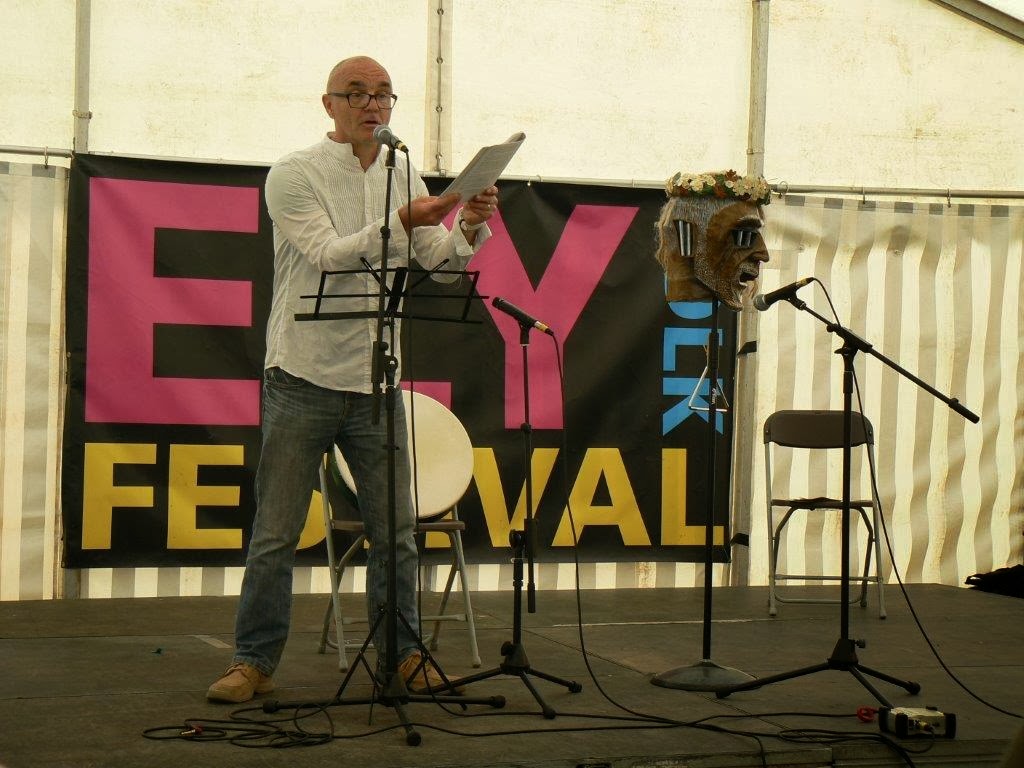
'Cromwell's Talking Head' is a lively rehearsed reading of 30 minutes. It was the first ever spoken word hosted by Ely Folk Festival in July 2013, where it went down like a real ale in a hot marquee. It has an ongoing residency at Oliver Cromwell's House in Ely, bookings at Marriott's Warehouse Upstairs in King's Lynn and the Cromwell Museum in Huntingdon and tours pubs, clubs and storytelling venues.
Cromwell's Talking Head is in the horrible history genre and aimed at the naughty kid in all of us. But it's all true - Cromwell the king-killer really was dug up from his 'royal' grave at the Restoration, hung, drawn, quartered and his head stuck on a traitor's pole for 25 years. After centuries of adventures in freaks shows and dodgy museums, bits nicked by trophy hunters, and carrying a legendary curse, the head was authenticated by cranial detectives and in 1960 secretly buried at his old college in Cambridge University. Secretly in case drunken royalist students dig him up again! In the monologue, the head tells the ghastly story and the story of the Civil War to a young grave robber who has dug up more than he bargained for. It's funny, informative and not that comfortable for royal ears. You’ll laugh your head off!
'A triumph of narration and verbal colouring' (Radio Drama Reviews.)
To hear the Siren FM radio production, go to iTunes - https://itunes.apple.com/gb/podcast/the-reading-room/id399470470
SEE ALSO: http://garethcalway.blogspot.co.uk/2014/01/press-release-jan-15-2014-cromwells.html Cromwell's Talking Head winter tour 2014


At Ely 2013, I enjoyed the support of a youngster in the crowd named Ethan reminding me to hit the triangle at the head of each chapter and got lots of lovely feedback. Cromwell rides again!
CROMWELL'S TALKING HEAD ELY FOLK FESTIVAL

PRESS RELEASE JULY 2013
14 July is a great date for Republicans in France. But the French don’t have the monopoly on setting up republics and chopping off the heads of tyrannical kings. Our very own Oliver Cromwell might appreciate his story being told on Bastille Day at this year’s Ely Folk Festival, twenty minutes walk from his old stomping ground and national memorial at Oliver Cromwell’s House, and in the shadow of Ely Cathedral.
The great patriot – “we are English, that’s one good fact” - might point out that he headed up the English Revolution a ‘big hundred’ century before Robespierre and Bonaparte led the French. The humble gentleman farmer Cromwell, first as soldier and then as statesman, combines the positive qualities of both these French leaders. The English Empire he established in the 1650s held a position in the world higher than any other between Agincourt and Trafalgar – 400 years. English (round)heads were held high.
Until the Stuart Restoration in 1660. At this point, Cromwell’s body, preserved and buried (against his wish) in royal state in the tomb of soldier-king Henry VII, was dug up by vengeful royalists, hanged at Tyburn, drawn, quartered, beheaded, and its tooth-smashed, ear-torn head spiked on the roof of Westminster Hall: the punishment meted out by Charles II for beheading his father Charles I in 1649. Cromwell’s head remained on its spike for 25 years, surveying the Great Fire of London and enduring a quarter of a century of English weather, until finally removed by a thunderbolt .
Fire and smoke damage ensued as it was hidden up a chimney by an old soldier (one of the redcoats he and Sir Thomas Fairfax had formed during the Civil War into the victorious New Model Army) and then spent centuries in freak shows and dodgy museums, bits being broken off as souvenirs. The Curse of Cromwell’s Head was said to follow anyone who held it in his possession and gory tales bear witness to this so-called curse.
But the real story is gothic enough. As is the curse. Cromwell is not a great favourite with the royalist view of history and whenever kings were popular, Cromwell’s head was best kept secret. But when the English grew restless again under unpopular and self-indulgent monarchs - such as James II and even for periods of Victoria’s reign – this relic of our only republic became a focus for demands that Cromwell’s progressive politics be honoured.
The relic was validated ‘beyond all reasonable doubt’ as Cromwell’s actual head and buried in his old college at Sidney Sussex, Cambridge in 1960. A nearby plaque commemorates the fact but the actual whereabouts are kept secret for fear royalist students might dig it up again. And what a story the head could tell if it talked!
Well now it is. Gareth’s carefully researched dramatic monologue imagines the conversation when a grave robber exhumes the head at midnight. After two sell out performances at the House last year, it will be staged at this year’s festival in Marquee 3 between 2 pm and 2.50 pm on July 14.
Subscribe to:
Posts (Atom)