March 26, 2014
Gin Trap Folk - March 25 2014
I can't remember a Gin Trap Folk evening quite so wonderful. I counted 54 people crammed into the L shaped room. There were first public outings from Gin Trap Virgins, there was dancing in the tight floorspace (and that song about boobs), box instruments I don't even recognise, all sorts of strings and winds and percussion, not a moment's let up in the parade of folk excellence, two of my favourite poems from the middle ages and middle earth of folk tradition and at the end of the evening there was an old guy singing from the heart, crouched over his guitar. He really has no idea how moving his voice and words are. But I think the ladies do.


February 26, 2014
Aiming for Progress - Collins series PUBLISHED AT LAST
Link to Lynn News feature on this publication-
http://www.lynnnews.co.uk/news/local/latest-local-news/sedgeford-author-aims-to-insipre-pupils-with-new-textbooks-1-5935041
Writing and editing the Second Edition of this series was one of the hardest and most sustained labours of love ever but also some of the work I'm most proud of.
These six books contain my best educational writing and editing by some distance. The fruits of three decades teaching and learning how to use high quality texts and make classroom resources that give, as Collins say, 'the freedom to teach'.
Two personal favourites, outside of my signature Boudicca, Slave Trade, Cromwell and Beatles territory (all included in the series) and the bees spread that had the new Science-English party buzzing, and ,well pretty much everything else :) are:
1. This Norfolk spread I wrote for Collins Aiming for Progress in Writing and Grammar Book3, which I hope puts some of our local issues on the world education map.

2. My favourite page from Writing Book 4, combining the model social media talents of one David Izod (Droitwich ) and the really talented Calway, our daughter Emma.


February 14, 2014
Good King John

January 20, 2014
Cromwell's Talking Head and Siege of Lynn winter tour 2014

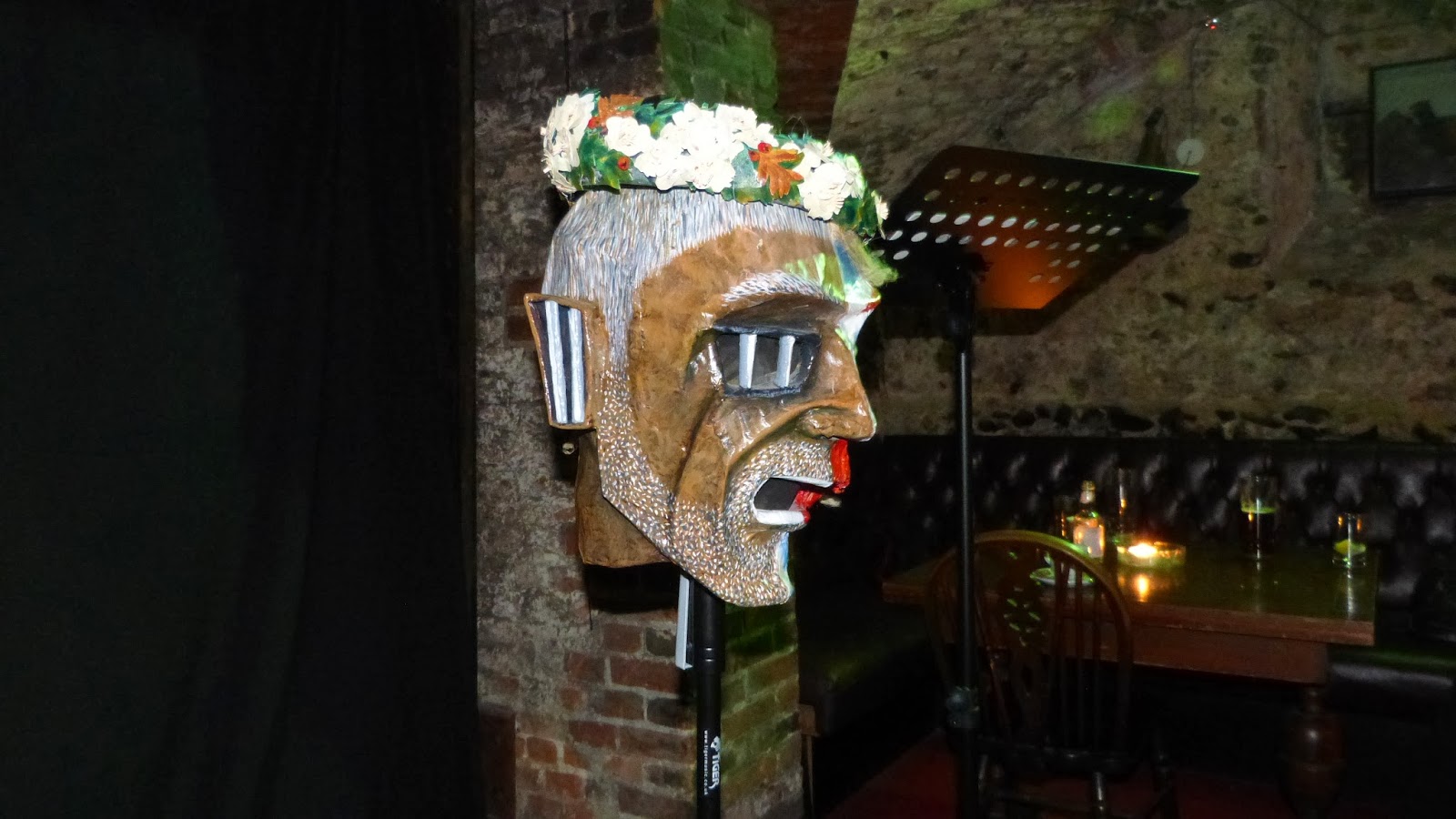
Cromwell’s Talking Head, a dramatic monologue by Gareth Calway. Lively rehearsed reading in the horrible history genre aimed at the naughty kid in all of us. But it's all true - Cromwell the king-killer really was dug up from his 'royal' grave at the Restoration and his head stuck on a traitor's pole for 25 years. Cromwell’s severed head tells his ghastly story of civil war and regicide to a modern grave robber. You’ll laugh your head off!
TOUR DATES
Cambridgeshire
Cromwell's Talking Head by Norfolk author Gareth Calway Oliver Cromwell’s House, 29 St Mary’s St, Ely CB7 4HF - Thursday, January 30, 2014. Ticket info 01353 662062 www.olivercromwellshouse.co.uk East Cambridgeshire Tourist Office says, "Join us on the anniversary of Cromwell’s grisly exhumation for a guided tour of his former home followed by a lively reading of a dramatic monologue. Hear the real story of what happened to the great man’s beheaded corpse. 2 pm. £7.50 includes glass of Cromwell cider."

Norfolk
Cromwell’s Talking Head plus, a dramatic monologue by Gareth Calway. Cromwell’s horrible history told by his severed head! Includes a bonus talk on the Siege of Lynn, 1643. Two gigs:
The Gin Trap, Ringstead, Norfolk, Friday 31 January. £5. Starts 7.30. Ticket info 01485 571828 www.garethcalway.co.uk

Great Massingham Social Club, Norfolk, Monday 3 February. £5. Members free. Starts 7.30. Ticket info 01485 571828 www.garethcalway.co.uk


Filled the 'Folkpot' room at Great Massingham with the artistic and intellectual flower of West Norfolk (3 pictured of 23 present). Expert questions after the talk - a real debate with real people engaged with the issues - in a fun atmosphere and lots of naughty kid laughter during the monologue. A splendid time had by all and a small party to follow - not bad for a cold Monday night in February!
Norwich,
Jurnet's Bar, Wensum Lodge, Wednesday 5 February 9.30 pm. Donation box only. Bar. Info 01485 571828. (as part of regular 8 pm-10.30 pm Storytelling event run by Dave Tong www.theyarnsmithofnorwich.com)
New territory - in the history-burdened bowels of the big city among ye guild of dedicated storytellers and with Cromwell comically at odds with the set theme of the evening - dragon tales (from all cultures, Nordic, Japanese, Beowulf etc) - but you could hear a pun drop in the silence. I sportingly contributed an impassioned Worm to the first half - dramatic verse done as one man theatre is not quite storytelling either. Had some generous feedback though.

http://www.lynnnews.co.uk/what-s-on/lifestyle-and-leisure/gareth-takes-a-horrible-history-look-at-cromwell-at-west-norfolk-venues-1-5835343
News Release from East Cambridgeshire District Council 21 January
What did happen to Oliver Cromwell’s body?
This January, Oliver Cromwell House will be the place to learn about what really happened to the former Lord Protector’s beheaded corpse.
‘Cromwell’s Talking Head’ on Thursday 30 January at 2pm, visitors to the tourist venue will be taken on a guided tour of the House followed by a dramatic monologue from Norfolk author Gareth Calway.
Gareth will explain how the body was buried in the manner of a king only to be exhumed after the Restoaration to be hung, drawn and quartered with the head put on the traitor’s pole over Westminister Hall for 25 years.
The mystery of what happened next is then told in vivd detail as Cromwell’s remains were hidden in various locations, presented at freaks shows and became the source of a terrible curse before finally being laid to rest at Sideny Sussex College in Cambridge.
Tracey Harding, Team Leader Tourism and Town Centre Services at East Cambridgeshire District Council, said: “It is wonderful to have Gareth Calway come back to tell his fascinating monologue of what happened to Oliver Cromwell’s corpse after it was exhumed during the reign of Charles II. What adds to the colour of the talk is knowing it is all based as far as possible on historical fact – it reminds us all that we have much to learn from the behaviour of our ancestors.”
Tickets are priced at £7.50 includes which includes a glass of Cromwell cider. For more information call 01353 662062 or visit www.visitely.org.uk.
ENDS
Notes for editors
For further information contact Tony Taylorson in the Communications Team on 01223 699285.
PRESS RELEASE JANUARY 20 2014.
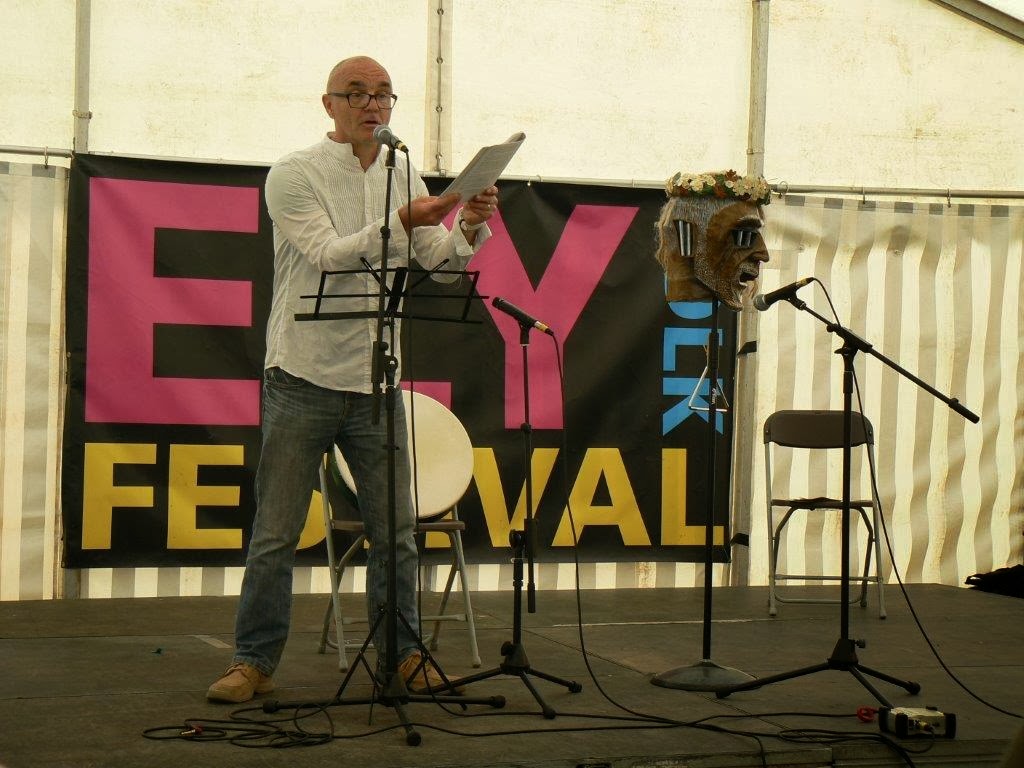
'Cromwell's Talking Head' is a lively rehearsed reading of 25 minutes, with a bit of Celtic drum. It was the first ever spoken word hosted by Ely Folk Festival last August (picture attached), officially judged as 'wonderful' and went down well in a hot marquee to eighty plus people.
It is in the horrible history genre and aimed at the naughty kid in all of us. But it's all true - Cromwell the king-killer really was dug up from his 'royal' grave at the Restoration, hung, drawn, quartered and his head stuck on a traitor's pole for 25 years. After centuries of adventures in freaks shows and dodgy museums, bits nicked by trophy hunters, and carrying a legendary curse, the head was authenticated by cranial detectives and in 1960 secretly buried at his old college in Cambridge University. Secretly in case drunken royalist students dig him up again! In the monologue, the head tells the ghastly story and the story of the Civil War to a young grave robber who has dug up more than he bargained for. It's funny, informative and not that comfortable for royal ears. You’ll laugh your head off!
PRESS RELEASE Jan 15 2014
CROMWELL’S TALKING HEAD RETURNS TO OLIVER CROMWELL’S HOUSE
As Head of State, Oliver, emulating his Tudor ancestor Thomas, oversaw an English Revolution centuries ahead of his time and raised English prestige abroad to its highest level between Agincourt and Trafalgar (400 years). Yet within three years of ‘royal’ burial, he was disgraced and spat upon. Only in Victorian times was there a national revival of respect/campaign for a statue outside the Parliament he did so much to advance. (Queen Victoria refused assent.) Gareth’s monologue has been described as "A triumph of narration and vocal colour" (Radio drama reviews) and as an "Interesting and lively new take on Cromwell" (Cromwell House) Surprising facts about Oliver – like his tolerance – will emerge. Cromwell’s Talking Head has a twice-yearly residency at Oliver Cromwell’s house marking Oliver’s posthumous execution (Jan 30) and ‘lucky day’ (Sep 3.)
An exciting partnership with ex-Mayor of Lynn and now deputy lord lieutenant of Norfolk Dr Paul Richards (author of the documentary history of King’s Lynn) is planned for next September 3 at Marriott’s Warehouse. This partnership will combine Calway’s monologue with some context from Dr Richards about Cromwell’s securing of King’s Lynn for the Parliamentary cause in 1643, against the intrigues of Thomas Gurlyn, Dr Richards’ mayoral predecessor – and a covert royalist - at that time. Meanwhile, at Ringstead and Massingham, Cromwell’s Talking Head is preceded by the author’s own talk on The Siege of Lynn 1643.
http://www.edp24.co.uk/norfolk-life/norfolk-history/17_jurnet_s_house_1_214362 Fascinating history of this house. Owned by Jews until the latter's expulsion from England for 400 years until - yes - Cromwell welcomed them back. Later owned by the famous Pastons. Dripping with history and atmosphere.
The Siege of Lynn 1643. Feature article published in the Eastern Daily Press Friday 24 January
The Siege of Lynn 1643
Less Puritan than Yarmouth or Norwich and with more active Cavaliers in its backwoods, King’s Lynn was the only place in Norfolk where Civil War blood was shed or gunfire heard. And if the Earl of Newcastle’s Royalist force had relieved the town, it might have turned war and country king-wards.
The Siege of 1643 is the whole war in microcosm: Cavalier audacity; Parliamentary accountability; a divided populace (tending to Parliament) above all united in devout wish for harvest, trade, peace over plunder, billeting, destruction.
And introducing one Colonel Cromwell, typically chastising his then superiors to greater efforts. ‘If I could speak words to pierce your hearts with the sense of our and your condition, I would… If somewhat be not done …you will see Newcastle’s army march up into your bowels.’
And an explosive September 3, ominous date of all Cromwell’s decisive victories, and his death.
Both of Lynn’s two MPs supported Parliament. Yet ‘Lynn Regis’ bears the (temporary) distinction – or stigma - of being the only Royalist town in Eastern England.
Charles I needed a strong fleet: the Civil War was partly triggered by his levies of Ship Money on a reluctant population. Losing London to Parliament was a blunder; losing the East-based navy began to seem like fecklessness. So he needed Lynn: chief exporter of the region’s corn; favoured port of entry to the eastern counties and import-supplier to ten counties (and London).
Parliament grasped this vital strategic importance of Lynn as a gateway between Royalist North and Parliamentary East and South. It instructed the town to keep armed men on its walls and by January 1642 gunpowder had been stored at Market Cross, St Anne’s Fort, Trinity Hall and Red Mount.
The Parliament-tending corporation prepared defences and sent out for an engineer to repair those walls. Drawbridges were set up at the east and south gates. Ironically, all of this would be seized by Royalists and used against the Parliamentary army in 1643.
The Royalist gentry of west Norfolk put pressure on Charles I sympathisers in the corporation. In spring 1643, Cromwell rushed from subduing mild Royalist unrest at Lowestoft to order the Mayor of Lynn to arrest ‘13 local gentlemen’ regarded as threats, orders duly carried out in May. They managed to escape – or were allowed to while sympathisers within the corporation, including the covertly Royalist Mayor, looked the other way.
Enter the dashing Hamon L’Estrange of Hunstanton Hall, a sexagenarian Cavalier living in the grand style with expensive tastes; expensive sons running up debts; eighteen servants (including a falconer and a fool) and a black marble floor in his stables. Supported by Sir Richard Hovell of Hillington and the Morduants of Massingham - encouraged by the Yelvertons of Rougham and the Pastons at Appleton - he now led a Town Hall coup, declaring himself on 13 August ‘governor of Lynn for the king’.
The borough’s two MPs, John Percival and Thomas Toll, were put under house arrest.
Parliament’s Eastern Association appointed the Earl of Manchester to retake the town and was scorned by the royalist press as having ‘as much hope of Heaven’s gate as to enter Lynn.’ The Puritans, as always, took this rebuke at its Word. Cromwell and Manchester lambasted the committees of the Eastern Association for ‘more arms, more troops, more supplies.’ Trust in God and keep your powder dry.
A siege brewed. An August entry in the record of the civic authorities notes that ‘a great company of strangers are now come to the Burgh’ and must be resisted. The 8000 strong Eastern Association army blockaded Lynn on land. Warwick’s Roundhead warships patrolled the Wash: only one Royalist ship carrying vital supplies sneaked through to the town, using fake signals and being fired on by blank rounds as part of a well-worked deception.
Ironically, the strong fortifications and well-equipped garrison established by Parliament now stood firm against it, ordnance turned towards land rather than sea by ‘strangers’ from west Norfolk. Were they loyalists or traitors?
To one besieging Roundhead captain they were a ‘wicked crew… enemies to God and Parliament …malignants and recusants…’ bankrolled by L’Estrange (who faced possible financial ruin if his enemies controlled Norfolk) with ‘a thousand pounds out of his own purse’ and (whose) ungodly strength... (‘1200 muskets, 500 barrels of gunpowder with bullet unanswerable, and three or four troops of horse…’) was only beatable because they were ‘cowardly Cavaliers’ without ‘the strength of the Lord.’
Cromwell ordered a new battery of cannon to move into position at West Lynn, his last local action before galloping north with a (siege-weakening) detachment of horse and dragoons for a pre-emptive strike at Newcastle.
The hope was to bombard the town – or rather a west Norfolk gentry who had seized leadership of its citizens - into submission, without the need of an assault.
One ‘eighteen pound’ cannonball notoriously smashed through the west window of St Margaret’s on Sunday September 3, ‘took the middle pillar a great part of, and broke it in a hundred pieces, dispersing them all over the church.’ ‘The people departed in a most confused manner….some leaving their hats, some their books, and some their scarves.’
Shot and granados flew daily into Tuesday Market Place, causing few casualties but much psychological damage. Houses and property were damaged and abandoned and the shrieks of women and children carried well beyond the town walls: a war of terror.
Death counts vary. One contemporary account suggests ‘above eighty … on both sides’ though parish registers record just two soldiers buried at St Margaret’s during the weeks of the siege and one at St Nicholas’s.
Routes south and east and fresh water supplies from the Gaywood River to the north were cut off. Manchester was within musket shot by September 7th.
The garrison dug in and waited for Newcastle. He never came. It made gallant sallies out: attempting to capture ‘3-400 beefs’ bound for Setchey Market; burning an almshouse known as the Hospital in the nearby village of Gaywood to prevent besiegers taking up quarters there, and meeting every summons to surrender with Cavalier bravado.
Meanwhile the local economy choked and the town feared ruin, even destruction. Boats for a river assault, ladders for scaling the walls and a force of 8000 men were all in place. Despite the derring do-and-die-hard-ism among some Royalists, when Manchester sent word that women and children should be sent out of the town - prior to a general assault on 16 September - an honourable surrender was agreed ‘not as fearing the taking of the town but to avoid the effusion of blood.’ The gun barrage over the sluggish Ouse ceased, sudden silence informing villages and farms to east and west the siege was over.
Or almost. A grumbling appendix of garrison offence required one further show of force– along with a farcical (though to Manchester’s rustic soldiery, dismaying) ‘two hour wrangle at the gate, in the darkness of the summer night’ amid harrowing cries of ‘Give fire!’ Men died in the confusion.
Next day, Manchester’s troops marched into Tuesday Market Place through streets lined only with women and established his HQ at the house of deposed MP Thomas Toll (who had escaped house-arrest several days earlier though a window.) The Earl ordered a thanksgiving service for the peaceful end of the siege, and sermons for the townspeople each morning.
Royalist arms were seized; leaders arrested. After a parley lasting many hours, and a pause for dinner, Hamon L’Estrange was held liable for all damages caused and his estates and property in west Norfolk sequestrated. His gamble on the fortunes of war miscarried, though he was still able to divide a considerable estate between his sons on his death in the Cromwellian England of 1653. The ‘gentlemen strangers’ were told to leave town, though keeping their horses, swords and pistols. A general amnesty was agreed and Lynn’s Parliament-tending, make-trade-not-war townspeople got their desired end.
For the next year, until the war moved west and south on the growing Parliament tide, Lynn became the front line garrison-town of the Eastern Association and major munitions store of Parliament forces.
Sources: RW Ketton-Cremer ‘Norfolk In The Civil War’; P. Richards ‘King’s Lynn’; Susan Yaxley ‘The Siege of King’s Lynn’.
Gareth Calway’s winter tour of ‘Cromwell’s Talking Head’ (a dramatic monologue by Cromwell’s severed head) comes to Oliver Cromwell’s House, Ely, Jan 30 2 pm (info 01353 662062), The Gin Trap Inn, Ringstead,* Jan 31, 7.30 pm; Great Massingham Social Club,* Feb 3, 7.30 pm and Jurnet’s Bar, Norwich, Feb 5, 9.30 pm (info 01485 571828) * = includes a talk on The Siege of Lynn.
January 15, 2014
Reviews written for EDP and Lynn News 2013-14
Fr Peter Rollins
Pilgrimage and the Port of Lynn
Marriott’s Warehouse Sunday 27 October
Fr Rollins wore his office lightly for this well-attended and
captivating talk, joshing late arrivals across a creaky Warehouse floor ‘Catholics
- always late for Mass!’ - and, over the clangour of someone’s mobile, ‘if
that’s the Pope, I’m unavailable.’
Celtic Lynn, meaning
‘lake’ or ‘pool’, attracted visitors to its magical lowland confluence of
water, sky and earth: like a sacred Blackpool.
The Walsingham connection began after the Norman lady Richeldis
de Faverches, inspired by a vision of the Virgin Mary there in 1061, built a
replica of the Holy House, hence England’s Nazareth.
Pilgrims arrived by sea in Lynn Episcopacy (Bishop’s Lynn)
with its skyline of five imposing friaries and giant harbourside Cross before
staying at the ‘motorway service stations’ of the age - the monasteries – and
flourishing Inns along the marathon walk to Walsingham. Rollins explained that Church-licenced,
uniformed pilgrims did not always behave in a penitential manner, and ‘football
crowd’ Ave Maria chants drew
complaints. The unworldly and disorientated (many from overseas) were also
mercilessly fleeced by locals.
The entire industry stopped in 1537 (until 1897) with Thomas
Cromwell’s concerns: to maintain Henry VIII’s financial independence (by ‘acquiring’
monastic wealth) and end idolatry associated with holy sites. This change was
brutally enforced and the 12 plumbers, masons and others (concerned for their
livelihoods as much as their Faith) who reopened Richeldis’s shrine were
hanged, drawn and quartered, two in Lynn. No others tried.
A fascinating insight.
The Bricks of BurstonFakenham Community Centre
100 years ago, the parson of Burston, Norfolk, drove Annie and Tom Higdon out of his county school and started the longest strike in trade union history.
The set is a convincing Edwardian classroom with attention focused on the nondescript door. In a fine moment of theatre, the audience realises the three compellingly-acted characters are trapped together in limbo.
Annie and Tom’s relationship is explored best through the story of the strike itself, which pitches dynamic chapel egalitarianism against landowning establishment and church.
Tom is a born fighter, defeating the parson (who runs the village) in a local election; Annie just wants to teach and fears to alienate their patron.
Their marital rows are as convincing as their shared belief that every child, however low-born (Tom himself is labourer’s son) deserves an education to make dreams come true, not just a training for servitude.
The NUT advises Annie to smile in court. The children strike on her behalf. Workers from all over the world send money and bricks to build an alternative school.
Alex Helm’s parson is a study of unctuous complacency challenged by a changing society and a gradual agonising self-awareness that he hates his own God.
http://www.lynnnews.co.uk/news/local/latest-local-news/back-to-the-summer-of-love-at-ely-folk-festival-review-by-gareth-calway-1-5382974
http://www.lynnnews.co.uk/what-s-on/lifestyle-and-leisure/review-the-sharps-gt-massingham-social-club-1-5774005
http://www.lynnnews.co.uk/what-s-on/lifestyle-and-leisure/review-deep-south-on-a-cold-night-1-5598507
http://www.lynnnews.co.uk/what-s-on/lifestyle-and-leisure/ringstead-buzz-banter-and-live-music-at-the-gin-trap-inn-1-4902668
http://www.lynnnews.co.uk/what-s-on/lifestyle-and-leisure/wolferton-howl-in-delight-with-the-wolf-folk-club-1-5052337
http://www.lynnnews.co.uk/what-s-on/lifestyle-leisure/review-east-anglian-hopefuls-get-their-chance-to-support-the-swarb-1-5977303 here
http://www.lynnnews.co.uk/what-s-on/lifestyle-leisure/dave-swarbrick-s-sell-out-gig-at-great-massingham-1-6008648
http://www.lynnnews.co.uk/what-s-on/lifestyle-leisure/review-the-real-tragedy-for-fisherfolk-on-black-friday-1-6102820
EDP Reviews are print only so I reproduce them here.
Rich Hall. King’s Lynn Corn Exchange. Wednesday 15 May.
There was a midweek stir about King’s Lynn as American stand up king of cuss Rich Hall drew a near-capacity crowd. Hall is not as barbed as some TV comedy stars – his jokes at the expense of the audience’s town were balanced with an expressed affection for Norfolk, if not for the London he has chosen to live, the Essex he says America started out from or the next town on his tour. Armed only with words - including an F word that became part of the rhythm of his delivery - he held this audience for over two hours, often making them the butt of his jokes, when he wasn’t bringing up to date Wilde’s quip that ‘We have everything in common with America nowadays, except of course language ’ with observations on armed US schoolteachers, English cobblers cutting keys and buttoned-up Englishmen not showing their appreciation. This audience showed it with chortles, claps, cheery heckling and whistles.
And then there were guitars: had Rich gone pop? No, though his strum-n-growl improvisations of audience stories– even persuading Nigel in row 2 to propose to Ellie!- added variety. And he did finish the evening singing a searing satire on Dylan.
KIng's Lynn Festival 2013
Laura van der Heijden (cello) and the European Union Chamber Orchestra, St Nicholas’s Chapel, King’s Lynn.
Apt that this King’s Lynn Festival concert began with the work of a 16-year-old prodigy, Mozart, as another, winner of BBC Young Musician 2012, was the star of several pieces, notably Haydn’s Cello Concerto No 1 in C Major. Early Mozart and Haydn is sometimes dismissed as ‘decorative’ – technically gifted but lacking the personal expression and mature emotion of later works - but you may as well accuse the air of heaven on a July evening of lacking gravity. And in any case, the beautiful adagio of the Cello Concerto held heart-strung emotion which the soloist handled with sublime ease before showing her mastery of the fraught final movement. Bridge of Sighs for solo cello and strings composed by Tom Waits, another (relative) youngster, present in this audience, carried a gentle breath of his workplace - St John’s College, Cambridge - into the warmest air St Nicholas’s can have known for many a summer, the work’s accessible modernity aided by its homage to a Monteverdi madrigal. To finish, the elegiac melodies of Grieg and dancing airs of Respighi left the audience charmed. Gareth Calway
Courtney Pine. Corn Exchange, King’s Lynn.
The musical diversity at this year’s King’s Lynn Festival is extraordinary – distinguished orchestras and conductors, bright new stars of classical music and, with Courtney Pine and his six piece band, a surprising new take on modern jazz
Jazz musicians always look cool. These guys looked Jamaican-cool. And as the dreadlocked Pine explains, it is the exciting rhythms, warmth and joyous improvisation of Jamaica that drives them. Led up, down and all over the scales by Pine’s soprano sax and EWI, the tight fusions of drums, steel drums, dual guitars and stripped-down bass take us on a helter-skelter of meringue, ska, mento, calypso and freestyle. ‘What is that tune?’ Pine enquires, ‘accidentally’ finding Take Five - though we were never allowed to stay in the comfort zone of a standard tune for long.
The virtuosity of each player also emerges in breathtaking solos – generously framed for the audience in dumb show of respect by the ever-genial Pine.
It is music as interaction that interests him most, dance music for the heart and this two-thirds capacity crowd joyfully responded throughout. By the end, it was on its feet, clapping, singing, making its own festival. Gareth Calway
The Benyounes Quartet. Town Hall, King’s Lynn.
These dynamic and elegant young players, judged best performers at the International Sador Vegh String Quartet Competition in Budapest and in receipt of four other prizes in 2012 including Best interpretation of Bartok, got the King’s Lynn Festival programme of coffee concerts off to an impressive start. Three recalls to the stage by a capacity Monday morning audience continuing to exclaim its approval as it filed out down the antique steps speaks for itself.
After paying its respects to the teenage Schubert’s String Quartet in E Flat major, the group tackled a new work by Tim Watts - present in this audience –inspired by a poem by Sylvia Plath. They daringly reversed Plath’s technique, successfully turning her crisp musical metaphors into actual music.
The intense closeness of the ensemble playing was evident to both eye and ear throughout and nowhere more than in the Slavonic folk tunes and dance rhythms of Dvorak’s String Quartet in E Flat. In each movement, the young players explored something fresh , tender or exuberant, or all at once, flowing seamlessly from fast polka rhythms through lyrical andante to joyous melody and showing a collective mastery of all.
Blazin’ Fiddles. Guildhall , King’s Lynn
‘We’ll start with a shet of reels from Setland.’ Not an easy sentence for a Highlander to say in a heat this traditional six-piece fiddle, guitar and keyboard band grinned about throughout – mentioning hot tubs and cocoa as their interval treat - but belied all evening by the fluency of the playing.
This King’s Lynn Festival event drew a different capacity crowd from those at the classical music and modern jazz concerts and it applauded the full range of Highland and Island stories, from jumping rhythms calling to the feet to the Jacobite lament and other pieces truly touching the heart. Each player - except the keyboard player who let his foregrounded syncopating rhythms and bearded smile do the talking - had a distinct tartan story to tell in spoken introductions then on a fiddle, redolent of late nights reeling towards dawn.
The solo virtuosity and ensemble of fiddles, keyboard and the acoustic guitar, thrashed with a rhythmic folk subtlety often lost as a lead instrument in amplified rock, had us clapping and jigging to this ceilidh-in-seats, in the truly warmed-up second half. A festival of British diversity in all its glory. Gareth Calway.
You look Familiar! The Familiars at Folkspot

http://www.lynnnews.co.uk/what-s-on/lifestyle-and-leisure/review-the-familiars-at-fincham-social-club-gareth-calway-1-5762350
FAIRPORT JUST KEEP ON ROCKING
p.32 EDP Monday 17 February
Fairport Convention
Princess Theatre, Hunstanton
Fairport are The Great Revisiters: old songs, grand old venues, grey longhaired audiences mirroring those onstage. The tour album By Popular Request (2012) revisits 45 years of fan-voted masterpieces. Tonight’s audience revisits young, gifted, wild 1967, proud to have been there.
Fairport wear their instrumental virtuosity like their motley clothes – casually: musicians not rock-stars.
Sole original member Simon Nicol denies Fairport ‘beat a drum for folk-rock’ - ‘we absorb some folk tradition’ into rock. But rock is heritage now too - vintage Sandy Denny and Richard Thompson songs are highlights.
Fairport also re-invent via sell-out evergreen winter tours (this is their 30th in a row); showcases for new acts (Edwina Hayes, a singer worthy of Sandy); their Cropredy festival and a host of new songs in which their creative phoenix burns on:
A billion dollar mandolin
Won’t play a bluegrass tune.
An unwanted novelty was Peggy, Fairport’s stage-clown bassist, chatting out front pre-show nursing a bandaged hand. Surely a joke? But Fairport have a long tradition of replacing the irreplaceable: Pegg Jnr impressively deputised, though hearts lifted when Andy-capped Dad grinned onstage for vocal duties.
The ensemble playing is, as always, vibrant, creative, soaring. And everyone sings.
See also: Fairport in a storm. http://garethcalway.blogspot.co.uk/2012/03/fairport-on-ice-in-north-sea.html">interview with Fairport Convention's Dave Pegg http://www.lynnnews.co.uk/what-s-on/lifestyle-leisure/dave-pegg-heading-back-to-norfolk-this-summer-we-always-look-forward-to-our-hunstanton-gigs-1-5951558
Jesus Christ Superstar
KLODS. Guildhall, King’s Lynn
The iconoclastic 1969 rock opera is recharged with contemporary energy, the hippy apostles re-imagined as anti-capitalist indignados of 2011. Peter Yates’ agitated Judas is Parka and booted against Jesus’s dazzling crown-of-thorn T shirt ‘summer of love’ and Sara-Jane Brennock’s heart-singing, free-loving, it-will-end-in-tears Mary Magdalene. The overture’s witty montage of celebrity Jesus counter-culture newspaper stories is an inspired touch. The music drives the production, an amplified heartbeat of fervour, sorrow, agony and passion over the exuberant hippy-Mama choruses. Always tricky to ‘play God’ – James Golder does it handsomely from idealist youth to crucifying experience. Peter is sung with piercing beauty; Simon with conviction. Judas, Rice’s alternative human antagonist in Peter’s stead, sings from a broken heart throughout and storms the gates of heaven with the show hit Jesus Christ Superstar, in which he post-suicidally emerges in a hell-tongued Rolling Stones T shirt and bomber jacket, amid dancing flames. The dark-glassed Sanhedrin is ‘wickedly’ costumed and sung, Caiaphas bass and dominitrix Priest awesome. The theatrical set pieces – Judas’s suicide, Jesus’s flogging and crucifixion, are lit, directed and played brilliantly. There is not a false step or note in this sexy all-singing all-dancing operatic triumph.
Historical features written for The EDP and Lynn News 2013-14
The latest- SHARP Sedgeford Historical Archaeolgical Research Project 2014 season-here

http://www.lynnnews.co.uk/news/local/latest-local-news/a-season-of-discovery-for-sedgeford-archaeological-digs-1-5420824
http://www.lynnnews.co.uk/news/local/latest-local-news/lectures-at-marriot-s-warehouse-in-king-s-lynn-1-5489280
http://www.lynnnews.co.uk/news/business/business-news/new-era-at-green-quay-s-marriott-s-warehouse-1-5170771
http://garethcalway.blogspot.co.uk/2013/09/historic-gem-set-for-bright-future-my.html (EDP but only online via my blog)
http://garethcalway.blogspot.co.uk/2013/12/you-have-it-madam-boudicca-edp-cover.html (ditto)
http://garethcalway.blogspot.co.uk/2014/01/the-meaning-of-christmas.html (ditto)
http://www.lynnnews.co.uk/news/local/latest-local-news/king-john-s-annus-horribilis-in-king-s-lynn-1-5884588
December 07, 2013
You have it, madam. Boudicca EDP cover story


.jpg)
On sale Saturday Dec 7, 2013, all over Icenia
The EDP doesn't put its features online, a policy I support as it keeps the print edition special. But I'm allowed to reprint the text of the article here. For the lovely images photographed above, there's always EDP weekend archives you'll have to dig through the recycled newspaper bin.
I’ve done a lot of Boudicca storytelling around Norfolk and beyond since I wrote my verse tragedy ‘Boudicca; Britain’s Dreaming’ in 1996. (The nod to punk dissidence continues in the 2013 version, called The Clash Between Boudicca and Rome.) There is a lot of interest in Norfolk’s ancient queen out there, and it’s growing, though basic knowledge, even on her home-ground, is patchy.
That’s not surprising. She is not a required part of the school history curriculum, not even in Norfolk. Eminent archaeologists will tell you ‘we know so little about her.’ Historians that ‘history is written by the victor and Boudicca neither wrote nor won.’
Historiographers - and critics of her magnificent but ahistorical statues in London and Cardiff - say she has become ‘a figure of myth’ and romance, her real story and personality ‘lost in the method of her portrayal, associated with folklore and legends.’
All true. But even legends have to start somewhere. And unlike that Celtic-Norman/pagan-Christian myth ‘King’ Arthur or even his downmarket rival as national hero – the relatively historicised thirteenth century-ish anti-Norman post-Saxon outlaw Robin Hood – there is a real time, place and date for Boudicca. Iron Age Icenia (modern Norfolk, Suffolk and parts of Cambridgeshire) AD 60-61.
And a narrative. The Roman incorporation of the wealthy client kingdom of Icenia into the Roman province of Britain in AD 60; the queen’s flogging; the rape of her daughters; the enslaving of her nobles; the theft of her cattle; the putting of matriarchal women in their place.
Boudicca’s subsequent rebellion united the tribes of Eastern Britain seething under this sort of thing and came close to driving the Romans out. It shook the Empire.
Yes, the narrative is based mostly in secondary sources – the Roman accounts of the sympathetic Tacitus and the lurid Dio, imbibed ever since as part of our 2000 year Roman heritage.
But this has been increasingly seasoned with the story written in the earth itself. The evidence of slaughtered Britons with ballista bolts in their backs; of punitive salt sowed into rich Iceni lands, the marks left by distinctly unsavoury Procurator Decianus Catus acting for Emperor Nero - and of Suetonius Paulinus, a Provincial General recalled and reprimanded ‘for excessive bloodlust’ (quite a feat on the front line of Empire.)
And for the Iceni the brutality continued. As Encyclopaedia Britannica puts it ‘the retarded development and modest character of Romano-British remains in Norfolk suggest the severity with the Iceni were crushed.’
Telling this story in drama and poetry against the grain of our still very Roman civilisation can be like banging your head against Hadrian’s Wall.
All through the Middle Ages, Latin cautionary tales warning against ‘hysterical’ women as heads of State persisted in monks’ Latin tales and patriarchal Christianity.
The fact that the name ‘Boadicea’ (and all the corruptions of this that followed – Voada, Voadicia, Bonduca, Bunduca, Bonduica, Boadicia) entered the monastery annals in the twelfth century and that this monk’s spelling mistake was still being taught in the 1960s suggests a lack for reverence for a figure who united the British in arms for the first time and who, but for the enduring propaganda of the victors, might have been called the mother of a nation.
What’s in a name? ‘Boadicea’ has a romantic sound perfect for the Thornyecroft statue in Whitehall, if not in proper history, and my audiences often cling to it. But it’s wrong.
Perhaps it’s easier to get it right in Wales. The ancient British word ‘Buddug’ preserved in modern Welsh, the name engraved on her statue in Cardiff town hall, means ‘Victory.’ It’s intriguing that our Norfolk ‘Victoria’s fame grew and her statue appeared in London during the reign of that other Queen Victoria, and became a symbol of ‘British courage in adversity’ and of the ‘mother of a nation.’ Until then Boudicca had been a footnote in Roman history or at best a walk-on part in her own drama.
But why does Boudicca the ancient queen of Norfolk have a statue in Whitehall, at the heart of government, in a London she razed to the ground and another in a Wales she probably never visited - but nothing in Norwich?
That’s a rhetorical question. But it gets answered. 1. History is written by the victor. Unlike Nelson and Churchill, she lost.
But what is history but the telling of stories that embody what we believe?
2. She is a Celt, venerated in a museum of Welsh heroes in Cardiff.
But so was King Arthur. And this Celt was as Norfolk as the centuries of Iceni buried in our soil.
3. She is a woman. And unlike the ancient Celts, we are unused to women commanders in war and more forgiving of righteous violence committed by male heroes.
But any mother will understand her outrage.
Norwich museum has a Roman exhibition coming soon and is rightly proud to be getting it. Rome remains one of the pillars of Western civilisation, the guardian of Greek classicism and (after a grim start persecuting it) of Christianity and certainly of law and order. Its feats of engineering and building were advanced beyond the native British imagination, arguably until the Industrial revolution. Its literature and art remain beacons. It has lasted beyond its own millennium.
But the squaddies and robber-bankers of its wild west frontier in AD 60 in Icenia were a disgrace, both to the later Rome and to humanity at any time. To spare the feelings of our listeners, the fact that Boudicca’s violated daughters were children is glossed over, though this of course then skews our understanding of the reprisals, and slants the story implacably in favour of the Romans.
These were Romans worthy of Nero. Beasts disguised by Roman culture, not representative of it. And a British queen challenged them.
She was ultimately outwitted by a futuristic military machine beyond her and her people, yes, but she achieved glorious successes against them on behalf of a very British spirit of defiance against the odds. Her war-painted amateur warriors – fighting for their lives and way of life, death-day naked except for woad and hair dyed with rowan berries – the men’s hair bleached with lime - defeated a fearsomely armed, professional Roman legion outside Lincoln, out-horsing the Roman cavalry with native horsemanship. And while the bladed wheels are a myth, the light holly-wood chariots are as exciting now as they were to my ten year old self.
Norfolk is certainly Nelson’s county and I love seeing that on the county signs as I come home. But let me try this on you: Icenia– Boudicca’s region. Let’s have that on the region’s signs. A reminder of that irrepressible moment when Norfolk, Suffolk and parts of Cambridgeshire ‘did different’ for all the right reasons.
And let’s have a statue to her in Norwich rooted in her real history and her own soil, a statue that ‘does different.’ With ‘Boudicca’ engraved on its plinth.
If my audiences are anything to go by – especially women and those of a ‘folk’ persuasion (and the Bank Holiday drinker at Flitcham last May demanding a march on County Hall for a Boudicca statue now) it’s time. Meanwhile I’ll keep staging my tale with the help of my woad-faced, spikily red-haired, corn/pony-tailed Boudicca created for me by a Norfolk art teacher nearly 20 years ago.
Gareth broadcasts a story time every Sunday at 7.15 pm on www.folkspot.co.uk Details on www.garethcalway.co.uk
Further reading? Check out 'Boudica: Her Life, Times and Legacy' by Dr John Davies and Bruce Robinson (Poppyland £9.95) and - more generally -'The Land of Boudica' Dr John Davies Norfolk Museums and Archaeology Service.
December 05, 2013
Dereham Times Review of From Creation To Cromer
From Creation To Cromer by Gareth Calway.
Elsing Village Hall, Saturday 26th October.
Mention poetry to most people and the reaction usually garners a whole range of misconceptions and prejudices towards the form. Why does the general public have such a problem with the “P” word? It is, after all, only an imaginative arrangement of words making use of the amazing diversity of the English language, often with some sort of rhyming scheme and definitely embracing a strong sense of rhythmic flow; in fact all the elements found within a pop song, but without the music! So why is poetry seen as being difficult to comprehend or dull and irrelevant to today?
It was therefore possibly a daring idea to promote Gareth Calway’s new show at Elsing Village Hall, From Creation To Cromer, as a “stand up poetry performance” but this was certainly no dry monotone recitation of dusty old verse. The idea behind the show was to start at the beginning; the beginning of everything in fact and to take a journey through time from the first days of creation up to living in Norfolk today.
The show started with a sequence of poems and spoken word pieces centred on the first six days of creation. The poem “Comet” likened the birth of the universe to a sort of cosmic “fart” and saw Calway speaking whilst circumnavigating the hall on a trajectory representing the flight path of his subject. “Animal” was performed on all fours as Calway took on the personas of the creatures he mentioned, even at one stage howling wolf-like at the moon. By the end of the first half the audience were certainly in no doubt what “performance poetry” entailed and responded with appreciative and enthusiastic applause.
After the interval the advance through time continued encompassing a diverse range of themes, mostly with a Norfolk slant. Boudica’s uprising against the might of Rome was portrayed as a punk rock band on tour. The more personal pieces of poetry were introduced with wry and sometimes moving anecdotes and included such diverse subjects as studying at UEA in the 1970s, observations upon the game of football (Calway was club poet for Bristol City FC) and the profession of teaching. Drawing the evening to a close, Calway's love of Norfolk was evident through poems about Sedgeford, Kings Lynn, Walsingham and Great Yarmouth. The poetical journey finally arrived at Cromer upon a stormy night when Fairport Convention played at the end of the pier. Calway’s painstaking observation manages to capture the feel of the county in his poems, from its rural depths to the bright lights of the seafront, evoking that strong sense of place which connects the human spirit to the landscape. Poetry; dull, boring and irrelevant? Not when it’s impassioned, witty, nostalgic and poignant writing performed with a total belief in every word.
Dereham Times
November 29, 2013
Happy anniversary, dear

REAL WIFE
We're not the teen-dream lovers of the songs
And films n’ soaps n’ mills n' boons n’ ads,
The 'hunters' living with their mums and dads,
The twenty-something dramas, dinging-dongs,
The sizzling catalogues of straps and thongs,
The Darcys, Juliets and golden lads
In modern strip from tales in which the cads
Are fifty-odd like us and cause all wrongs.
Our story didn't end like these above
In frozen celebrations, wedding-deaths;
We've raised a daughter into Now and Next,
We're grownups grown together, more or less,
Our romance is a realistic text:
A dangerous, married, grail-quest of true love.
34 years with the right bloody woman. (The context for this is my poor old Uncle Riley who, when congratulated on his ruby wedding said, 'Aye, 60 years with the wrong bloody woman!') Note the artistic placing of daughter's hand in the right of the frame.
October 14, 2013
Stand Up Poet at Elsing Oct 26


Review by Tim Chipping published in The Dereham Times
From Creation To Cromer by Gareth Calway.
Elsing Village Hall, Saturday 26th October.
Mention poetry to most people and the reaction usually garners a whole range of misconceptions and prejudices towards the form. Why does the general public have such a problem with the “P” word? It is, after all, only an imaginative arrangement of words making use of the amazing diversity of the English language, often with some sort of rhyming scheme and definitely embracing a strong sense of rhythmic flow; in fact all the elements found within a pop song, but without the music! So why is poetry seen as being difficult to comprehend or dull and irrelevant to today?
It was therefore possibly a daring idea to promote Gareth Calway’s new show at Elsing Village Hall, From Creation To Cromer, as a “stand up poetry performance” but this was certainly no dry monotone recitation of dusty old verse. The idea behind the show was to start at the beginning; the beginning of everything in fact and to take a journey through time from the first days of creation up to living in Norfolk today.
The show started with a sequence of poems and spoken word pieces centred on the first six days of creation. The poem “Comet” likened the birth of the universe to a sort of cosmic “fart” and saw Calway speaking whilst circumnavigating the hall on a trajectory representing the flight path of his subject. “Animal” was performed on all fours as Calway took on the personas of the creatures he mentioned, even at one stage howling wolf-like at the moon. By the end of the first half the audience were certainly in no doubt what “performance poetry” entailed and responded with appreciative and enthusiastic applause.
After the interval the advance through time continued encompassing a diverse range of themes, mostly with a Norfolk slant. Boudica’s uprising against the might of Rome was portrayed as a punk rock band on tour. The more personal pieces of poetry were introduced with wry and sometimes moving anecdotes and included such diverse subjects as studying at UEA in the 1970s, observations upon the game of football (Calway was club poet for Bristol City FC) and the profession of teaching. Drawing the evening to a close, Calway's love of Norfolk was evident through poems about Sedgeford, Kings Lynn, Walsingham and Great Yarmouth. The poetical journey finally arrived at Cromer upon a stormy night when Fairport Convention played at the end of the pier. Calway’s painstaking observation manages to capture the feel of the county in his poems, from its rural depths to the bright lights of the seafront, evoking that strong sense of place which connects the human spirit to the landscape. Poetry; dull, boring and irrelevant? Not when it’s impassioned, witty, nostalgic and poignant writing performed with a total belief in every word.
Dereham Times
The pics shows the poet shortly after the Himalayan-recorded tantric horn making the OM at the start of 'Creation' - 'Creation' is a one-man theatre sequence exploring the first six days of Creation in which (among other things) I orbit like a comet, wriggle like a worm and howl like a wolf on my way to the playing fields of Eden for a sequence of football and teaching poems, all nearer hell and purgatory than heaven but with glimpses of it;
one of Tim's Biblical signs
and finally the poet in media res The Clash Between Boudicca and Rome, an exhortation that Norwich gets a statue of Norfolk's ancient queen not just another 2000 years celebrating the Roman version. Leading into an odyssey of stand up poems from Celtic Norfolk through West Norfolk to Yarmouth, the North Sea - that seaside meeting of sandcastle holiday impermanence and the eternal fathomless ocean - and finally Cromer. One man theatre/stand up poet/one man theatre/ stand up poet. It seems to work.
Particularly prized was the audience participation OM with which the show ended, and over which I pitched the final couplet of the evening. It put the Om into Home.
AS FEATURED ON FOUR COUNTIES RADIO SUE MARCHANT BIG NIGHT IN SUNDAY OCT 20 33minutes in... (Steve Hackett was my warm up man and the show is rooted in Genesis...what can it all mean?)
http://www.bbc.co.uk/programmes/p001d7sb
October 26 is the day once believed to be the first of Creation (Oct 26 4004, to be precise, and they had calendars which worked it all out.) So, like Creation, I'm going to start from there and see where it goes.
I’ll be ranging through my seven published books of poetry – by heart and off the page – including the ballads and stories that have proved popular around the folk clubs. A chance to hear how the lyrical moments fit together into some kind of overall vision. And a no-repeat guarantee: Elsing has heard none of these – and nothing like these – before!
PRESS RELEASE
FROM CREATION TO CROMER
One man theatre/ poetry performance at Elsing Village Hall Saturday October 26
PRESS RELEASE
FROM CREATION TO CROMER
One man theatre/ poetry performance at Elsing Village Hall Saturday October 26
There are no lonely, wandering daffodils or dust-dry crossword puzzles here, only insightful, impassioned, witty and poignant writing which draws on our collective experiences of living in the modern age. Of Gareth Calway, Ted Hughes (Poet Laureate until his death in 1998) said, "wholesome, strong and to my tastes, simple in the best way, the real way"; The Guardian thought his ‘Tales Out Of School’ ‘very funny...a metaphor for a country in decline’; our very own EDP (reviewing his Norfolk and Norwich festival show House on the River) proclaimed Gareth “an eloquent poet,” The Scotsman described his performance of King Arthur’s legend at the Edinburgh Fringe as “slam poetry with a patriotic twist..... packed full of boyhood glee’ while Three Weeks (the Fringe festival review) called his punk-rock take on Norfolk’s warrior queen Boudicca ‘impassioned ruthless and funny’.
Of From Creation to Cromer Gareth says, ‘This is my first one man theatre/poetry show since I took Arthur and Boudicca to the Edinburgh fringe in 2011 and I’m really excited about premiering it at Elsing Village Hall, where Tom and Harry (Gareth’s play about Anne Boleyn and then men in her life) played to a full and appreciative house last May.
http://www.derehamtimes.co.uk/news/review_lots_of_history_as_cast_serves_up_a_real_treat_in_the_village_hall_1_2228196)
After a series of successful and enjoyable collaborations with actors and musicians across Norfolk and Cambridgeshire, and many well-received individual poems performed at Norfolk folk clubs like The Wolf, Gin Trap Folk, Meet In The Hedge and Folkspot Radio, I want to bring all the music and theatre of words back home to the single poet on stage, acting out his stories - and fitting the heightened moments each individual poem gives into an overall vision.’
‘October 26 4004 was once believed to be the first day of Creation. You could say ‘From Creation to Cromer’ sets the passing fairs of time represented by the sea front against the metaphorical eternity of the North Sea. But not always as seriously as that sounds!
Tickets are on sale now priced £6 advance from The Old Chapel, Elsing, Tel. 01362 637331 or from Sounds Music, Dereham. Entry will be £7.50 on the door. The Mermaid Inn will provide a bar which will be open from 7.45pm when the doors open. Performance commences at 8.30pm.
October 08, 2013
Bound For Jamaica On Folkpost Radio Oct 13 2013

This is the launch of a regular storytime/spoken word slot from me on Folkspot radio which will be broadcast weekly from 7.15 to 7.30 pm. The subject of this week’s story has been chosen to coincide with Norfolk Black History month.
www.google.co.uk/#q=norfolk+black+history+month+2013
(The next few weeks of broadcast thereafter will serialise a murder mystery set at UEA in the Hendrix late 60s called ‘Who Killed Lucy?’)
Details of book - http://www.collinseducation.com/titles/78912/bound-for-jamaica-gareth-calway-alan-gibbons-9780007489077
Folkspot radio link - http://www.folkspot.co.uk/folkspot%20radio.html (radio player is live Sunday evenings 6.45-10.00 pm)
September 25, 2013
Historic gem set for bright future (my EDP feature published 24 September 2013)
This feature draws attention to a Tudor warehouse on the South Quay in King's Lynn currently spearheading a drive to develop the Great Ouse waterfront. See also my earlier post 'Marriott's Warehouse' (first published in the Lynn News) and also on this blog. Don't miss the lecture series!
Marriott’s Warehouse– A History Of King’s Lynn In One Building

King’s Lynn has an unrivalled series of historic warehouses reflecting its status as a leading English port with a rich maritime heritage. Yet while historic York has no less than three heritage officers, guess how many Lynn, the Hanseatic capital of England has? Yes that’s right. None
The historical value of Lynn was not lost on the makers of the film Revolution, in which it represented New York circa 1776. But it often seems to have been lost on town planners.
Until now.
Lynn’s waterfront of Hanseatic buildings along the canalised Great Ouse, - waterfronts which in cities like Norwich or Bristol would have been celebrated as a vibrant cultural and heritage centres decades ago - is having a renaissance. And Marriott’s Warehouse on the old South Quay is leading it.
It is not the first renaissance to come to the port. It was during the Renaissance (in about 1450) that the land on which Marriott’s Warehouse stands was first reclaimed from the Great Ouse– it was just a landing stage then.
Though named after John and Thomas Marriott, Victorian business men with various properties on the South Quay, including a lease on part of the Hanse House, Marriott’s Warehouse was built during an upturn in the Tudor economy in the 1570s and ’80s, facing St Margaret’s Church.
It was this upturn that prompted Lynn developer Thomas Clayborne, a dealer in salt, corn and wine and the premier Lynn businessman of the time, that he needed a new warehouse for his merchandise.
The whole town was known then as ‘The Warehouse on the Wash.’ Wool, corn, salt, coal, wine, timber, fish filled the ships and Fenland lighters that sailed in and out of the great port of the Ouse, with access to the counties via the Great Ouse river system. Lynn’s merchants rebuilt their warehouses and mansions along the riverside streets and lanes in brick between 1580 and 1620 from the wealth generated by this trade.
But the foundations of this wealth were laid a Tudor generation earlier by the man who put the ‘King’ into King’s Lynn. Henry VIII
He wrested ‘Bishop’s Lynn’ from the control of the Bishop of Norwich in 1537; granted King’s Lynn permission to hold two weekly markets on Tuesdays and Saturdays, the two Tudor market places around which still define the look of this town; established the February Mart, which ran for nearly 500 years and founded King’s Lynn Grammar School, now KES, in 1510. His portrait still dominates its Great Hall.
And his royal hand is certainly visible in the frontage of Marriott’s Warehouse. The upper half is that famous Tudor brick; the lower is carboniferous limestone blocks, prime (and very expensive) building material in a Norfolk always short on natural building stone.
Only the Church could afford to buy and cart it in. Which they did to build the thriving mediaeval friaries of Whitefriars, Greyfriars and Lynn Priory, (where the Lynn visionary Margery Kempe dictated her famous Book). Until Henry knocked them down.
Henry’s Dissolution of the Monasteries brought demolished Church stone onto the market as part of the Tudor building boom. You can still see how some of the stones used in Marriott’s frontage in about 1570 have been shaped by their previous building use. They can also be found in other Lynn warehouses by the waterside like Clifton House.
The timbers in the ground floor/ceiling were felled in 1498/9 so were probably taken from dismantled friary buildings too. Other beams felled in 1569/70 and 1583/4 show that the building was almost certainly raised or built up in the 1580s when trade was booming.
Stand on the ground floor of Marriott’s today and you looking at an oak joist that was a sapling during the Black Death – the death rate in Norfolk was 50%, one of the worst hit areas. But don’t get your feet wet- you would be standing in the river itself back then! The shoreline was much nearer St Margaret’s Church than now.
The oak for that sapling was felled around the time Henry father, Henry VII, was arranging for Richard III to be buried under what is now a Leicester city car park.
Another ground floor joist - clearly re-used - may be a survivor from a building destroyed in the Great Fire of Lynn in 1414, in which Lynnites believed the prayers of Margery Kempe saved St Margaret’s from destruction
Before the quay was raised in modern times against the continuing risk of floods, the water actually lapped against the warehouse at high tide. In the floods of 1613, flood water stretched all the way from King’s Lynn to Terrington St Clement and 1000 people were drowned along with their livestock.
Even today, sandbags are piled inside the doorways of Lynn’s heritage shore as far as King St (called Stockfish St until renamed in 1809) and beyond. The impressive and unspoiled riverside buildings of this historic street follow the curve of what was once the strand of the mediaeval river - since removed by reclaimed and built-up land.
The Ouse remained Lynn’s lifeblood for centuries. Only the railways could rob Lynn of its position as a major English port, taking away much of its river and coastal traffic in the mid-19th century.
A hint of the good times returned after the burgeoning of trade between the UK and the EU in the 1970s as the balance tipped back from the Atlantic ports of Bristol and Liverpool. And the Russian voices that fill the night air of a modern Lynn evening are a reminder of the Hanseatic links that once defined the port.
In 1999/2000 Marriott’s Warehouse was restored as a visitor centre with a trust dedicated to environmental issues but the ending of Council grant made a rethink necessary - the emphasis is now on Lynn's exceptional historic built environment - particularly merchant houses and warehouses.
And now, as Trustees and Friends of Marriott’s Warehouse work together to bring these riches more into public view as part of a general development of the south quay, we enter a new and hopeful time for heritage in Lynn.
Warehouse Wisdom
A series of keynote autumn lectures will give an academic underpinning to the Trust’s popular history of Lynn.
Dr Simon Thurley tackles ‘Building in England’ on 3rd October and weekly Thursday night lectures by John Selby, Phil Haslam, Bryan Howling, Robin Stevenson, Professor Sandy Heslop and Susan Maddock will follow on Norfolk’s brick buildings; managing sustainable seas; the River Great Ouse in Lynn’s history; ‘rock and roll’ (about ballast); West Norfolk church-building and Streets and Records of Mediaeval Lynn.
A less formal companion series, Pleasant Sunday Afternoons (which began with Dr Richards’ fascinating talk on the German Hanse in Lynn 1271-1757 on Sunday 22) given by Bryan Howling, Dr Clive Bond, Robin Stevenson, Professor Fred Cooke, Fr Peter Rollings and Anne Whiting will explore salt production in Eastern England; the Origins of King’s Lynn; the building stones and geology of Marriott’s Warehouse; the Wash rivers from Roman times until present; Pilgrimage and the Port of Lynn; Mediaeval Castle Rising and Norman stone houses.
All talks will take place in the upper floor auditorium of the refurbished Marriott’s Warehouse. Trust Chairman Dr Paul Richards says “I am grateful to the distinguished speakers who have agreed to contribute to the re-launch of the educational activities of the Trust. The Trust’s charitable objectives are educational and it wants to increase understanding of its mission to the wider public. It is hoped the exciting new lecture programme will go some way to achieve this.”
For all Trust enquiries tel 07582 037301 .
© Gareth Calway 2013. Gareth’s stand up poetry show ‘From Creation to Cromer’ plays Elsing Village Hall on Oct 26; his ‘Beat Music It Was 50 Years Ago Today’ (Spoken word celebration of Beatlemania with guitar by John William) comes to Great Massingham Social Club and live Folkspot radio broadcast on Nov 10. His play Tom and Harry (about Norfolk-born Anne Boleyn) comes to Marriott’s Warehouse on Nov 28.
Marriott’s Warehouse– A History Of King’s Lynn In One Building

King’s Lynn has an unrivalled series of historic warehouses reflecting its status as a leading English port with a rich maritime heritage. Yet while historic York has no less than three heritage officers, guess how many Lynn, the Hanseatic capital of England has? Yes that’s right. None
The historical value of Lynn was not lost on the makers of the film Revolution, in which it represented New York circa 1776. But it often seems to have been lost on town planners.
Until now.
Lynn’s waterfront of Hanseatic buildings along the canalised Great Ouse, - waterfronts which in cities like Norwich or Bristol would have been celebrated as a vibrant cultural and heritage centres decades ago - is having a renaissance. And Marriott’s Warehouse on the old South Quay is leading it.
It is not the first renaissance to come to the port. It was during the Renaissance (in about 1450) that the land on which Marriott’s Warehouse stands was first reclaimed from the Great Ouse– it was just a landing stage then.
Though named after John and Thomas Marriott, Victorian business men with various properties on the South Quay, including a lease on part of the Hanse House, Marriott’s Warehouse was built during an upturn in the Tudor economy in the 1570s and ’80s, facing St Margaret’s Church.
It was this upturn that prompted Lynn developer Thomas Clayborne, a dealer in salt, corn and wine and the premier Lynn businessman of the time, that he needed a new warehouse for his merchandise.
The whole town was known then as ‘The Warehouse on the Wash.’ Wool, corn, salt, coal, wine, timber, fish filled the ships and Fenland lighters that sailed in and out of the great port of the Ouse, with access to the counties via the Great Ouse river system. Lynn’s merchants rebuilt their warehouses and mansions along the riverside streets and lanes in brick between 1580 and 1620 from the wealth generated by this trade.
But the foundations of this wealth were laid a Tudor generation earlier by the man who put the ‘King’ into King’s Lynn. Henry VIII
He wrested ‘Bishop’s Lynn’ from the control of the Bishop of Norwich in 1537; granted King’s Lynn permission to hold two weekly markets on Tuesdays and Saturdays, the two Tudor market places around which still define the look of this town; established the February Mart, which ran for nearly 500 years and founded King’s Lynn Grammar School, now KES, in 1510. His portrait still dominates its Great Hall.
And his royal hand is certainly visible in the frontage of Marriott’s Warehouse. The upper half is that famous Tudor brick; the lower is carboniferous limestone blocks, prime (and very expensive) building material in a Norfolk always short on natural building stone.
Only the Church could afford to buy and cart it in. Which they did to build the thriving mediaeval friaries of Whitefriars, Greyfriars and Lynn Priory, (where the Lynn visionary Margery Kempe dictated her famous Book). Until Henry knocked them down.
Henry’s Dissolution of the Monasteries brought demolished Church stone onto the market as part of the Tudor building boom. You can still see how some of the stones used in Marriott’s frontage in about 1570 have been shaped by their previous building use. They can also be found in other Lynn warehouses by the waterside like Clifton House.
The timbers in the ground floor/ceiling were felled in 1498/9 so were probably taken from dismantled friary buildings too. Other beams felled in 1569/70 and 1583/4 show that the building was almost certainly raised or built up in the 1580s when trade was booming.
Stand on the ground floor of Marriott’s today and you looking at an oak joist that was a sapling during the Black Death – the death rate in Norfolk was 50%, one of the worst hit areas. But don’t get your feet wet- you would be standing in the river itself back then! The shoreline was much nearer St Margaret’s Church than now.
The oak for that sapling was felled around the time Henry father, Henry VII, was arranging for Richard III to be buried under what is now a Leicester city car park.
Another ground floor joist - clearly re-used - may be a survivor from a building destroyed in the Great Fire of Lynn in 1414, in which Lynnites believed the prayers of Margery Kempe saved St Margaret’s from destruction
Before the quay was raised in modern times against the continuing risk of floods, the water actually lapped against the warehouse at high tide. In the floods of 1613, flood water stretched all the way from King’s Lynn to Terrington St Clement and 1000 people were drowned along with their livestock.
Even today, sandbags are piled inside the doorways of Lynn’s heritage shore as far as King St (called Stockfish St until renamed in 1809) and beyond. The impressive and unspoiled riverside buildings of this historic street follow the curve of what was once the strand of the mediaeval river - since removed by reclaimed and built-up land.
The Ouse remained Lynn’s lifeblood for centuries. Only the railways could rob Lynn of its position as a major English port, taking away much of its river and coastal traffic in the mid-19th century.
A hint of the good times returned after the burgeoning of trade between the UK and the EU in the 1970s as the balance tipped back from the Atlantic ports of Bristol and Liverpool. And the Russian voices that fill the night air of a modern Lynn evening are a reminder of the Hanseatic links that once defined the port.
In 1999/2000 Marriott’s Warehouse was restored as a visitor centre with a trust dedicated to environmental issues but the ending of Council grant made a rethink necessary - the emphasis is now on Lynn's exceptional historic built environment - particularly merchant houses and warehouses.
And now, as Trustees and Friends of Marriott’s Warehouse work together to bring these riches more into public view as part of a general development of the south quay, we enter a new and hopeful time for heritage in Lynn.
Warehouse Wisdom
A series of keynote autumn lectures will give an academic underpinning to the Trust’s popular history of Lynn.
Dr Simon Thurley tackles ‘Building in England’ on 3rd October and weekly Thursday night lectures by John Selby, Phil Haslam, Bryan Howling, Robin Stevenson, Professor Sandy Heslop and Susan Maddock will follow on Norfolk’s brick buildings; managing sustainable seas; the River Great Ouse in Lynn’s history; ‘rock and roll’ (about ballast); West Norfolk church-building and Streets and Records of Mediaeval Lynn.
A less formal companion series, Pleasant Sunday Afternoons (which began with Dr Richards’ fascinating talk on the German Hanse in Lynn 1271-1757 on Sunday 22) given by Bryan Howling, Dr Clive Bond, Robin Stevenson, Professor Fred Cooke, Fr Peter Rollings and Anne Whiting will explore salt production in Eastern England; the Origins of King’s Lynn; the building stones and geology of Marriott’s Warehouse; the Wash rivers from Roman times until present; Pilgrimage and the Port of Lynn; Mediaeval Castle Rising and Norman stone houses.
All talks will take place in the upper floor auditorium of the refurbished Marriott’s Warehouse. Trust Chairman Dr Paul Richards says “I am grateful to the distinguished speakers who have agreed to contribute to the re-launch of the educational activities of the Trust. The Trust’s charitable objectives are educational and it wants to increase understanding of its mission to the wider public. It is hoped the exciting new lecture programme will go some way to achieve this.”
For all Trust enquiries tel 07582 037301 .
© Gareth Calway 2013. Gareth’s stand up poetry show ‘From Creation to Cromer’ plays Elsing Village Hall on Oct 26; his ‘Beat Music It Was 50 Years Ago Today’ (Spoken word celebration of Beatlemania with guitar by John William) comes to Great Massingham Social Club and live Folkspot radio broadcast on Nov 10. His play Tom and Harry (about Norfolk-born Anne Boleyn) comes to Marriott’s Warehouse on Nov 28.
July 28, 2013
Sedgeford Historical Archeological Research Project 2013 (Lynn News)
Lynn News article link

The sketch is a conjectural reconstruction by Dr John Jolley (pictured, digging in the Lynn News article) of the industrial-scale oven (unearthed remnant pictured) that served Saxon Sedgeford.


The Sedgeford Historical Archaeological Research Project (SHARP) has just packed up its tents and marquees at the end of its eighteenth season. It has come a long way from that chance meeting off the Amalfi coast in 1996 between founder-director Dr Neil Faulkner, then conducting a tour of Roman archaeological sites, and renowned anthropologist Sedgeford Estate owner Bernard Campbell, whose ploughs frequently unearthed bones. Dr Faulkner’s 18th Annual Open Day talk ‘Who were the Anglo-Saxons?’ dismissed the view, established by the Venerable Bede in the 8th century and still learned by many of us at school twelve centuries later - that waves of axe-bearing Angles, Saxons and Jutes ‘invaded’ post-Roman Britain and established a barbarian bridgehead from which eventually all southern Britain became Angle-land.
On the contrary, these early ‘Saxons’ were a relatively democratic band of comrades-in-arms often actually joined by local Britons looking for leadership and protection in the ‘dark’ times after Roman withdrawal. It was no picnic crossing the North Sea in a small boat to start again on a north-facing coastal hill above the River Heacham. These vigorous egalitarian immigrants gave hope and leadership to a society that had fallen apart and where much of the toil had been done by slaves.
The modern-day village of Sedgeford, built on a gentle south-facing hill, has 600 inhabitants and lies within an area of outstanding natural beauty. In Saxon times, Sedgeford by contrast lay south of the river. SHARP’s original focus was a riverside graveyard mysteriously abandoned in Norman times but preserved in old mother’s threats to naughty children ‘you’ll be sent to the boneyard with the dead folk.’ This ‘Boneyard’ yielded Saxon burial and cremation – and a Viking woman buried with a horse – and a Late Saxon murder scene: a large healthy male with fatal wounds still etched into the skeleton by a Viking marauder, now an exhibit, as well as a crouch-burial dating from the Bronze Age.
Current excavations are of the ‘living space’ atop the hill. Though north-facing, this Sedgeford was sheltered from the prevailing wind and in the days of wattle and daub walls and thatched roofs –pole marks of these in the wattle are still visible – shelter may have weighed with locals as much as Conservation Area status does today. The find of the season is an industrial-scale oven (pictured) - with a Mid-Saxon handprint preserved in the hardened clay - set outside the village because of the fire-danger sparks and flames posed to thatched roofs. The rich Saxon soil it rests in puts ours to shame.
Diggers-for-a-day are so enthused by Debra Riches’ inductions they stay for week and come back annually, sifting through the shells of oysters eaten by our six foot plus forebears boated upriver to market as far as the Saxon harbour at Fring. If only the bread Saxon Sedgeford ate hadn’t contained so much grit, which wore out their teeth and plagued them with abscesses and septicaemia, we might envy their health and lifestyle .
Diggers range from archaeology scholars and students to enthusiastic amateurs of all ages and are a lively mixture of Norfolk (one man cycles in from King’s Lynn) national and international. Two locals whose future has been found in the Sedgeford trenches are Max Ogden from Snettisham, enthused by the dig aged 12, later graduate in Archaeology at Nottingham University, and Milly Foster of Sherbourne, a 16 year old SHARP digger just graduated in Archaeology at Reading. Postgraduate Alice Wolff from California explained the huge distance travelled as due to the international prestige of the site and the fact that East Anglia has so much more history than America under its quiet fields.
The past digging of 49 test pits in the gardens of Sedgeford villages themselves produced unexpected finds and included the community. Loss of revenue due to crop disturbance on the Sedgeford Estate is made good in a proportional donation made by SHARP to the church.
Once inducted, all diggers – like their namesakes in the English Civil War - have an equal say in how the project is run and over its finds. Dr Faulkner’s forthcoming book ‘Digging, Sedgeford; a people’s archaeology’ will be author-credited to ‘The SHARP team.’ If the school history many of us studied was found in Bede and a Sutton Hoo barrow in 1938 (not a great time for embracing our German heritage) , the future of school history may well come out of a trench in Sedgeford.
Director of SHARP since 2007 Mr Gary Rossin summed up, “The project’s founding objective was to research and explore human settlement and land usage within the parish of Sedgeford. The main focus of its eighteen years has been the Mid-Late Saxon period. There are important pieces of the jigsaw yet unfound, not to mention the picture on the box! In 2014, we’ll be revisiting glimpses of a Roman farmstead, a mediaeval manor, moving backwards and forwards from our continuing Saxon focus. And, on the centenary of World War 1, we will also revisit our research at the nearby aerodrome
For further information see www.sharp.co.uk (which includes a regularly updated webblog)
July 15, 2013
Been There, Done That, Got My Name On The T Shirt: Cromwell's Talking Head at Ely Folk Festival


'Cromwell's Talking Head' is a lively rehearsed reading of 30 minutes. It was the first ever spoken word hosted by Ely Folk Festival in July 2013, where it went down like a real ale in a hot marquee. It has an ongoing residency at Oliver Cromwell's House in Ely, bookings at Marriott's Warehouse Upstairs in King's Lynn and the Cromwell Museum in Huntingdon and tours pubs, clubs and storytelling venues.
Cromwell's Talking Head is in the horrible history genre and aimed at the naughty kid in all of us. But it's all true - Cromwell the king-killer really was dug up from his 'royal' grave at the Restoration, hung, drawn, quartered and his head stuck on a traitor's pole for 25 years. After centuries of adventures in freaks shows and dodgy museums, bits nicked by trophy hunters, and carrying a legendary curse, the head was authenticated by cranial detectives and in 1960 secretly buried at his old college in Cambridge University. Secretly in case drunken royalist students dig him up again! In the monologue, the head tells the ghastly story and the story of the Civil War to a young grave robber who has dug up more than he bargained for. It's funny, informative and not that comfortable for royal ears. You’ll laugh your head off!
'A triumph of narration and verbal colouring' (Radio Drama Reviews.)
To hear the Siren FM radio production, go to iTunes - https://itunes.apple.com/gb/podcast/the-reading-room/id399470470
SEE ALSO: http://garethcalway.blogspot.co.uk/2014/01/press-release-jan-15-2014-cromwells.html Cromwell's Talking Head winter tour 2014


At Ely 2013, I enjoyed the support of a youngster in the crowd named Ethan reminding me to hit the triangle at the head of each chapter and got lots of lovely feedback. Cromwell rides again!
CROMWELL'S TALKING HEAD ELY FOLK FESTIVAL

PRESS RELEASE JULY 2013
14 July is a great date for Republicans in France. But the French don’t have the monopoly on setting up republics and chopping off the heads of tyrannical kings. Our very own Oliver Cromwell might appreciate his story being told on Bastille Day at this year’s Ely Folk Festival, twenty minutes walk from his old stomping ground and national memorial at Oliver Cromwell’s House, and in the shadow of Ely Cathedral.
The great patriot – “we are English, that’s one good fact” - might point out that he headed up the English Revolution a ‘big hundred’ century before Robespierre and Bonaparte led the French. The humble gentleman farmer Cromwell, first as soldier and then as statesman, combines the positive qualities of both these French leaders. The English Empire he established in the 1650s held a position in the world higher than any other between Agincourt and Trafalgar – 400 years. English (round)heads were held high.
Until the Stuart Restoration in 1660. At this point, Cromwell’s body, preserved and buried (against his wish) in royal state in the tomb of soldier-king Henry VII, was dug up by vengeful royalists, hanged at Tyburn, drawn, quartered, beheaded, and its tooth-smashed, ear-torn head spiked on the roof of Westminster Hall: the punishment meted out by Charles II for beheading his father Charles I in 1649. Cromwell’s head remained on its spike for 25 years, surveying the Great Fire of London and enduring a quarter of a century of English weather, until finally removed by a thunderbolt .
Fire and smoke damage ensued as it was hidden up a chimney by an old soldier (one of the redcoats he and Sir Thomas Fairfax had formed during the Civil War into the victorious New Model Army) and then spent centuries in freak shows and dodgy museums, bits being broken off as souvenirs. The Curse of Cromwell’s Head was said to follow anyone who held it in his possession and gory tales bear witness to this so-called curse.
But the real story is gothic enough. As is the curse. Cromwell is not a great favourite with the royalist view of history and whenever kings were popular, Cromwell’s head was best kept secret. But when the English grew restless again under unpopular and self-indulgent monarchs - such as James II and even for periods of Victoria’s reign – this relic of our only republic became a focus for demands that Cromwell’s progressive politics be honoured.
The relic was validated ‘beyond all reasonable doubt’ as Cromwell’s actual head and buried in his old college at Sidney Sussex, Cambridge in 1960. A nearby plaque commemorates the fact but the actual whereabouts are kept secret for fear royalist students might dig it up again. And what a story the head could tell if it talked!
Well now it is. Gareth’s carefully researched dramatic monologue imagines the conversation when a grave robber exhumes the head at midnight. After two sell out performances at the House last year, it will be staged at this year’s festival in Marquee 3 between 2 pm and 2.50 pm on July 14.
Subscribe to:
Posts (Atom)