Showing posts with label Catholicism. Show all posts

July 10, 2015

A Nice Guy: The Burning of William Sawtrey of Lynn.

A Morality Play.

See the opening scenes in rehearsal here

You are the 400+ reader of this post.

"A good man and a faythfull Priest, inflamed wyth zeale of true religion..."

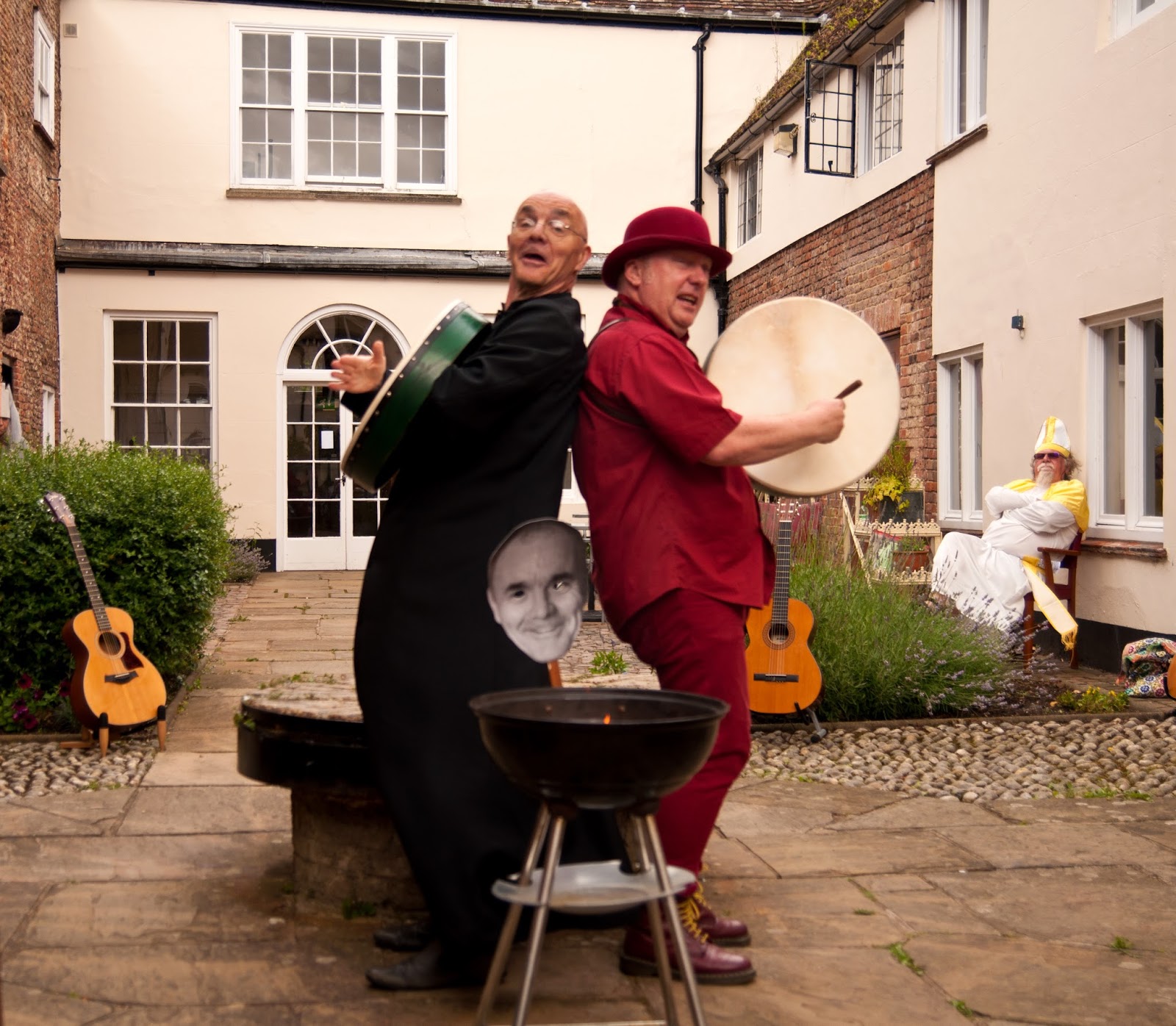
Pics by Zariah Wood-Davies and Baz Allan from the show (July 17 2015)

Lynn News review of show here  Read the full script here


Faith (Sawtrey) and Flesh
Whoopsy daisy!

World, Flesh and Devil

Soul

World, Mind and William

Devil and World

 God

The opposition


A young and impressionable parishioner of William's
(Margery Kempe)

and some phone pics from the audience by Tony Rafferty


'Toast!!'


More fab show pics at end of this blogpost.

BBC Eastern Counties radio interview (75 minutes into the programme) here

EDP news item here

William Sawtrey preview in Lynn News (June 26).

and in July Suffolk Norfolk Life magazine p. 106-107

A line drawing of Sawtrey's execution for heresy. I'll be doing it without the beard.


dress rehearsal; blackbird's eye view


World and Faith seek God's guidance

You are the 300+ person to read this post. The rehearsal pics below show left to right a queenly Vanessa Wood-Davies as the harp-playing Soul; Bob Bones as the hilarious joke bishop; Anto Morra (Morrissey's more talented second cousin) as guitar-toting Flesh kicking against the pricks and Gareth Calway as a provoked William Sawtrey. The bonfire couldn't be lit for health and safety reasons - how would they burn a Lollard today I wonder? - but will be when we can really slip back to 1401.


Part of Room at the Hanse's Four Shows In July - as featured in The Lynn News and in a festival history lesson here

Sound promo for our July Festival shows here

Hear the Soul of William Sawtrey here 

See and hear the inflammatory Flesh of William Sawtrey here

First cast (King’s Lynn Festival Fringe; Hanse House Courtyard, South Quay, King’s Lynn July 17 2015.) premiere.

Pictured in rehearsal by ace photographer Barry Allan

God (Taj Kandula) and Soul (Vanessa Wood-Davies) hover above Julian of Norwich (Julie Bones). Flesh (Anto Morra)'s arm just visible.


William Sawtrey of Lynn (Faith) - Gareth Calway
God – Taj Kandula
Flesh - Morra (+ drum, guitar)
Soul – Vanessa Wood-Davies (harp)
Bishop Dispenser – Bob Bones (+ bass)
Mother Julian, Anchoress of Norwich – Julie Bones (+ guitar)

William in prison near a bonfire with guy of William on it.


This is an extract from the script. Read the full script here
William: I am William Sawtrey, a Lollard of Lynn;
Priest of this Parish, in Death’s Door Nailed;
The Bishop Dispenser has bruised me in Limb
And broken my Spirit for two days in gaol:
(resisting) I don’t believe in Signs, Rites, Blessings;
In Prayers by the Hour, Priests, Priests, Grails;
Saint-Adoration; Idolatrous bread; leprous blind Latin;
Fat church Patriarchs piling on the shillings;
In Confessions, Crusades: that ‘what Christ was the Cross is.’

Enter Bishop Dispenser, furious.

William: I do believe that what we’re for
Is Apostling and preaching and teaching the poor;
In Scripture and Christ above Roman Church Lore;
In plain English speech for our priestly office!


Bishop Dispenser: You no longer have an office. By the Statute of Heresies, 1400. (strips off William’s priestly rank) (vestments, tonsure etc)

William: Through seven steps of degradation
Reduced from magic priest to bare doorman.
(new hope) Did Christ not come this Way? Would Christ not also say:
The peasants got Word, their simple souls sang
‘When Adam delved and Eve span,
Who was then the gentleman?’
They call peasants (Bishop with him) ‘revolting’. Christ’s blessed I say!

Bishop Dispenser: Tell that to the flames. (sarcastic) Have a nice Pray! (diabolical laugh, exit)

William prays. Flesh appears with drum (fearful heartbeat).

William: (looking at bonfire, tries to pray) Oh God-

Flesh: Never mind God. You should listen to your Body, son.
(sings with drum)
I bide as a broad bursten-gut aboven on these towers,
Everybody is the better that to mine bidding is bent.
I am Mankind’s fair Flesch, flourished in flowers.
My life is with lusts and liking i-lent.
With tapets of taffeta I timber my towers.
In mirth and in melody my mende is i-ment.
Though I be clay and clod, clapped under clowrys,
Yet would I that my will the world went,
Full true I you behight
I love well my ease
In lusts me to please:
Though sin my soul seize,
I give not a mite.


...


Flesh: William you’re a Lynn boy
Where’s your Norfolk grit?
Your Mind’s like a frightened girl,
You make me blooming spit.
...


Bishop: See what happens when you read Acts, 26 chapter 14 without Church guidance?

William: Not if we read it context. (preaching with Bible, like the proto-Wesley he is).

“I heard a voice speaking unto me, and saying in the Hebrew tongue, Saul, Saul, why persecutest thou me? It is hard for thee to kick against the pricks. And I said, Who art thou, Lord? And he said, I am Jesus, whom thou persecutest.”

...

Flesh: You want me to kick his face in?

Soul: Be quiet Flesh. Listen to your Soul!


She plays her harp. Flesh quietens. William prays again, entranced.

God appears above...


God: But yes, William, you were right. Creed, ritual, dogma, the conventional ideas of heaven and hell and sin, are perversions of the truth, and confuse and bewilder rather than clarify and inspire.  The spiritual life is something to be lived, not talked about. It – and it alone – will produce the peace and love and harmony which we seek to establish as the constant of our lives. The root of all our difficulties, individual and social, is self-interest. All you need is Love.

...
Scene 7. William joins God in the window (above)


Bishop Dispenser tries to climb up.

God: Welcome, brighter than blossom on a briar,
My son dear. Come forth and stand ye with me. (to Bishop Dispenser) You go to hell.

Bishop Dispenser goes to hell.

God: (points at Bishop) Et qui bona egerunt ibunt in vitam eternam; qui vero mala, in ignem eternum.

William: Or, as we say in Bishop’s Lynn (translating) ‘And whoso does good will go to eternal life; but who evil into eternal fire. Matthew 25, 46.’

God: And they that well do in this world here, wealth shall awake;
In heaven they shall be heyned in bounty and bliss.
And they that evil do, they shall to hell lake
In bitter bales to be burnt: my judgement it is.
My heavenly powers will then make them quake:
There is no wight in the world that may scape this.
All men example hereat may take
To maintain the god and menden their miss.
Thus endeth our games.
To save you from sinning,
Ever at the beginning
Think on your last ending.
(indicates Bishop Dispenser)
Don’t end up in flames!


Author's note: This playlet grew out of my interest in the Book of Margery Kempe (William was her parish priest) and was originally one scene within that larger story.  That story is told in 'Margery Kempe, The Wife of Lynn's Tale' -  performance details and routes to script here

More shots from the premiere-

a devil of a fire to start

we get under way in front of a packed house
Flesh leads William astray


Flesh burns but Soul doesn't


If by this act I can light a flame...


Soul remains serene

 The hot seat

Soul premieres her lovely tunes

Dancing cheek to cheek

Fat church patriarchs piling on the shillings

Getting ready to play God  

God and Mankind (Will) share a pre-show sofa

August 07, 2014

Blickling Hall and Anne Boleyn (EDP Feature)


Gareth Calway as Sir Thomas Wyatt and Steve Knowles as Henry VIII in 'Tom and Harry' (2014)


Blickling Hall is certainly a good place to set a ghost story. It was voted the most haunted house in Britain in a National Trust survey in October 2007.

Tonight is the 478th anniversary of Anne Boleyn’s execution and her spirit has good cause to be restless. Her failure to provide a male heir for the Tudor dynasty convinced Henry VIII his marriage was cursed by God.

Her miscarriages, defective births, extra finger and a prominent neck mole didn’t help, encouraging the myth that she was a 'she-devil'. The famous sexual magnetism of her then-unfashionable dark looks and small frame contributed further to her occult mystique. Less famously, but more significantly, her advanced and well-read Protestantism fanned the flames of anathema.

She could not be placed at any of the scenes of the ‘crime’ with any of the six ‘adulterers’ accused, including her brother Lord Rochford and the famous poet Sir Thomas Wyatt (the only one released.) But the witch-hunter’s accusations that she could materialise anywhere, anytime, rather hampered her defence!

At her trial for treason, presided over by her uncle, the Duke of Norfolk, she was accused of acting the 'libertine' before her marriage to Henry, and of being a disciple of Satan who had 'bewitched' (seduced) Henry with sorcery.

During her imprisonment at the Tower in May 1536 -  in the very state rooms she had spent her happy coronation – this ‘witch’ enquired anxiously about her father, also her 'sweet broder' and lamented that her mother would die of 'sorrow' for her.

The Boleyn family was living a nightmare, their fairy castle of achieved ambition swept away in one spring-tide of trauma.

It had taken Anne’s father Sir Thomas Boleyn a lifetime to build.

Well established as a diplomat and linguist at the Royal Court before Henry became King in 1509, his calculated marriage to the well-connected royally-descended Howards, Catholic dukes of Norfolk, aided his upward drive.

Thomas’s three children, George, Mary and Anne, were all well-educated and part of his grand plan to attain ever greater power and status.

The girls spent their teenage years in France as ladies-in-waiting to Henry's sister the French Queen, then consecutively joined Queen Katherine of Aragon’s household, as maids of honour. Both caught the King’s eye.

Anne played harder to get and her family benefited from her perceived ‘consort in waiting’ status. Thomas was created Earl of Wiltshire and her brother Lord George Rochford appointed to the Royal Privy Chamber.

Henry secretly wed Anne on 25th of January, 1533, and secured the Boleyns' status as one of England’s pivotal families, in an England that under Henry VIII was really going places. It was said she was the only woman who ever dared answer Henry back – his later wives were expressly required to be 'untroublesome'.

There was probably more head than heart in Anne’s requiting Henry’s troth. Her initial betrothal to Lord Henry Percy had been callously terminated by Cardinal Wolsey (on the King’s orders) and she had inspired Sir Thomas Wyatt’s aching love long before Henry’s.

On Monday 15 May, 1536, her uncle the Duke of Norfolk proclaimed the death sentence on Anne with 'tears in his eyes'.

On  Friday 19 May, 1536 at 8.00am, aged 29, she took her place on a scaffold - her brother and the other ‘adulterers’ had already died on theirs, horribly - dressed in a robe of black damask covered by an ermine mantle of white.

Instead of denying her guilt as an adulteress and disciple of witchcraft, she delivered a generous speech praising her former lord and lover Henry VIII. After being blindfolded, a French swordsman severed her head from her delicate neck.

The story goes that on May 19 every year, a carriage pulled by six headless horses with a headless coachman carries a headless Anne to the door of Blickling Hall and the former Queen gets out brandishing her severed head!  She then roams the hall’s corridors until daybreak when she disappears.

Perhaps she meets her father’s ghost. Sir Thomas had – inexplicably - continued to work closely with Henry, his children's treacherous killer and true source of his family’s new infamy. After his wife died in 1537, a year after Anne's death, he passed away himself (in 1539.) Elizabeth, Anne's mother, had reportedly died from a broken heart.

Mary – distanced from Anne by the latter’s replacing her in Henry’s affections - died in 1542 but was survived by a young daughter and the rumoured illegitimate son of Henry.

Legend has it that, as penance for the untimely deaths of two of his children, Sir Thomas’s ghost must cross 12 bridges before cockcrow every 19th May. With his own coach of headless horses, he starts at Blickling and crosses bridges at Aylsham, Belaugh, Burg, Buxton, Coltishall, Hautbois, Meyton, Oxnead and Wroxham.

It’s not all legend. The original manor house in Blickling (the surviving red-bricked Hall is Jacobean) was the Boleyn family home and it is reasonable to assume that in 1507 Anne was born there.


The family was deeply rooted locally. The earliest evidence that the Rev. Canon W. L. E. Parsons, Rector of Salle (“Some Notes on the Boleyn Family” published in the Norfolk and Norwich Archaeological Society’s journal in 1935) could find was a John Boleyn mentioned in 1283 in the Register of Walsingham Abbey. There is a record of the Prior of Walsingham suing William Boleyn of Thurning, and Prior’s Bailiff in Salle, for an account and a John Boleyn acting as a surety.

The family status was not all Thomas-won and Tudor-riche. “The descendants of Nicholas Boleyn,” notes Parsons, “weren’t just holders of land under the Lord, they owned the manor of Calthorpe as of fee and right.”

A Geoffrey Boleyn was laid to rest in Salle Church in 1440. His children included Cecily, buried at Blickling; Thomas, a priest and Master of Gonville Hall, Cambridge, from 1454-72 and Geoffrey, a Lord Mayor of London.

It was this second Geoffrey who brought the family to financial and social prominence in the reign of Henry VI. As the protégé of his Norfolk neighbour, the famous Sir John Falstaff (grossly caricatured by Shakespeare) he travelled to London, achieving fame, fortune and royal favour, married into the nobility, and served as Sheriff of London.

Falstaff sold Blickling manor to Geoffrey before dying at Caister Castle in 1459. Geoffrey’s son William served as Sheriff of Norfolk from 1500 to 1501. He was buried in Norwich Cathedral on his death in 1505.

Thus, Thomas Boleyn, Anne’s father, inherited from William the manors of Blickling, Calthorpe, Wikmere, Mekylberton, Fylby, West Lexham, Possewick, Stiffkey and Hever Castle. But he didn’t stop there.

Honours were heaped upon him in the 1520s: first Treasurer of the Household, then Knight of the Garter, Viscount Rochford, and finally, in 1529, the Earldom of Wiltshire. In 1533, when his daughter Anne Boleyn became Queen, the Boleyns had reached the top.

Their fall was as spectacular - and much more swift. Within eight years, not one member of the immediate Boleyn household survived. The remaining relatives, stigmatised by tragedy and shame, disappeared, reportedly to Ireland.

Their curse continued. Even the Howards were infected – Anne’s cousin Catherine Howard later mirroring her own fate. After Sir Thomas’s death in 1539, Blickling passed through his brother’s hand to his relatives, the impressively wealthy Cleres. Yet Sir Edward Clere died a bankrupt in 1605 and eleven years later his widow sold the whole Estate.

Blickling Hall today is one of Norfolk's top visitor attractions, boasting nearly 5000 acres, that impressive Jacobean build, gardens and parkland walking The landscape, with its hedges, tree-lined lanes, woodlands and red brick manor reaches back to a Tudor-founded England, despite the top secret work carried out by the RAF during the Second World War. A great place to root yourself.

Watch out for the ghosts though!

(feature first published in EDP Weekend 19/5/14)