Showing posts with label Julian of Norwich. Show all posts

December 14, 2022

Saints and Singers; Our Christmas LP


First released in 2021 as a 6 track EP and now expanded to showcase  all our Christmas material including new recordings for this year. 
The whole attempts to be greater than the sum of its jolly parts by evoking a journey Eastward - part mediaeval/allegorical orientation, part benighted rural Look East of England-  culminating in an arrival at Whatever Christmas Promises around track 13.


https://peacocks-tale.bandcamp.com/album/saints-and-singers-our-christmas-album


https://youtu.be/xdBI4GQp-eY  The video


November 25, 2022

A Mass of Carols For Margery by Peacock’s Tale folk indie duo


Imagine. It is Christmas Day 1443 and Lynn mystic Margery Kempe’s 70 year life is being celebrated in a remembrance service of words and music in her beloved parish church of St Margaret’s Lynn, with a dozen songs about her and her contexts as the carols and with dramatic readings from her Book as the Lessons.


Premiered in 6 You Tube episodes, beginning today with ‘Anchorless and Quite Alone’ (featuring Julian of Norwich) and every Sunday from now to Christmas at 3 pm:


1. https://youtu.be/ajVfKAQeLWg Anchorless and Quite Alone   Tuesday 22 Nov 3 pm

2. https://youtu.be/VViwn4ytM64 Heaven and Hell Fire!               Sunday 27 November 3 pm

3. https://youtu.be/0JeMQewaJg4 The Mortification of Mr Margery  Sun 4 Dec 3 pm

4. https://youtu.be/-afa3sDavDU Pilgrim, Mystic                 Sunday 11 December 3 pm

5. https://youtu.be/D2VBx8CHJ2c Roaring Margery           Sunday 18 December 3 pm.

6. https://youtu.be/WIsA1J0r-hU A Lynn Carol                Sunday        25 December


Peacock's Tale folk indie duo evoke Margery in a musical duet of female and male voice and through various perspectives: in the context of her fellow female contemporary Norfolk mystic Julian of Norwich; her Merchant prince of Lynn father and the Hanseatic League; of her husband John Kempe and her role as mediaeval wife and mother of 14; her semi- unauthorised pilgrimages and mysticism; her famous weeping and her and often disputed claims to ('kitchen sink'?) mysticism; her status as a homely carol icon - carols being originally not just for Christmas but holy songs written by the common people rather than by professional clerics, this homeliness most charmingly embodied by her auditory vision of the English robin redbreast in place of the traditional dove of the Holy Ghost; her relationship with the Lollard heresy (notably its promotion of holy writ in a vernacular language); her loving kindness, attacks on clerical hypocrisy and dereliction of duty and her status as the (illiterate) mother of English autobiography. Kitchen sink mysticism from https://peacocks-tale.bandcamp.com


The soundtrack album as a one hour digital download with full lyrics, commentaries, historical, theological and literary analysis, credits, track art, links, photography and much else besides, becomes available with the premiere of A Lynn Carol the final episode. https://peacocks-tale.bandcamp.com/album/a-mass-of-carols-for-margery


A pocket guide to Margery Kempe https://bitternbooks.co.uk/product/the-book-of-margery-kempe-of-lynn/

April 29, 2018

The Ballad of John Kempe Part 1

Hear this ballad set to music and played by the Penland Phezants (and with explanatory notes) here

"Upon the Ouse's stinking beach
I stand and look across,
Amid the waste, and West Lynn seems
The Eden that we've lost.
"I take the ferry there, now Lynn's
Jerusalem or Rome,
Those Walsinghams she'll chase to find
She's just as far from home.
"The grass is always greener on
The other side," I say.
She says, "in heaven it really is
This green hill far away."
With a bump, I bring her back to Earth,
"You’re a mother not that maid
Who sang the Song of Songs to kings,
Our class must toil and trade."
"You great lump, John, in lechery,
You waste my church-spire dreams;
Trade children, chores and chamber pots
For heaven's shining greens."
"The grass is always greener on
The other side," I say.
She says, "in heaven it really is
This green hill far away."

June 01, 2016

Margery Kempe In Our Time


Room at the Hanse Theatre Company after their performance of 'Hanseatic Characters' at the 2016 Hanse Festival, which included a performance of The Ballad of Margery Kempe (the 4 involved on that song are, from l to r - Melanie Calway, vocal; Vanessa Wood-Davies, harp; Father William Sawtrey aka Gareth Calway, lyrics; Anto Morra music, guitar, production)

This Thursday morning, June 2 2016, six centuries after,  BBC Radio 4's flagship culture  programme 'In Our Time' considers the contribution made by a Lynn housewife to the history of ideas.

'Do different' is Norfolk's motto.  Margery Kempe (1373-1438) is not the first Lynner to have thought different. Her parish priest William Sawtrey, a Lollard heretic, was the first man burned for his beliefs in England (in 1401) and has even been identified as the 'morning star' - the pioneer (for good or ill) - of the English Reformation. Lynn-raised Fanny Burney changed the course of the English novel. There is even 'compelling evidence' that the father of English poetry, Geoffrey Chaucer, was born in Lynn. It is only Norfolk's self- deprecation that stops us trumpeting all this as other regions might.

But Margery is surely the most unusual pioneer of them all.  Illiterate, she 'wrote' (by dictation) the first autobiography in English, 'The Book of Margery Kempe'. And an extraordinary book it is.

She includes details of the mediaeval world she lived in - the thriving Hanseatic waterfront of that premier league port Bishop's Lynn - and of her life in it as a Lynn burgess's wife and mother of 14 children. A recent letter to her by her son found in Danzig (now Gdansk) corroborates her book's historical accuracy. She also mentions that she was the daughter of John Brunham, the town's leading merchant, MP, mayor, benefactor, royal agent , a major player in the precarious European trade politics of the time.

But none of this interests her much. Her Book is mostly about the visions she received - first of devils, then of a beautiful loving Jesus - after her first traumatic labour. From that point on, her life was fraught with danger.

As a mediaeval woman, she was supposed to serve her husband and, as a lay person, to defer to the church. Her claims to divine visions of Jesus, of a loving God; a virgin Mary and a robin redbreast singing merrily in her right ear (which she believed was the holy ghost) - defied all conventions.

To the authorities she was either a would-be saint - which her married status prohibited and her not being a virgin called into question - or possessed of the devil. She was accused of, and tried for, the Lollard heresy, for which her parish priest was burnt in 1401, by powerful enemies like the Archbishop of York - whose steward she accused of sexual assault - and the Mayor of Leicester. Some believe it was only her position as the daughter of Lynn's rich and powerful mayor that saved her.

But other holy voices, like Mother Julian of Norwich (whom she met) and minor clerics like the Vicar of Sedgeford and Alan of Lynn, supported her claims. One of these minor clerics helped her record her visions as her scribe, which established herself as part of the mystical tradition of the fifteenth century. And a figure of increasing interest - in our time.

The lyric of The Ballad of Margery Kempe is on sale in Waterstones, Jarrold's, True's Yard Museum, Hanse House and via the publisher in 'Doin different, new ballads from the east of England', (Poppyland publishing, 2015) 

Links:

How The Lynn News covered this story - here
Portal to The Wife of Lynn's Tale (2015 Lynn Festival Fringe production) and a wealth of support material -  - here
Margery Kempe ballad in the book 'Doin different - new ballads from the east of England' (scroll down to Margery in the list of ballads and in the list of historical support  (published features etc) - here 


April 06, 2016

Hanseatic characters of Lynn

Watch a film of the live show Hanseatic Characters  here

Feature published in Norfolk Suffolk Life July 2015

John Brunham, William Sawtrey and Alan of Lynn - Margery Kempe's merchant father, her parish priest and her scribe - will all make their returns as part of the Doin different tour 2016


Four Norfolk notables – a mystic, a merchant (her father), a monk (her scribe) and a martyr (her priest)– will live again in historic settings along Lynn’s mediaeval waterfront this summer, thanks to Lynn theatre company ‘Room at the Hanse’. Gareth Calway, director of the company, writes…

 ‘Hanse’ - from the mediaeval Hanseatic League - means a convoy of ships or people travelling together for safety against pirates and bandits. Lynn has pioneered English participation in the New Hanse since 2005. 2015 is the Year of the Hanse and Hanse the theme of this July’s King’s Lynn Arts Festival. Room at the Hanse - based in rooms at Hanse House and Marriott’s Warehouse - jumped at the chance to mount two Hanse-themed productions at the 2015 Festival fringe.

The Wife of Lynn’s Tale - prefaced by The Scribe’s Prologue and The Merchant’s Prologue - is about Lynn’s visionary Margery Kempe (c1373-1438) writer of the first autobiography in English. It will be staged in the magnificent Lynn Minster, her own church. A Nice Guy: The Burning of William Sawtrey, the first heretic burned for his beliefs in England, plays outdoors in the courtyard of Hanse House, the last remaining Hanseatic building in England.

The Scribe’s Prologue mines the comic possibilities of the mismatch in Margery’s Book of cartoonish autobiography – an illiterate visionary Word with too much Flesh on it for the clerics– with the clerical spin of her amanuensis:  “a woman’s story filtered through a male religious lens.” The amazing discovery in Gdansk this May (2015) of a letter by her son John – which has shown Margery as no fantasist but a reliable narrator of real events – happily supports her over my Scribe’s comic claims to be the real author (and also incidentally consolidates Margery’s status as the main documentary witness of Julian of Norwich’s lifer and character.)

The Merchant (Margery’s father) introduces his Prologue thus-

‘John Brunham of Bishop’s Lynn, deal-broker. Navigating treaties, steering rivals, roping in partners. Exporting and importing whatever the Warehouse of the Wash needs. Five times Mayor, twice MP, alderman, coroner, justice of the peace, chamberlain, royal agent, merchant-statesman, benefactor…

Brunham’s monologue evokes the hustle and bustle - ‘the dance - of the Hanse’ and a glimpse of the man behind the merchant. It reminds us that, beneath the courtiers and kings, knights and wars of our long island story, merchants and mayors made history as they made the nation’s wealth – on a daily basis. Brunham brokered a vital and uneasy peace with Prussia on behalf of Richard II during the Hanseatic trade wars of the 14th century- the politics of port rather than court.

Though ruled by the Bishop of Norwich from his palace at Gaywood, Bishop’s Lynn had enjoyed a degree of borough freedom since Lynn-friendly King John gave the town its own ‘Magna Carta’ in 1204 and would eventually gain the rest thanks to Henry VIII, who made it King’s Lynn in 1537.  In Brunham’s time - and Lynn historian Paul Richards’ words - it was “in the premier league of English medieval ports.”

This was the age before exploration and trade opened up the Atlantic West. Norfolk was the heart of England: advanced, densely populated, bristling with impressive churches. The Hanseatic League linked this heart with Germany, Scandinavia, the Baltic.


Margery lived on Lynn’s teeming international waterfront, in St Margaret’s parish, a true wife and daughter of the town, her family later tied to Hanseatic Germany by marriage. A mayor’s daughter and a burgess’s wife, Margery was pregnant for pretty much two decades, raising 14 children. She brewed beer (not very successfully) as Lynn wives did and managed a horse-drawn grain mill at Lynn’s hub of Wash waterways and busy sea routes. All this was forty five Norfolk miles from Mother Julian, whom she met and consulted, and who like her followed a visionary path. But Margery was a world apart from the mystic who called her ‘sister.’ She was not supposed to have visions!

She broke all the rules, caught between two church-approved states of womanhood - neither devotedly serving her husband indoors nor following a religious vocation in a convent or cell like Julian. She undertook Hanseatic journeys, and pilgrimages in self-appointed white robes, without the sanction of her confessor, asserting she was ‘directed to do so by God.’  God gave her a freedom wives rarely had.

While honouring the Sacrament of Marriage for twenty years, with saintly impatience, she eventually bought a vow of celibacy from John Kempe, along with his conjugal rights. And, ahead of her time as always, she dictated the first autobiography in English, not letting a little thing like illiteracy get in her way.

Maternal mortality in childbirth was common: her first labour was nearly her last. An unsympathetic priest refused to hear what she thought was a ‘death-bed’ confession and this precipitated visions of flame-mouthed devils - and of a beautiful gentle Jesus.

Unlike Julian’s church-approved ‘showings’ Margery’s visions were rejected by the authorities as ‘deceptions.’ Her direct personal relationship with the Trinity (without a priest present) might have been acceptable if like Julian she had been literate, learned and officially dead to the world (walled up alive and the burial service read over her.)
Instead, she was active, noisy, unorthodox and at odds with the authorities of a church she fervently loved. Despite support from ‘small friars’ like Robert of Caister the Vicar of Sedgeford and Alan of Lynn, who believed her visions and helped her record them, not to mention the parish priest who credited her with miraculously saving her beloved St Margaret’s from the Great Fire of Lynn in 1421, she continually upset fellow parishioners with loud weeping at mass, any mention of Christ’s suffering likely to set her off.

As her scribe whinges - “The whole parish is Mass en masse, cheek-by-blessed howl with you. The Bishop’s at his wits’ end!”

For a married woman and mother of fourteen children to claim the Son and Mother of God had given her a mission and instructions for a holy life was controversial enough. Margery added to it a new Franciscan emphasis on love experienced in a direct relationship with Christ and a highly emotional style of religious expression that riled church, citizens and pilgrims alike.

I suspect Margery’s visions and metaphors were too Earthy for the theological literati, the aristocrats who ran the church. Her Jesus is dishy, purple silk-clad. Her ‘female gaze’ would later see him in every handsome Italian she saw in Rome.

Her prayer for a robin in place of the inscrutable ‘rushing wind’ of God’s third person - which she complained was like a ‘bellows – parallels the heretical wish of contemporary rebels like John Wycliffe for simpler faith and a homely Bible in English.

Wycliffe’s ‘Lollard’ heresy, rife in Norfolk – did for our fourth Norfolk notable, Margery’s parish priest William Sawtrey, burned as a heretic in 1401.

Sawtrey was England’s first Lollard martyr or the morning star (Lucifer) of the Reformation, depending on your religious politics. He was ‘examined’ for preaching Lollardy by the Bishop Dispenser of the Norwich diocese. After two days, William, recanted only to relapse into the same heresies in London a year later. This time he didn’t recant and was burned at Smithfield.

It’s difficult for us to grasp how terrifying Lollardy was to the English church and king at the time. The Lollard heresy would shape the Protestant one: centuries of blood, fire, inquisition, execution, gunpowder and plot as the Reformation replaced the established Catholic church in England and much of Northern Europe. Europe would wage a 47 year war (the dreadful and misnamed 30 years war) over ‘Lollard’ issues. A Nice Guy, using the delightful Morality play format of the 15th century – borrowing a verse form and some speeches from the contemporary (Norfolk-written?) play the ‘Castle of Perseverance’ – takes a moral perspective. The company’s feelgood trademarks are all here - Norfolk-based musicians and actors; heritage and humour; catchy songs; poetic theatre, proper history. God, Soul, Mind, Flesh, World and the Devil all appear!

Margery – perhaps tainted by association with William - protested her orthodoxy. The point was even such protestation was ‘unwomanly’ by the repressive standards of the time.  Ordered by the archbishop of York to swear not to teach in his diocese, she defended her right to speak her conscience. A brave stand to make a century before Luther – and by a woman.

Mother of English autobiography, pre-feminist, rebel, Lynn has every right to be proud of its under-sung visionary. Six centuries after the fact, we celebrate her life in her beloved St Margaret’s.

for 2016 tour go to  Doin different tour 2016.

(2015 tour was:

The Wife of Lynn’s Tale (with Prologues by the Scribe and John Brunham)  written by Gareth Calway and starring Joanna Swan as Margery Kempe plays Lynn Minster on July 24th 7.30pm. Tickets £9 from Lynn Custom House 01553 763044. Performance approx 90 minutes with interval and bar. A Nice Guy – The Burning of William Sawtrey by Gareth Calway  plays the Hanse House Courtyard on the South Quay, Lynn on the 17th July 4.00pm. Performance 30 minutes. Donations only. www.garethcalway.co.uk, http://www.hansehouse.co.uk, http://www.marriottswarehousetrust.co.uk)


July 20, 2015

Introducing Margery Kempe, The Wife of Lynn’s Tale - Lynn Festival Fringe Production, July 2015


Welcome :) You are the 500+ person to read this post.

                                         Margery: caught between holy bellows
in the ear and a womb in hell

by Gareth Calway

The amazing tale of Lynn’s mediaeval mystic and visionary.


Read the script here
Hear the ballad here

Future date for your diary:

Aug 3 2016: at SHARP, Sedgeford's historic Boneyard Field  - The Wife's Tale/ The Visionary's Tale

Premiere - Lynn Minster, July 24 2015. Watch 20 minutes of highlights here

Act One
The Scribe’s Prologue (directed by Gareth Calway)
The Merchant’s Prologue (directed by Gareth Calway)
The Wife’s Tale (directed by Joanna Swan)
Act Two
The Visionary’s Tale (directed by Joanna Swan)

Joanna Swan is a Norfolk-born actress. She trained in physical theatre with Theatre Melange and Greek theatre on Hydra, Greece. Recent professional theatre credits include ‘The Hundred and One Dalmations’ with Baroque Theatre Co, ‘Romeo “or” Juliet’ with The Keeper’s Daughter Co and ‘The Poisoners Pact’ with Stuff of Dreams Theatre Co (returning for a reprise tour this October) http://joannayorke.wix.com/joanna-swan

Gareth Calway is a playwright, poet, novelist and journalist. His debut was playing Minister to Simon Pegg’s Tom Sawyer in 1982. He has taken three one man shows to the Edinburgh fringe and founded Room at the Hanse theatre company in 2012. Doin’ Different (From Boudicca to Nelson) - his book of new East Anglian ballads about the region’s heroes - will be published by Poppyland this Christmas. www.garethcalway.co.uk

David Norfolk retired from the Fire Service in 2008 for a new career in film, television and stage. He has acted in over 120 productions (including James Bond and Midsomer Murders) as a supporting artiste and also in featured and leading roles. www.davidnorfolk.co.uk

(Dr) Paul Richards is a local historian of international repute and a trustee of Marriott’s Warehouse Trust and True’s Yard. He has been elected Mayor of Lynn twice and is a deputy Lord Lieutenant of Norfolk.
Music by Tom Conway

Thanks to Melanie Calway, Alison Gifford, Canon Ivory, Al Pulford, Marriot’s Warehouse Trust, The Custom House and the Lynn News, without whom…

5 minute trailer here   Review here


BBC Eastern Counties radio interview (75 minutes into programme)  -here


Sound promo for July 2015 Festival fringe shows here

Margery Kempe's Lynn - a guided walk meeting at 2pm on 17/07/2015 outside Lynn Minster's west doors. £5 per person - no booking necessary!

Margery ( 'This creature') and modern American scholarship here


Performed and directed by Joanna Swan

(with prologues by Gareth Calway and David Frost)

All pictures by Al Pulford


Margery Kempe was a fifteenth century Lynn housewife, international traveller and visionary. Though illiterate, she ‘wrote’ the first autobiography in English, dictating it to a scribe. Her father was John Brunham, royal agent, merchant-mayor and MP of Bishop's Lynn, a Hanseatic port at the height of its prosperity and influence. Introduced by her Scribe and her Merchant father, she speaks here isolated on stage and direct to a modern audience: the aspergic cri de couer in all our wildernesses.


Part One
1. The Scribe’s Prologue   read it here   - hear it here

The Scribe in situ at the Minster,
pulpit picture by Al Pulford


2. The Merchant’s Prologue  read it here   - watch it here
3. The Wife’s Tale (begun)  read it here   - watch a 20 minute highlights package here


Interval

Part Two
4. The Wife’s Tale (concluded)  read it here   - hear the author read it here

Music composed by Tom Conway.   Hear an extract here

Estimated length
Part One: 45 minutes
Interval 20 minutes
Part Two: 25 minutes
Total 70 minutes + 20 minute interval

A King’s Lynn Fringe Festival Premiere at Lynn Minster (Margery’s own church)
7.30 pm Friday July 24 2015


Accused of the Lollard heresy, Margery’s social status perhaps protected her from the fate that befell her parish priest (William Sawtrey) the first heretic to be burned in England.

See also feature in July edition of Suffolk Norfolk Life p.106-107 and in Lynn News July 3

Hear Sawtrey's Lollard heresy here 
Read a Morality Play of his demise here
Hear the author read the play here.

Lynn News feature on Room at the Hanse's four show summer.


Margery and Julian of Norwich

Tickets for Margery Kempe The Wife of Lynn’s Tale at Lynn Minster (7.30 pm 24 July) from Lynn Custom House, 01553 763044.

July 10, 2015

A Nice Guy: The Burning of William Sawtrey of Lynn.

A Morality Play.

See the opening scenes in rehearsal here

You are the 400+ reader of this post.

"A good man and a faythfull Priest, inflamed wyth zeale of true religion..."

Pics by Zariah Wood-Davies and Baz Allan from the show (July 17 2015)

Lynn News review of show here  Read the full script here


Faith (Sawtrey) and Flesh
Whoopsy daisy!

World, Flesh and Devil

Soul

World, Mind and William

Devil and World

 God

The opposition


A young and impressionable parishioner of William's
(Margery Kempe)

and some phone pics from the audience by Tony Rafferty


'Toast!!'


More fab show pics at end of this blogpost.

BBC Eastern Counties radio interview (75 minutes into the programme) here

EDP news item here

William Sawtrey preview in Lynn News (June 26).

and in July Suffolk Norfolk Life magazine p. 106-107

A line drawing of Sawtrey's execution for heresy. I'll be doing it without the beard.


dress rehearsal; blackbird's eye view


World and Faith seek God's guidance

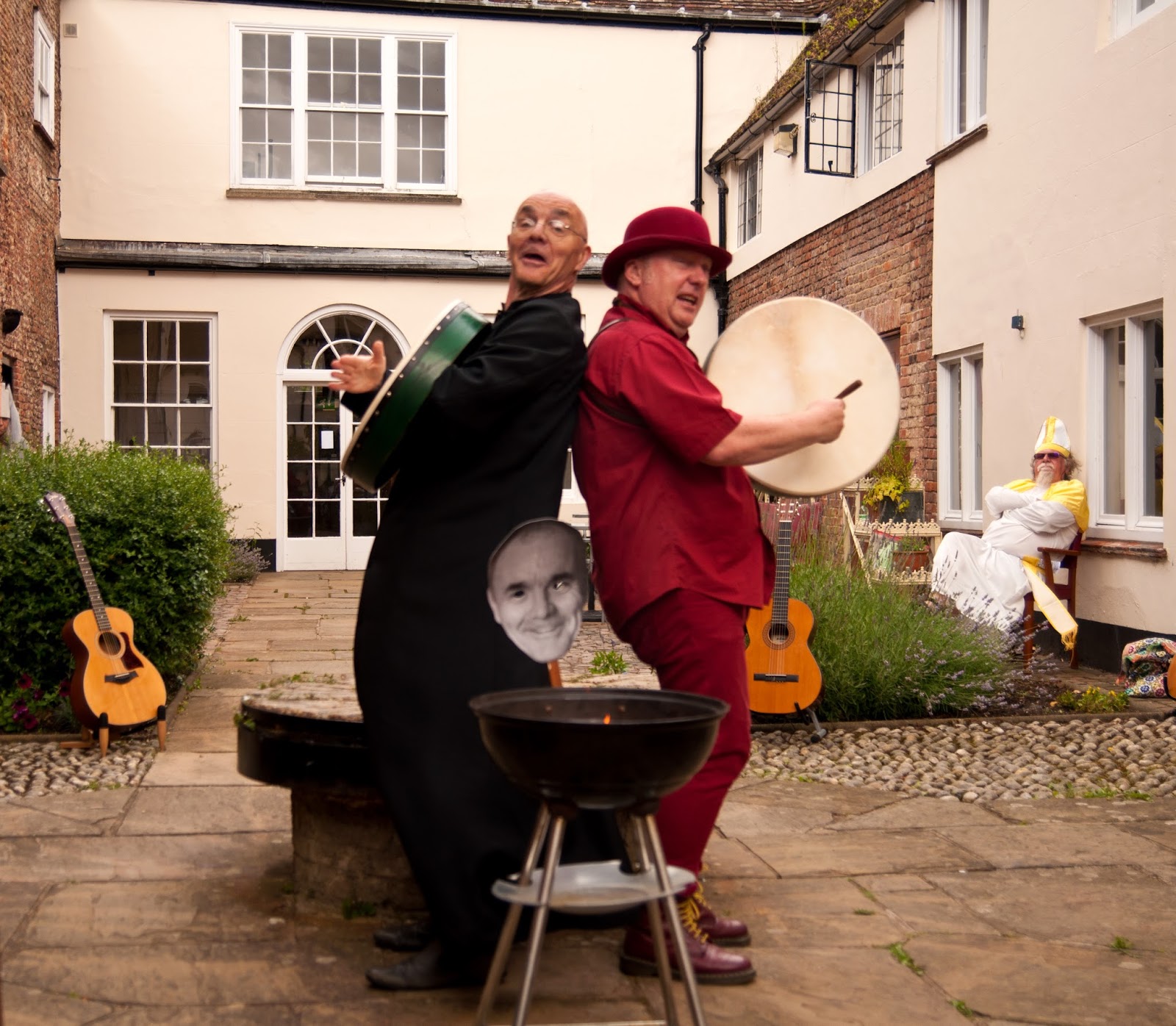
You are the 300+ person to read this post. The rehearsal pics below show left to right a queenly Vanessa Wood-Davies as the harp-playing Soul; Bob Bones as the hilarious joke bishop; Anto Morra (Morrissey's more talented second cousin) as guitar-toting Flesh kicking against the pricks and Gareth Calway as a provoked William Sawtrey. The bonfire couldn't be lit for health and safety reasons - how would they burn a Lollard today I wonder? - but will be when we can really slip back to 1401.


Part of Room at the Hanse's Four Shows In July - as featured in The Lynn News and in a festival history lesson here

Sound promo for our July Festival shows here

Hear the Soul of William Sawtrey here 

See and hear the inflammatory Flesh of William Sawtrey here

First cast (King’s Lynn Festival Fringe; Hanse House Courtyard, South Quay, King’s Lynn July 17 2015.) premiere.

Pictured in rehearsal by ace photographer Barry Allan

God (Taj Kandula) and Soul (Vanessa Wood-Davies) hover above Julian of Norwich (Julie Bones). Flesh (Anto Morra)'s arm just visible.


William Sawtrey of Lynn (Faith) - Gareth Calway
God – Taj Kandula
Flesh - Morra (+ drum, guitar)
Soul – Vanessa Wood-Davies (harp)
Bishop Dispenser – Bob Bones (+ bass)
Mother Julian, Anchoress of Norwich – Julie Bones (+ guitar)

William in prison near a bonfire with guy of William on it.


This is an extract from the script. Read the full script here
William: I am William Sawtrey, a Lollard of Lynn;
Priest of this Parish, in Death’s Door Nailed;
The Bishop Dispenser has bruised me in Limb
And broken my Spirit for two days in gaol:
(resisting) I don’t believe in Signs, Rites, Blessings;
In Prayers by the Hour, Priests, Priests, Grails;
Saint-Adoration; Idolatrous bread; leprous blind Latin;
Fat church Patriarchs piling on the shillings;
In Confessions, Crusades: that ‘what Christ was the Cross is.’

Enter Bishop Dispenser, furious.

William: I do believe that what we’re for
Is Apostling and preaching and teaching the poor;
In Scripture and Christ above Roman Church Lore;
In plain English speech for our priestly office!


Bishop Dispenser: You no longer have an office. By the Statute of Heresies, 1400. (strips off William’s priestly rank) (vestments, tonsure etc)

William: Through seven steps of degradation
Reduced from magic priest to bare doorman.
(new hope) Did Christ not come this Way? Would Christ not also say:
The peasants got Word, their simple souls sang
‘When Adam delved and Eve span,
Who was then the gentleman?’
They call peasants (Bishop with him) ‘revolting’. Christ’s blessed I say!

Bishop Dispenser: Tell that to the flames. (sarcastic) Have a nice Pray! (diabolical laugh, exit)

William prays. Flesh appears with drum (fearful heartbeat).

William: (looking at bonfire, tries to pray) Oh God-

Flesh: Never mind God. You should listen to your Body, son.
(sings with drum)
I bide as a broad bursten-gut aboven on these towers,
Everybody is the better that to mine bidding is bent.
I am Mankind’s fair Flesch, flourished in flowers.
My life is with lusts and liking i-lent.
With tapets of taffeta I timber my towers.
In mirth and in melody my mende is i-ment.
Though I be clay and clod, clapped under clowrys,
Yet would I that my will the world went,
Full true I you behight
I love well my ease
In lusts me to please:
Though sin my soul seize,
I give not a mite.


...


Flesh: William you’re a Lynn boy
Where’s your Norfolk grit?
Your Mind’s like a frightened girl,
You make me blooming spit.
...


Bishop: See what happens when you read Acts, 26 chapter 14 without Church guidance?

William: Not if we read it context. (preaching with Bible, like the proto-Wesley he is).

“I heard a voice speaking unto me, and saying in the Hebrew tongue, Saul, Saul, why persecutest thou me? It is hard for thee to kick against the pricks. And I said, Who art thou, Lord? And he said, I am Jesus, whom thou persecutest.”

...

Flesh: You want me to kick his face in?

Soul: Be quiet Flesh. Listen to your Soul!


She plays her harp. Flesh quietens. William prays again, entranced.

God appears above...


God: But yes, William, you were right. Creed, ritual, dogma, the conventional ideas of heaven and hell and sin, are perversions of the truth, and confuse and bewilder rather than clarify and inspire.  The spiritual life is something to be lived, not talked about. It – and it alone – will produce the peace and love and harmony which we seek to establish as the constant of our lives. The root of all our difficulties, individual and social, is self-interest. All you need is Love.

...
Scene 7. William joins God in the window (above)


Bishop Dispenser tries to climb up.

God: Welcome, brighter than blossom on a briar,
My son dear. Come forth and stand ye with me. (to Bishop Dispenser) You go to hell.

Bishop Dispenser goes to hell.

God: (points at Bishop) Et qui bona egerunt ibunt in vitam eternam; qui vero mala, in ignem eternum.

William: Or, as we say in Bishop’s Lynn (translating) ‘And whoso does good will go to eternal life; but who evil into eternal fire. Matthew 25, 46.’

God: And they that well do in this world here, wealth shall awake;
In heaven they shall be heyned in bounty and bliss.
And they that evil do, they shall to hell lake
In bitter bales to be burnt: my judgement it is.
My heavenly powers will then make them quake:
There is no wight in the world that may scape this.
All men example hereat may take
To maintain the god and menden their miss.
Thus endeth our games.
To save you from sinning,
Ever at the beginning
Think on your last ending.
(indicates Bishop Dispenser)
Don’t end up in flames!


Author's note: This playlet grew out of my interest in the Book of Margery Kempe (William was her parish priest) and was originally one scene within that larger story.  That story is told in 'Margery Kempe, The Wife of Lynn's Tale' -  performance details and routes to script here

More shots from the premiere-

a devil of a fire to start

we get under way in front of a packed house

Flesh leads William astray


Flesh burns but Soul doesn't


If by this act I can light a flame...


Soul remains serene

 The hot seat

Soul premieres her lovely tunes

Dancing cheek to cheek

Fat church patriarchs piling on the shillings

Getting ready to play God  

God and Mankind (Will) share a pre-show sofa