January 28, 2017

To The Immortal Memory of Robbie Burns (Wolferton Social Club 27 January 2017)

Link to Lynn News preview of this event, with an edited extract of the Immortal Memory speech reproduced in full at the end of this post.

This was my first ever Burns Night as at the M/C  - doing the Selkirk Grace, the Address To The Haggis and the 15 minute 'Immortal Memory.' speech. 60 people attended the sell out event. The catering was wonderful - a true monarch of a haggis, mash and swede and a welcomingly light dessert - and I was plied all night with the amber bead (whisky). Great hosts, a most convivial atmosphere, an extremely appreciative audience for my efforts to bring the great man into the room with some of the poems and some thoughts about them, some fine-looking Scotsmen in full national dress and a rainbow of other tartan (looking better on the ladies than on me, it has to be said)  some sprightly Scottish dancing, two stunning Burns songs by Gill Sims-McLennan and some diverting comical behaviour worthy of the occasion, including the gentleman who tried to out his hand up m' kilt!


Immortal Memory Speech  (Jan 27 2017)

Donald McTrump has left his goal course and is visiting a hospital. He says to the first patient, "Hi there! I'm President Donald. How are you?"
The patient replies, "Fair fa' your honest, sonsie face."
He moves to the second patient and says, "Hi there! I'm President Donald How are you?"
To which the answer is, "My luve is like a red, red rose."
He moves to the next patient and says, "Hi there. I'm President Donald. How are you?"
To which the reply is, "Should auld acquaintance be forgot."
Donald turns to the matron and asks, "Is this the mental health ward?"
To which she, of course, replies, "Nae, it's the Burns unit."

(TOAST - to the Nurses, Doctors and Staff of the NHS!)

Rabbie Burns was born on January 25 1759, the son of a small farmer. He was brought up in circumstances of agricultural poverty and strict Calvinism. Overwork as boy brought the first symptoms of the heart trouble that would kill him at 37. On his father's death in 1784, the 25 year old went into subsistence farming with his brother Gilbert at Mossgiel and also sowed more than a few wild oats. Unfortunately for his reputation and  his purse, his unmarried sweetheart Jean Armour proved more fertile than the farm.

Burns had a weakness for whisky and wild wild women but he won't be getting any stick from us tonight on that. He copped plenty for it in his lifetime from the kirk. To which he responded by entertainingly satirising Calvinistic hypocrisy in poems like 'Holy Willie."

Burns published his first book - Poems, Chiefly In The Scottish Dialect  - to raise money in 1786. It is called the Kilmarnock edition because it was published in Maidenhead.  (joke) It made him famous in Edinburgh, where he was lionised by the fashionable as an untutored 'ploughman poet,' a misnomer he genially accepted but (like his 15 months of fame) always saw through. His father, with a Scottish esteem for education England did not share (still doesn't?) sent him to various schools he couldn't afford though (apart from maths) he learned most of what mattered from his own reading.  This 'unlettered peasant'/ 'artless folksinger' read not only the Bible (which he loved) Shakespeare and Pope but also the Spectator magazine, Richardson, Laurence Sterne and Gray. He had little Latin and less Greek but read French and his French reading included Racine. More importantly, he read the Scots poets from an early age, including those 18C dazzlers and world-beating football namesakes Ramsay and Fergusson.

His individual genius was only possible because of the living tradition of Scottish verse-making and folksongs in which he was steeped. He is the flower of this Scotland. He made a singular malt of this heady blend.  Burns Scots is a fine blend of everything from Ayrshire to standard English. The Chaucerian/ Shakespearean/ Bacchanalian/ super Calli go ballistic Celtic are atrocious fertility and scope of his surprising phrases and images is endless. The underlying life of Scotland - its humorous knowledge, sense of life's complexity, its generous kindliness, its reckless bravery, its old proverbial wisdom. And whether reporting as an inside commentator or letting his characters speak for themselves, he is always at the generous heart of what he presents. The lives and speech of a whole people may be relished like a fine whisky in his work.

TOAST - the lives and speech of the people of Scotland.

He was taken up as a rough diamond by Edinburgh 'Society' set but Burns never spoke their language. He entertainingly mocks them spooning back their French 'ragout' from little bowls while he, the haggis eater, ladles out a much rougher, tastier, stronger language. Like Scottish national poet Liz Lochead would never have confused a car accident on the M8 with the  place you leave your children - a crèche.

(Toast - to Liz Lochead, the current national Poet of Scotland)

During his Edinburgh year, Burns immortalised himself as a songwriter contributing hundreds of songs - new and reworked - to James Johnsons' The Scots Musical Museum, including 'A Red Red Rose' and 'Auld Lang Syne.'  Though desperately poor, he received no money for this labour of lasting love, which he regarded as a patriotic duty.

With the proceeds of his first book, he bought a small (and poor) farm in Ellisland and settled there with Jean, now his wife. Other 'lassies' like Alison Begbie and Mary Campbell, who'd been his Muses in the intervening years, did not join them. 

Ae fond kiss, and then we sever.

'Sever' is no about cutting the haggis. It's about how this poet can in his minimalist singable format choose the one word that expresses the clean, final, ruthless, surgical agony of the break up, like a pledge in a legally binding document.

TOAST - to Alison, Mary and the lassies!

Jean Armour (or should that be amour) his enduring first love from whom the kirk divided him, and who was now at last his wife, he did not leave.  So, let us drink not to the IMMORAL memory of the poet but to his enduring amour for Jean.

TOAST  - his enduring amour for Jean.

Jean and Rabbie had 4 children and Burns became an excise man to supplement his farmer's meagre income.  (I also was surprised that Burns, like Woody Allen 2 centuries later, farmed and sold meagres…)

He developed  an ardent sympathy with the French Revolution based not (like many middle class radicals) on reading the political theory of the Enlightenment but on the personal experience of poverty and injustice. The second line of the Selkirk Grace - some wad eat that want it - shows that one of the reasons he celebrated meat and drink with such relish is that he cold never take them for granted.

Poverty drove the Burns unit from the farm to the lively country town of Dumfries in 1792. He did not romanticise farming like Wordsworth - it had always been a strain and anxiety to him, but his poetry is one of the most authentic accounts of it. He turned to his new job of Excise Officer with relief  and was reasonably happy - esteemed by his superiors, respected by his fellow townspeople and gathering convivial friends about him - but he was also in poor health, badly paid, chronically short of money and required to work  outside in all weathers. In1796, his health undermined by rheumatic fever, his heart broken by overwork (of all kinds) and his liver worn out with - well, let's not go there tonight, he died. He did more in 37 years than most poets do in a full lifetime.

His poetic voice is hearty, generous, rollicking, tender, with a sympathy that encompasses humans of all types - from national heroes like Robert the Bruce to tavern roarers like - well, us. And all creatures.

To A Mouse

Wee sleeket, cowran, tim'rous beastie,
O, what a panic's in thy breastie!
Thou need na start awa sae hasty,
Wi bickering brattle!
I wad be laith to rin and chase thee
Wi' murdering pattle.

I'm truly sorry Man's dominion
Has broken Natture's social union,
An' justifies that ill opinion,
Which makes thee startle,
At me, thy poor, earth-born companion
An' fellow mortal.

The mouse-sized moral inspired a sombre book (and film) by John Steinbeck but is also regularly quoted in comic catastrophe by Bertie Wooster and Jeeves.

But Mousie, thou art no they-lane  (not alone)
In proving foresight may be vain:
The best-laid schemes o' Mice an' Men
Gang aft agley.

The 'flyting' poem 'To a Louse' brings Nature shockingly alive. 'Flyting' is where you mercilessly send something up. The Scots are very good at it. But the attack on the disgusting louse is also full of admiration and as large as the life described.  It's the kind of poem the brilliant 17C metaphysical poet John Donne might have written, if instead of being appointed Dean of St Paul's and performing intellectual gymnastics in the pulpit, he'd done a real job on a farm.

To A Louse. On seeing one on a Lady's bonnet at Church:

Ha! whare ye gaun, ye crowlan ferlie!
Your impudence protects you sairly:
I cannot say but ye strunt rarely,
Owre gawze and lace:
Tho 'faith I fear ye dine but sparely
On sic a place.

Ye ugly, creepan, blastet wonner,
Detested, shunn'd, by saunt an' sinner
How daur ye set your fit upon her
Sae fine a Lady!
Gae somewhere else and seek your dinner,
On some poor body.

(TOAST - to a Louse!)

Satire and Wit was the poetic fashion of the age and Burns (like Pope, Johnson and Crabbe) was a master of it.  Where he differs from those English masters is not just the Scots dialect and brilliant verse forms learned from the Scottish Chaucerians but in his hearty sympathy with the human condition. He is always a comic writer rather than a tragic or merely satirical one.

But it is the songs of Burns that are immortal in the memory and will surely last as long as men or mice live and make plans. In this, Burns was a Wordsworth before his time. He revived the lyric, celebrated the literary forms and legends of folk culture and wrote in a language - in his case Scots English- really spoken by the common people. (And, outside of business hours, by the Scots gentry as well.) It is hard to imagine how new, direct and dialect-fresh these similes from Nature were in contrast to the bookish and overworked language of the café society poetry then fashionable. It must have been like a punch in the face from Burns' compatriot Billy Connolly who once said "This world is too full of nuclear bombs and not enough people getting a smack in the mouth.."  And this one describes how every gentleman here tonight feels about his wife.

Oh my Luve is like a red red rose
That's newly sprung in June;
Oh my Luve's like the melodie
That's sweetly played in tune.

And fare thee weel, my only Luve!
And fare thee weel, a while!
And I will come again, my Luve,
Tho' it were ten thousand mile.

Which is fresh today as it was when it was written and when it inspired the Proclaimers' "And I will walk ten thousand miles (all right I know it's five really, Kevin) and I will walk ten thousand more to be the one who walks ten thousand miles to see you at your door."

(TOAST - to the Proclaimers)

Burns is not only the national poet of Scotland
 but a song-writer for all English-speaking people. Wherever the world may be on New Year's Eve, when, helped by a 'wee dram' and the reminder of mortality as time continues to  wear awa', men and women indulge their instinct of a common humanity, join hands and sing a song of Burns.

Should auld acquaintance be forgot
And never brought to mind?
Should auld acquaintance be forgot
And auld lang syne. (time gone by)

(Chorus) For auld lang syne, my jo,
For auld lang syne,
We'll take a cup of kindness yet
For auld lang syne.

As fine an example of the elemental simplicity, cogent power and verbal economy of the folk ballad ever written.

TOAST - to the Immortal Memory of Rabbie Burns.


Report to follow...

December 22, 2016

St Edmund for England

Hear our Ballad for St Edmund here

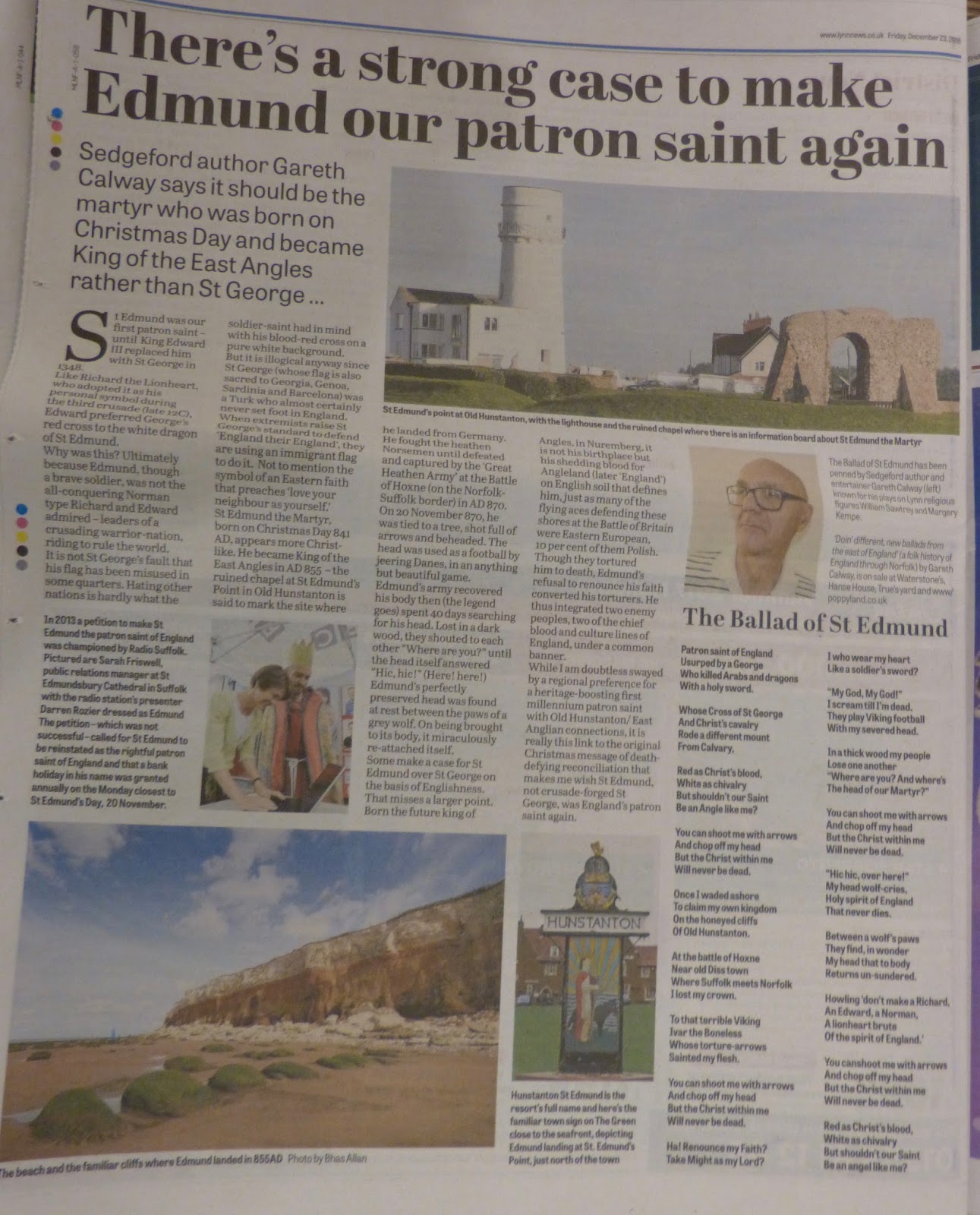
Read my full page Lynn News feature on why St Edmund (as in Bury St Edmunds and Hunstanton St Edmund) should be England's patron saint.


St Edmund - born the King of Angles

St Edmund was our first patron saint. King Edward III replaced him with St George in 1348. Like Richard the Lionheart, who adopted it as his personal symbol during the third crusade (late 12C), Edward preferred George's red cross to the white dragon of St Edmund.

Why was this? Ultimately because Edmund, though a brave soldier, was not the all-conquering Norman type Richard and Edward admired: leaders of a crusading warrior-nation, riding to rule the world.

It is not St George's fault that his flag has been misused in some quarters. Hating other nations is hardly what the soldier-saint had in mind with his blood-red cross on a pure white background.

But it is illogical anyway since St George (whose flag is also sacred to Georgia, Genoa, Sardinia and Barcelona) was a Turk who almost certainly never set foot in England. When extremists raise St George's standard to defend 'England their England,' they are using an immigrant flag to do it.  Not to mention the symbol of an Eastern faith that preaches 'love your neighbour as yourself.'

St Edmund the Martyr, born on Christmas Day 841 AD, appears more Christ-like. He became King of the East Angles in AD 855 - the ruined chapel at St Edmund's Point in Old Hunstanton is said to mark the site where he landed from Germany. He fought the heathen Norsemen until defeated and captured by the 'Great Heathen Army' at the Battle of Hoxne (on the Norfolk-Suffolk border) in AD 870.

On 20 November 870, he was tied to a tree, shot full of arrows and beheaded. The head was used as a football by jeering Danes, in an anything but beautiful game.

Edmund's army recovered his body then (the legend goes) spent 40 days searching for his head. Lost in a dark wood, they shouted to each other "Where are you?" until the head itself answered "Hic, hic!" (Here! here!)

Edmund's perfectly preserved head was found at rest between the paws of a grey wolf. On being brought to its body, it miraculously re-attached itself.

Some make a case for St Edmund over St George on the basis of Englishness. That misses a larger point. Born the future king of Angles, in Nuremberg, it is not his birthplace but his shedding blood for Angleland (later 'England') on English soil that defines him, just as many of the flying aces defending these shores at the Battle of Britain were Eastern European, 10% of them Poles.

Though they tortured him to death, Edmund's refusal to renounce his faith converted his torturers. He thus integrated two enemy peoples, two of the chief blood and culture lines of England, under a common banner.

While I am doubtless swayed by a regional preference for a heritage-boosting first millennium patron saint with Old Hunstanton/ East Anglian connections,  it is really this link to the original Christmas message of death-defying reconciliation that makes me wish St Edmund, not crusade-forged St George, was England's patron saint again.


The Ballad of St Edmund, Patron St. Of England (until 1348.) 
The historical argument
The religious argument

Patron saint of England
Usurped by a George
Who killed Arabs and dragons
With a holy sword.

Whose Cross of St George
And Christ's cavalry
Rode a different mount
From Calvary,

Red as Christ's blood,
White as chivalry
But shouldn't our Saint
Be an Angle like me?

You can shoot me with arrows
And chop off my head
But the Christ within me
Will never be dead.

Once I waded ashore
To claim my own kingdom
On the honeyed cliffs
Of Old Hunstanton.

At the battle of Hoxne
Near old Diss town
Where Suffolk meets Norfolk
I lost my crown

To that terrible Viking
Ivar the Boneless
Whose torture-arrows
Sainted my flesh.

You can shoot me with arrows
And chop off my head
But the Christ within me
Will never be dead.

Ha! Renounce my Faith?
Take Might as my Lord?
I who wear my heart
Like a soldier's sword?

"My God, My God!"
I scream till I'm dead.
They play Viking football
With my severed head.

In a thick wood my people
Lose one another
"Where are you? And where's
The head of our Martyr?"

You can shoot me with arrows
And chop off my head
But the Christ within me
Will never be dead.

"Hic hic, over here!"
My head wolf-cries,
Holy spirit of England
That never dies.

Between a wolf's paws
They find, in wonder
My head that to body
Returns un-sundered.

Howling 'don't make a Richard,
An Edward, a Norman,
A lionheart brute
Of the spirit of England.'

You can shoot me with arrows
And chop off my head
But the Christ within me
Will never be dead.

Red as Christ's blood,
White as chivalry
But shouldn't our Saint
Be an angel like me?


And also its brother double page feature in the EDP on St Felix (as in Felixtowe, Babingley, Dunwich, Gt Ryburgh...)

The print edition (23 Dec) of the Lynn News includes the Ballad of St Edmund and other pictures.

December 14, 2016

St Felix - from here to Eternity (EDP article)

He came to England from his native Burgundy in c 631. He fixed his episcopal see as the Bishop of Dunwich, then a thriving Suffolk seaport, ruling his diocese for 17 years. He died in c648. His name survives in Felixstowe. His legacy, according to the available 8th century sources, is nationwide and eternal.

The Venerable Bede in his "Ecclesiastical History of the English People" (c731) tells us how the evangelical exertions of Sigeberht, King of East Anglia, converted in exile, "were nobly promoted by Bishop Felix, who, coming to Honorius, the archbishop, from the parts of Bergundy, where he had been born and ordained… was sent by him to preach the Word of life to the aforesaid nation of the Angles "and delivered "all the province of East Anglia from long-standing unrighteousness and unhappiness." Praise indeed.

The only other documentary source - the Anglo-Saxon Chronicle - sings from the same hymn sheet. A gentler, kinder civilisation blew in from Christian Europe and the heathen English embraced it. Felix Culpa!

This felicitous 'golden age' - the century between Christian conversion and the Viking invasions - is usually consigned to the mists of romance. A time of wonders,  saints' miracles and folk tales.

Like the one about St Felix's triumphant entry to England. A tempest forced him inland up the Babingley River, between Castle Rising and Wolferton in West Norfolk. Such was its ferocity that he could not escape it unaided and a colony of beavers came to his rescue: a 'miracle' celebrated on the Babingley village sign which includes both Saint Felix and a beaver being handed a bishop's mitre by the grateful saint! A reminder that beavers were native fauna until the 16C and, incidentally, evidence that this faith-story is a very old one.


But we no longer have to abandon Felix's golden age to the 'non-history' which Christian scholar C.S Lewis calls "one of those phantom periods for which the historian searches in vain."
Because last month, at waterlogged Great Ryburgh, those down-to-earth diggers stuck their shovel in. Trial trenches put in by archaeologist Matt Champion ahead of landowner Gary Boyce's  planning application for a lake and flood defence system revealed 6 plank-lined Anglo-Saxon graves, believed to be the oldest of their kind found in Britain, alongside 81 coffins made from hollowed oak trunks.


Finding intact timber graves of this age is almost miraculous, due to wood’s tendency to leave little more than a smudge in the earth. “The combination of acidic sand and alkaline water created the perfect conditions for the skeletons and wooden graves to survive,” explained excavation leader James Fairclough.

Traces of a timber structure believed to have been a church were also found. The fact the graves face East, with timber posts but no grave goods, suggest the dead were Christians (not Roman or prehistoric.) Historic England believes the exceptionally well-preserved graves (with their consequent clarity of details of Anglo-Saxon practices) date from between the 7th and 9th centuries and were "the final resting place for a community of early Christians." The historic bishop St Felix would have been known to such a community.

Research continues as to where the bodies came from, how they were related and what their diet and health was like.
Meanwhile, to get an early prediction of what the archaeology might tell us about these converted Christian communities, I contacted Gary Rossin, director of the Historical and Archeological research project in Sedgeford. The Sedgeford dig has documented 300 Saxon Christian burials over 20 years but, intriguingly,  only 10 were in coffins - most were shroud or crouch burials. Coffins normally indicate status. 81 coffins is a lot of status.

Mr Rossin added that Christian conversion will often be archaeologically indicated by changes to a more ascetic diet - fish, eggs and milk often preferred to red meat - and the promotion of metalwork and literacy (for the monks, indicated by styli). These very rapid cultural changes following conversion were typically top-down, the model being St Felix's partnership with the convert King Sigeberht. "He probably wouldn't have gone direct to the village blacksmith," commented Mr Rossin.

Christianization would be evidenced in a new template, a new standardized ordering of society, new layouts of buildings and burials. While the new broom of Christianity didn't make a clean sweep of the existing culture, it nudged and pushed everything in a Christian direction. A society being led away - if not from a belief in the miraculous and supernatural per se - then at least from fetishistic beliefs and heathen practices towards a more rational and enlightened spirituality. St Felix rocks up and everything changes. Very quickly.


Felix really started something. We may think of our round-towered Saxon churches (Norfolk has 124 of the 185 still standing in England) as monuments of ancient Christianity  but Felix was there earlier, building in wood (the main material for church buildings in East Anglia for 400 years after him.) And his missionaries chose sites that have remained 'holy' longer than even stone can stand.  Ecclesiastical foundations and missionary stations were often established among Roman ruins, because of the desire for the ideals of Roman culture ('romanitas') and to associate Christianity with it. Early Christians also liked the way ruins marked off the religious world from the everyday.

The site of the ruined church of St James on the crest of a slight hill at Bawsey on what is now in the Gaywood valley of West Norfolk is thought to have provided the missionaries just this required division of the worldy from the holy, combined with an easy navigation into the world they wished to evangelize
What St Felix brought to these islands certainly endures. The unusual church of Saint Andrew in Great Ryburgh, with its Saxon round tower and distinctive cruciform shape (and chancel re-ordered in 1912 to give a feeling of space and light) is testament to the ability of Christianity to re-invent its evangelizing spirit through time. It is fitting to see, on its famous Screen, on which Saints are depicted and named, St. Felix included, as 1st Bishop of East Anglia, 630. 

Much else has altered, even East Anglian geography. St James' at Bawsey no longer occupies the 'otherworldy' location it did, flung out to sea on the raised Bawsey peninsula and marked off by a substantial ditch. It is now several miles inland.


The original hub of St Felix's mission, Dunwich, once a Roman fort and the capital of a Saxon Kingdom, denoted in Domesday Book as one of the largest ports on the east coast with a thriving fishing industry and around 3,000 residents,  is today a few cottages, a church, a pub, a small visitor centre and the ruins of a friary, with a population of about 100.


Coastal erosion, coupled with the growing spit of land, actually created by the 13C a near perfect harbour, where ships from the Continent could be safe from gales. Dunwich boomed. But by the 14C, the old port had to be abandoned. Over 400 houses were swept away in a single storm. In the 17C, the sea washed out the high street and reached the market place.  

St Felix's holy foundations appear to have been stronger. The coasts of East Anglia may crumble but his "Word of life to the aforesaid nation of the Angles" has lasted not just to Domesday but a thousand years beyond.