Showing posts with label Dr Neil Faulkner. Show all posts

April 06, 2016

Digging Deep (SHARP in Suffolk Norfolk Life Magazine)


(feature published July 2014)

The origins of The Sedgeford Historical and Archaeological Research Project can be traced back to a hotel bar overlooking the Bay of Naples. It was here in 1995 that a chance meeting took place between SHARP's founder director, Dr Neil Faulkner, and the owner of the Sedgeford Hall Estate, Professor Bernard Campbell, who mentioned the archaeology found on his estate….

Nineteen seasons later SHARP is one of the largest independent archaeological projects in Britain, and firmly rooted in the local community. It has won awards for its outstanding contribution to education. Half a dozen locals who went on to study archaeology as postgraduates found their futures in the trenches of Sedgeford’s past.


The project was set up with a broad remit – the understanding of human settlement and land usage within the parish. The refusal to narrow focus may be why it has lasted, surviving a shift in archaeology from the micro to the macro. What diggers are now trained to look for is not the individual find but the general picture. One diseased bone is significant: a field full of them tells a story about how a community lived and died.

Since 1996 SHARP has undertaken a wide range of excavation and research projects from an Early Bronze Age crouched burial to a First World War aerodrome.

Beginning with Iron Age and Saxon burials – including murders - in the spooky Boneyard Field, around the Reeddam and St. Mary’s Church, excavations and research have since extended to Chalk Pit Field North, Eaton Roman Villa, the Saggy Horse Field, West Hall, East Hall, Hall Wood, Ladywell Field and even Sedgeford Hall Bowling Green!


The Sedgeford Village Survey, involving excavations of local gardens, proved popular with locals presented with Anglo-Saxon and Medieval pottery unearthed from under their own property along with a greater understanding of the history below their feet.
The aerodrome will receive particular focus in this centenary of that fateful August 1914, whose appalling tally of local names on the Sedgeford War Memorial still inspires.

Death has a long and changing history here. SHARP has unearthed evidence of remote pagan burial practices of the Bronze and Iron Ages and a possible Anglo-Saxon chapel with thegn-class burial in the village’s West End.

It is rare until modern times for a holy site once established to be abandoned. But this one was replaced by what became St Mary’s parish church, intriguingly just before the Norman invasion.

You and I might just see an insignificant depression running north-south down ‘Chalkpit’ field. Dr John Jolleys and his SHARP-eyed team see a shallow U-shaped valley formed in the last Ice Age ‘as a result of glaciation and melt water.’ And their instruments recorded ‘four strong magnetic anomalies’.
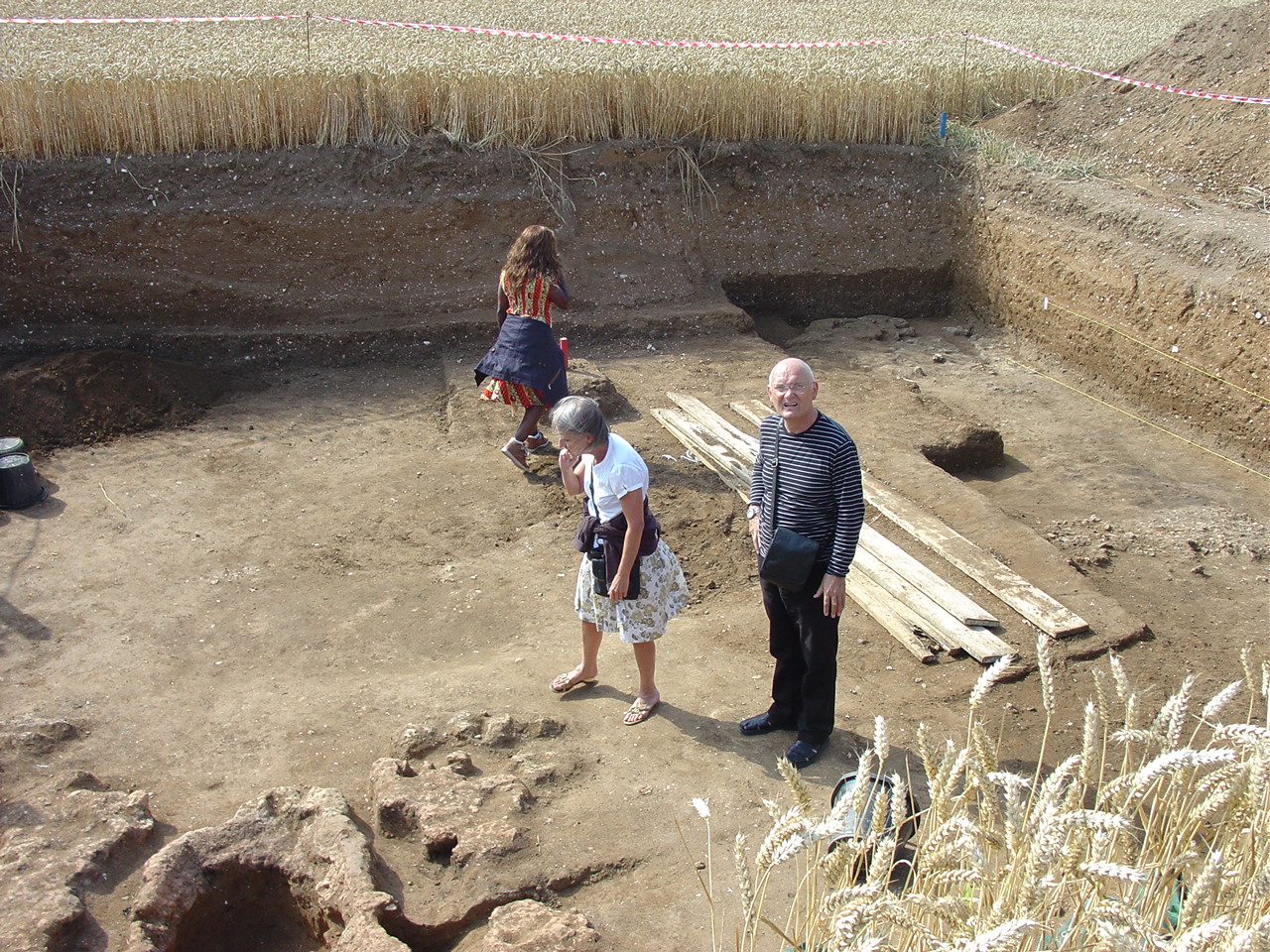
What were they? Last year’s excavation – two metres down into Middle Anglo-Saxon layers of soil formed as a result of ploughing activity ... thrillingly revealed an Anglo-Saxon oven capable of large-scale cereal production for an estate or a monastery. There were a further two metres of earlier ploughsoils beneath the Middle Anglo-Saxon one, going back to the Late Iron Age and Romano-British period.
And the ghostly hand of the past. “The presence of hand and finger marks on the inner wall of the oven was noted, the … size of the prints (suggesting) it may have been the work of women, or children.”
Our Sedgeford ancestors’ daily work for their daily bread was also evidenced. “… Small pieces of charcoal…A mass of charred grain…found within the fire pit just by the inner border of the stoking shelf. The soil over a wide area outside was noted to be stained with fine carbonised material.”
What would our middle Saxon forebears make of our exhausted modern soil? Dr Jolleys details the contrast. “The preserved plough soil from the Middle Anglo-Saxon period, a layer rich and humic and containing only Ipswich Ware pottery (c 650 -850 CE) …sealed by 1.5m of orange brown sandy colluvium which has accumulated over the last 1200 years. The modern plough soil has a thickness of 0.3m and is much less rich in humus than either the Iron Age or Middle Saxon layers.”
Could you be part of all this ground-breaking work? SHARP secretary Brenda Stibbons enthused "If you have always wanted to work on an archaeological site, this is your opportunity - we welcome people of all ages on the courses.
“The Basic Excavation & Recording Techniques course teaches the theory and practical side of excavation - they will be working on the main site for their practical experience. A campsite, well served with hearty victuals, is provided.

“If people live locally they do not have to camp on site but can travel in each day.

“If you are interested but do not fancy digging, you can join one of SHARP’s week or day courses which run throughout the excavation season 6th July – 15th August”.

A variety of courses cover the theoretical and practical aspects of archaeology. This year Archaeology of WW1, Church Archaeology, Landscape, Archaeology of Human Remains and Archaeometallaurgy. There are also day courses – like Anglo Saxon cookery- and also Dig for a Day.

It’s not all work. The annual tradition of Norfolk-based entertainment and scrumptious mediaeval banquet will be provided this year by Room at the Gin’s theatrical production of Margery Kempe of Lynn (on July 30) and returning folk band the Fried Pirates.
Director of SHARP since 2007 Mr Gary Rossin sums up, “The project’s founding objective was to research and explore human settlement and land usage within the parish of Sedgeford. The main focus of its nineteen years has been the Middle to Late Anglo-Saxon period. There are important pieces of the jigsaw yet unfound, not to mention the picture on the box!
“In 2014, we’ll be revisiting glimpses of a mediaeval landscape, including a manor house itself, moving backwards and forwards from our continuing Saxon focus.
“And, on the centenary of World War 1, we will also revisit our research at the nearby First World War aerodrome, along with the militiarised landscape of the local area. The Roman farm under Hall Field will have to wait until 2015 as it has sugar beet in it this year!”
Details of courses are at http://www.sharp.org.uk/courses.html and general information on www.sharp.co.uk.


August 27, 2014

OPEN DAY Digging Sedgeford - A people's archaeology - NOW PUBLISHED

DIGGING SEDGEFORD, AN ACCOUNT OF SHARP'S FIRST 19 YEARS BY THE DIGGERS' COLLECTIVE , IS PUBLISHED TODAY AND LAUNCHED AT SEDGEFORD CHURCH ON FRIDAY AUGUST 29.

I review it here

 Book-launch feature (Lynn News) here

Previous press features and pics here


(feature in EDP Weekend July 26)

As I write, a mechanical digger is making a big hole in a field. Something like it has been happening here in Sedgeford every July for the past 19 years.  It’s exciting - and has nothing to do with farming or building. That digger is unearthing a thousand years of village stories.

Some are unsolved mysteries. Like why the whole village moved from its ancient north-facing slope to its present south-facing one, at or just before the Norman invasion.

Some are murder stories, part of the timeless ancestral battle for survival and territory. Many of these are buried in the ‘Boneyard’.

This riverside graveyard - SHARP’s original focus – was abandoned in Norman times. But it has been preserved for centuries in old wives’ tales and mother’s threats to naughty children ‘you’ll be sent to the boneyard with the dead folk.’

This ‘Boneyard’ yielded Saxon burial and cremation – and a Viking woman buried with a horse – and a Late Saxon murder scene:  a large healthy male with fatal wounds still etched into the skeleton by a Viking marauder, now an exhibit you can see on the SHARP site all July, as well as a crouch-burial dating from the Bronze Age.

Many of the stories SHARP digs up are ongoing detective stories, presenting clues and evidence for as many theories as there are diggers. Gary Rossin, director of SHARP, laughs that the collective noun for archaeologists is an ‘argument’.

 All in a way are ghost stories, haunting our relatively quiet modern Sedgeford with its illustrious, teeming, historically central and thickly populated past. The manor is not listed in Domesday Book for nothing.

Fasten your tardis belts for a quick review of SHARP finds.

8000-4000 BC (Early Stone Age)

Worked flint found in the deserted Boneyard/Reedham area west of the church and south of the modern settlement – locally believed to be haunted – suggests that ancient hunter gatherers set up temporary camp here.

4000-2350 BC (Late Stone Age)

A flint axe – lost or discarded – and other worked flint indicates early farmers at work.

2350-700 BC (Bronze Age)

A crouched burial dating from the Early Bronze Age (2458-2200 BC) in the Lower Chalkpit Field and a series of round barrows – burial mounds - in a tight cluster on rising ground.

700 BC – AD 60 (Iron Age)

A second crouched burial thirty metres and an entire Age (two thousand years) distant from the previous one, Iron Age rather than Bronze Age. A hoard – now famous and in Lynn Museum – of 39 gold staters (gold coins) found concealed within a cow’s humerus. In the same area, a horse burial – the ancient preserved huge skeleton a breathtaking sight at the time when seen in neighbour’s garage! No sign of Boudicca… yet.

AD 60-400 (Roman)

A definite Roman farmstead, a probable villa and a possible supply plant for Brancaster Roman fort. A cremated body in a grain drying oven!

AD 400-700 (Early Anglo-Saxon)

Cremation (pagan) and inhumation (Christian) cemeteries.

AD 700-875 (Middle Anglo-Saxon)

SHARP’s primary thrust. 300 excavated burials in and around the Boneyard (to add to 70 discovered there in the pre-SHARP 1950s by the archaeologist Dr Peter Jewell). More recently, excavations of the living settlement and last year’s huge find: a large baked clay oven containing quantities of burnt grain, big enough to serve a monastery or an estate and suggesting an industrial-sized operation and settlement here.

AD 875-1100

The village abandons its north-facing slope and moves down into the valley. A crippled woman of the thegn class is interred with honour in a (hitherto undiscovered) chapel, the holy site oddly abandoned when St Mary’s Church was built. Was she some kind of holy woman? Why was this original holy ground not used for the church?

 AD 1100 – 1500 (Mediaeval) and into Early Modern

Building of moated manorial courts and major rebuilding of St Mary’s Church; general expansion of the village.

1914-1918 (First World War)

Coastal defence aerodrome. Ammo boxes used as stairs; a soldier invalided home from France is bombed in a field. 

1945- present (Postwar)

Ribbon development links separate settlements.

The Sedgeford Historical and Archaeological Research Project was established in 1996 as a long term, multi-period, multi-disciplinary research project. It was born out of a chance meeting off the Amalfi coast between founder-director Dr Neil Faulkner, then conducting a tour of Roman archaeological sites, and anthropologist Sedgeford Estate owner Bernard Campbell, whose ploughs frequently unearthed bones.

The idea was to investigate the entire range of human settlement and land use in the Norfolk parish of Sedgeford. This is a wider focus than usual and in keeping with modern archaeological science – it is not the one-off fascinating find that matters but how many finds build into a picture of how a community lived. It included a popular and inclusive Sedgeford village survey in which domestic gardens got the trench treatment.

This initiative meant that villagers saw for themselves the layers of history they live on: in my own garden- clay pipes from pre-Victorian times, a large intact pottery vessel marked ‘A Beam and Co, Ale and Spirit Merchant, King’s Lynn’ and – much to the diggers’ excitement at the time – a piece of (rare) Early Saxon pottery now expertly annotated by SHARP and displayed in my library.

I was told at the time that this was a more significant find for what it told us about human settlement here than the gold hoard, though the popular imagination does not seem to agree! How the pot got there is definitely a story I will write someday.

The success of the internationally prestigious project from a Norfolk point of view is demonstrated by the fact that over the years half a dozen young local volunteers later went on to study archaeology at University. It still draws local enthusiasts to its annual camp along with regional, national and international enthusiasts, students and scholars.

It brings an air of youth, adventure, academic enquiry and the big outside world to the village. The average age of Sedgeford residents probably halves during July! There are also popular talks, lectures, music and theatre available to everyone.

One of the highlights for this year will be the launch of the first comprehensive book about the SHARP excavations. It concentrates in detail on the first twelve years of fieldwork and summarises provisional result for the last six years.

And now at last, we are going to get the full story (so far). “Digging Sedgeford: A People’s Archaeology” (authored, Dr Faulkner insists, in the same way as the project is run – collectively.)

I asked its publisher Peter Stibbons of Poppyland publishing what insights the book’s analysis of nearly 300 skeletons from that Anglo-Saxon site could give into the lives of Sedgeford's inhabitants of the period. Were they the primitive barbarian settlers we learned about at school, decivilising a post-Roman culture, for example?

“The insights are fascinating.” Mr Stibbons explained, “We can dispense with some commonly accepted ideas. Their spindle whorls, pin-beaters and dress pins help us understand their industry and their clothing. Their love of gold in ornamentation and in coinage is revealed, their delicate combs carved from bone, their grain ovens and castaway bones speak of their food, and glass and beads speak of their appreciation of decoration and taste.”

Indeed, Dr Faulkner’s most recent Annual Open Day talk (last July) ‘Who were the Anglo-Saxons?’ dismissed the view, established by the Venerable Bede in the 8th century - that waves of axe-bearing Angles, Saxons and Jutes ‘invaded’ post-Roman Britain and established a barbarian bridgehead from which eventually all southern Britain became Angle-land.

On the contrary, these early ‘Saxons’ were a relatively democratic band of pioneering comrades-in-arms often actually joined by local Britons looking for leadership and protection in the ‘dark’ times  after Roman withdrawal.

This is ground-breaking stuff, a whole new story. I wonder how much the negative portrayal of ‘Saxons’ as savage invaders was unconsciously conditioned, or encouraged as convenient propaganda, by the threat of invasion from Germany in the twentieth century.

In the centenary of that fateful summer of 1914, this threat itself has now passed into archaeology as SHARP further investigates the coastal defence aerodrome (later a training function) a mile east of Sedgeford. The appallingly long list of war dead on Sedgeford’s War Memorial – a telephone directory of local names – seems to underwrite the seriousness of this work.

I asked Mr Stibbons how specialised ‘Digging Sedgeford’ was – was it mainly for scholars of archaeology? And would it interest anyone outside Sedgeford itself?

“The book presents both the detailed information required by the archaeological community but in such a way as to be of great interest to any with a more general interest in 50 generations of history from a Norfolk village. Indeed, the members of the SHARP team who have led the writing of the text make the point that it is not simply a unique story of one village but that it can be seen as the story of a 'normal' village, a story which will fit many other Norfolk settlements.

“It is richly illustrated with photographs, maps and diagrams. With 256 pages and colour throughout, there's a chance to understand human settlement in the county over many decades.

Mr Stibbons concluded.  “It doesn't claim to be a comprehensive account of the whole site and its story but is the opening round of a series of titles which could well stretch for years ahead, should the remarkable SHARP excavations continue for as long as they already have.”

 “Digging Sedgeford - A People's Archaeology” is published by Poppyland Publishing and will be in local bookshops from 29th July. It is priced at £19.95; you can see further details or purchase directly from www.poppyland.co.uk You can also link from  the Poppyland Publishing Facebook page.  Details of SHARP courses – from Human Remains to Anglo Saxon Cookery! - are at http://www.sharp.org.uk/courses.html and more general information on the project is on www.sharp.co.uk.


July 28, 2013

Sedgeford Historical Archeological Research Project 2013 (Lynn News)


Lynn News article link 


The sketch is a conjectural reconstruction by Dr John Jolley (pictured, digging in the Lynn News article) of the industrial-scale oven (unearthed remnant pictured) that served Saxon Sedgeford.


The Sedgeford Historical Archaeological Research Project (SHARP) has just packed up its tents and marquees at the end of its eighteenth season. It has come a long way from that chance meeting off the Amalfi coast in 1996 between founder-director Dr Neil Faulkner, then conducting a tour of Roman archaeological sites, and renowned anthropologist Sedgeford Estate owner Bernard Campbell, whose ploughs frequently unearthed bones. Dr Faulkner’s 18th Annual Open Day talk ‘Who were the Anglo-Saxons?’ dismissed the view, established by the Venerable Bede in the 8th century and still learned by many of us at school twelve centuries later - that waves of axe-bearing Angles, Saxons and Jutes ‘invaded’ post-Roman Britain and established a barbarian bridgehead from which eventually all southern Britain became Angle-land.
On the contrary, these early ‘Saxons’ were a relatively democratic band of comrades-in-arms often actually joined by local Britons looking for leadership and protection in the ‘dark’ times after Roman withdrawal. It was no picnic crossing the North Sea in a small boat to start again on a north-facing coastal hill above the River Heacham. These vigorous egalitarian immigrants gave hope and leadership to a society that had fallen apart and where much of the toil had been done by slaves.

The modern-day village of Sedgeford, built on a gentle south-facing hill, has 600 inhabitants and lies within an area of outstanding natural beauty. In Saxon times, Sedgeford by contrast lay south of the river. SHARP’s original focus was a riverside graveyard mysteriously abandoned in Norman times but preserved in old mother’s threats to naughty children ‘you’ll be sent to the boneyard with the dead folk.’ This ‘Boneyard’ yielded Saxon burial and cremation – and a Viking woman buried with a horse – and a Late Saxon murder scene: a large healthy male with fatal wounds still etched into the skeleton by a Viking marauder, now an exhibit, as well as a crouch-burial dating from the Bronze Age.
Current excavations are of the ‘living space’ atop the hill. Though north-facing, this Sedgeford was sheltered from the prevailing wind and in the days of wattle and daub walls and thatched roofs –pole marks of these in the wattle are still visible – shelter may have weighed with locals as much as Conservation Area status does today. The find of the season is an industrial-scale oven (pictured) - with a Mid-Saxon handprint preserved in the hardened clay - set outside the village because of the fire-danger sparks and flames posed to thatched roofs. The rich Saxon soil it rests in puts ours to shame.

Diggers-for-a-day are so enthused by Debra Riches’ inductions they stay for week and come back annually, sifting through the shells of oysters eaten by our six foot plus forebears boated upriver to market as far as the Saxon harbour at Fring. If only the bread Saxon Sedgeford ate hadn’t contained so much grit, which wore out their teeth and plagued them with abscesses and septicaemia, we might envy their health and lifestyle .
Diggers range from archaeology scholars and students to enthusiastic amateurs of all ages and are a lively mixture of Norfolk (one man cycles in from King’s Lynn) national and international. Two locals whose future has been found in the Sedgeford trenches are Max Ogden from Snettisham, enthused by the dig aged 12, later graduate in Archaeology at Nottingham University, and Milly Foster of Sherbourne, a 16 year old SHARP digger just graduated in Archaeology at Reading. Postgraduate Alice Wolff from California explained the huge distance travelled as due to the international prestige of the site and the fact that East Anglia has so much more history than America under its quiet fields.
The past digging of 49 test pits in the gardens of Sedgeford villages themselves produced unexpected finds and included the community. Loss of revenue due to crop disturbance on the Sedgeford Estate is made good in a proportional donation made by SHARP to the church.

Once inducted, all diggers – like their namesakes in the English Civil War - have an equal say in how the project is run and over its finds. Dr Faulkner’s forthcoming book ‘Digging, Sedgeford; a people’s archaeology’ will be author-credited to ‘The SHARP team.’ If the school history many of us studied was found in Bede and a Sutton Hoo barrow in 1938 (not a great time for embracing our German heritage) , the future of school history may well come out of a trench in Sedgeford.
Director of SHARP since 2007 Mr Gary Rossin summed up, “The project’s founding objective was to research and explore human settlement and land usage within the parish of Sedgeford. The main focus of its eighteen years has been the Mid-Late Saxon period. There are important pieces of the jigsaw yet unfound, not to mention the picture on the box! In 2014, we’ll be revisiting glimpses of a Roman farmstead, a mediaeval manor, moving backwards and forwards from our continuing Saxon focus. And, on the centenary of World War 1, we will also revisit our research at the nearby aerodrome

For further information see www.sharp.co.uk (which includes a regularly updated webblog)