LISTING
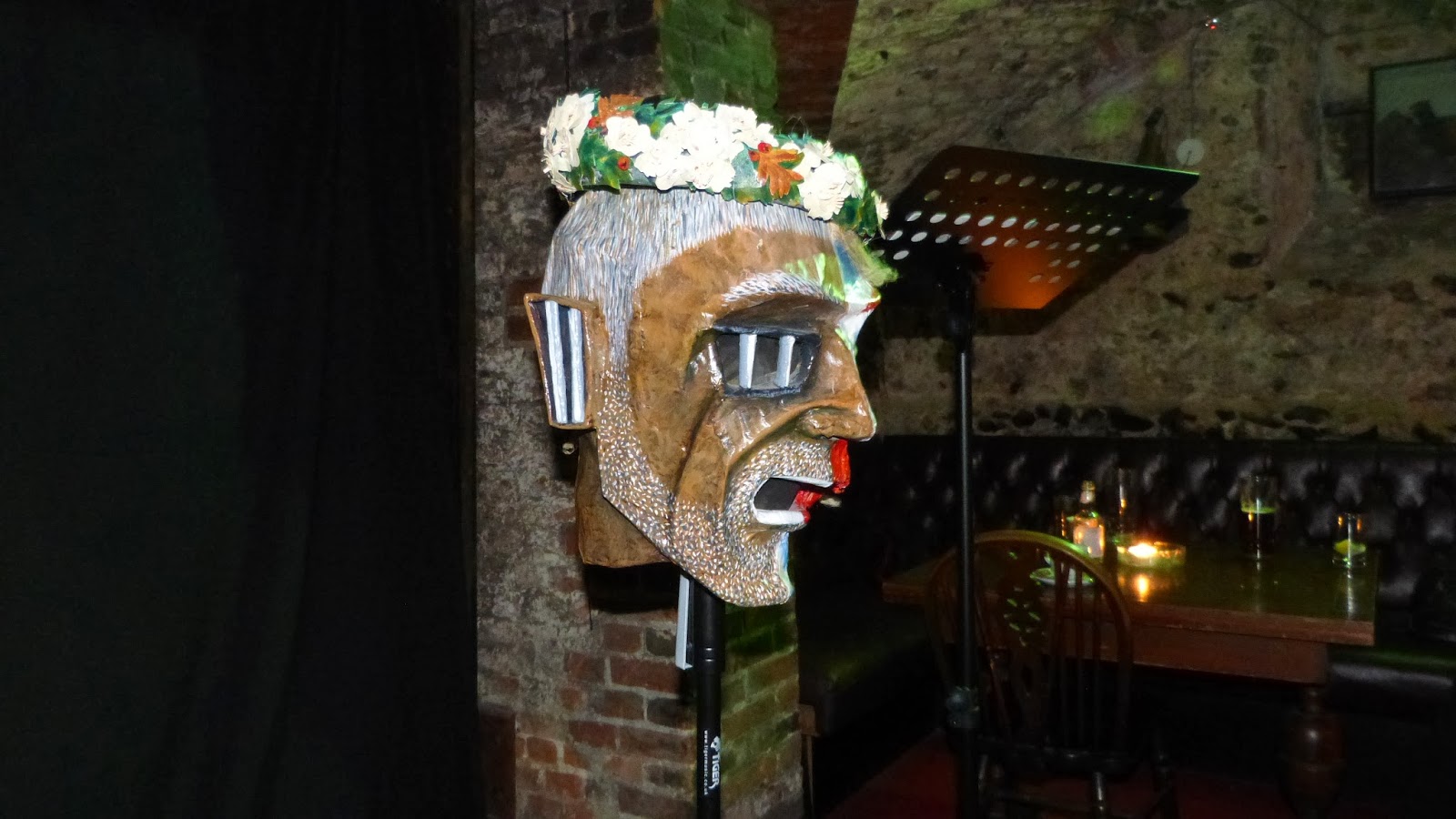
Cromwell’s Talking Head, a dramatic monologue by Gareth Calway. Lively rehearsed reading in the horrible history genre aimed at the naughty kid in all of us. But it's all true - Cromwell the king-killer really was dug up from his 'royal' grave at the Restoration and his head stuck on a traitor's pole for 25 years. Cromwell’s severed head tells his ghastly story of civil war and regicide to a modern grave robber. You’ll laugh your head off!
TOUR DATES
Cambridgeshire
Cromwell's Talking Head by Norfolk author Gareth Calway Oliver Cromwell’s House, 29 St Mary’s St, Ely CB7 4HF - Thursday, January 30, 2014. Ticket info 01353 662062 www.olivercromwellshouse.co.uk East Cambridgeshire Tourist Office says, "Join us on the anniversary of Cromwell’s grisly exhumation for a guided tour of his former home followed by a lively reading of a dramatic monologue. Hear the real story of what happened to the great man’s beheaded corpse. 2 pm. £7.50 includes glass of Cromwell cider."
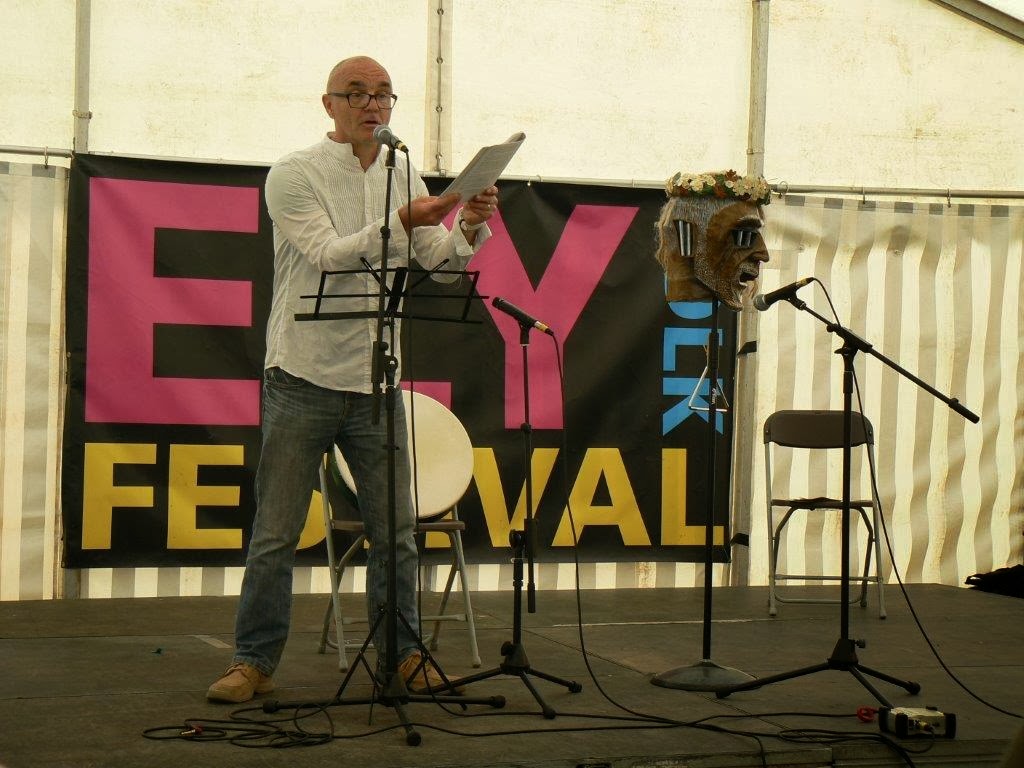
Lovely audience for this today, nodding at all the references and groaning at all the groaners, best OCH gig ever for me. Tracey and team supportive and full of positive vibes as always. A great start to Oliver's charge through two cities and two Norfolk villages. Tally hooo. (NB picture is from last September's gig, as sunshine and short sleeves suggest.)
Norfolk
Cromwell’s Talking Head plus, a dramatic monologue by Gareth Calway. Cromwell’s horrible history told by his severed head!
Includes a bonus talk on the Siege of Lynn, 1643. Two gigs:
The Gin Trap, Ringstead, Norfolk, Friday 31 January. £5. Starts 7.30. Ticket info 01485 571828 www.garethcalway.co.uk
At the 'Room at the Gin' which gives the company its name and the first ever Siege of Lynn talk, a contrast to the second half's horrible history of the talking head. Engaged, appreciative - and again mostly new - audience: one group hurrying in from their fish and chips and another needing Cromwell done by 9 so they could have theirs - it all makes this home venue, and attractive little room - unique.
Great Massingham Social Club, Norfolk, Monday 3 February. £5. Members free. Starts 7.30. Ticket info 01485 571828 www.garethcalway.co.uk
Filled the 'Folkpot' room at Great Massingham with the artistic and intellectual flower of West Norfolk (3 pictured of 23 present). Expert questions after the talk - a real debate with real people engaged with the issues - in a fun atmosphere and lots of naughty kid laughter during the monologue. A splendid time had by all and a small party to follow - not bad for a cold Monday night in February!
Norwich,
Jurnet's Bar, Wensum Lodge, Wednesday 5 February 9.30 pm. Donation box only. Bar. Info 01485 571828. (as part of regular 8 pm-10.30 pm Storytelling event run by Dave Tong www.theyarnsmithofnorwich.com)
New territory - in the history-burdened bowels of the big city among ye guild of dedicated storytellers and with Cromwell comically at odds with the set theme of the evening - dragon tales (from all cultures, Nordic, Japanese, Beowulf etc) - but you could hear a pun drop in the silence. I sportingly contributed an impassioned Worm to the first half - dramatic verse done as one man theatre is not quite storytelling either. Had some generous feedback though.
http://www.lynnnews.co.uk/what-s-on/lifestyle-and-leisure/gareth-takes-a-horrible-history-look-at-cromwell-at-west-norfolk-venues-1-5835343
News Release from East Cambridgeshire District Council 21 January
What did happen to Oliver Cromwell’s body?
This January, Oliver Cromwell House will be the place to learn about what really happened to the former Lord Protector’s beheaded corpse.
‘Cromwell’s Talking Head’ on Thursday 30 January at 2pm, visitors to the tourist venue will be taken on a guided tour of the House followed by a dramatic monologue from Norfolk author Gareth Calway.
Gareth will explain how the body was buried in the manner of a king only to be exhumed after the Restoaration to be hung, drawn and quartered with the head put on the traitor’s pole over Westminister Hall for 25 years.
The mystery of what happened next is then told in vivd detail as Cromwell’s remains were hidden in various locations, presented at freaks shows and became the source of a terrible curse before finally being laid to rest at Sideny Sussex College in Cambridge.
Tracey Harding, Team Leader Tourism and Town Centre Services at East Cambridgeshire District Council, said: “It is wonderful to have Gareth Calway come back to tell his fascinating monologue of what happened to Oliver Cromwell’s corpse after it was exhumed during the reign of Charles II. What adds to the colour of the talk is knowing it is all based as far as possible on historical fact – it reminds us all that we have much to learn from the behaviour of our ancestors.”
Tickets are priced at £7.50 includes which includes a glass of Cromwell cider. For more information call 01353 662062 or visit www.visitely.org.uk.
ENDS
Notes for editors
For further information contact Tony Taylorson in the Communications Team on 01223 699285.
PRESS RELEASE JANUARY 20 2014.
'Cromwell's Talking Head' is a lively rehearsed reading of 25 minutes, with a bit of Celtic drum. It was the first ever spoken word hosted by Ely Folk Festival last August (picture attached), officially judged as 'wonderful' and went down well in a hot marquee to eighty plus people.
It is in the horrible history genre and aimed at the naughty kid in all of us. But it's all true - Cromwell the king-killer really was dug up from his 'royal' grave at the Restoration, hung, drawn, quartered and his head stuck on a traitor's pole for 25 years. After centuries of adventures in freaks shows and dodgy museums, bits nicked by trophy hunters, and carrying a legendary curse, the head was authenticated by cranial detectives and in 1960 secretly buried at his old college in Cambridge University. Secretly in case drunken royalist students dig him up again! In the monologue, the head tells the ghastly story and the story of the Civil War to a young grave robber who has dug up more than he bargained for. It's funny, informative and not that comfortable for royal ears. You’ll laugh your head off!
PRESS RELEASE Jan 15 2014
CROMWELL’S TALKING HEAD RETURNS TO OLIVER CROMWELL’S HOUSE
As Head of State, Oliver, emulating his Tudor ancestor Thomas, oversaw an English Revolution centuries ahead of his time and raised English prestige abroad to its highest level between Agincourt and Trafalgar (400 years). Yet within three years of ‘royal’ burial, he was disgraced and spat upon. Only in Victorian times was there a national revival of respect/campaign for a statue outside the Parliament he did so much to advance. (Queen Victoria refused assent.) Gareth’s monologue has been described as "A triumph of narration and vocal colour" (Radio drama reviews) and as an "Interesting and lively new take on Cromwell" (Cromwell House) Surprising facts about Oliver – like his tolerance – will emerge. Cromwell’s Talking Head has a twice-yearly residency at Oliver Cromwell’s house marking Oliver’s posthumous execution (Jan 30) and ‘lucky day’ (Sep 3.)
An exciting partnership with ex-Mayor of Lynn and now deputy lord lieutenant of Norfolk Dr Paul Richards (author of the documentary history of King’s Lynn) is planned for next September 3 at Marriott’s Warehouse. This partnership will combine Calway’s monologue with some context from Dr Richards about Cromwell’s securing of King’s Lynn for the Parliamentary cause in 1643, against the intrigues of Thomas Gurlyn, Dr Richards’ mayoral predecessor – and a covert royalist - at that time. Meanwhile, at Ringstead and Massingham,
Cromwell’s Talking Head is preceded by the author’s own talk on The Siege of Lynn 1643.
http://www.edp24.co.uk/norfolk-life/norfolk-history/17_jurnet_s_house_1_214362 Fascinating history of this house. Owned by Jews until the latter's expulsion from England for 400 years until - yes - Cromwell welcomed them back. Later owned by the famous Pastons. Dripping with history and atmosphere.
The Siege of Lynn 1643. Feature article published in the Eastern Daily Press Friday 24 January
The Siege of Lynn 1643
Less Puritan than Yarmouth or Norwich and with more active Cavaliers in its backwoods, King’s Lynn was the only place in Norfolk where Civil War blood was shed or gunfire heard. And if the Earl of Newcastle’s Royalist force had relieved the town, it might have turned war and country king-wards.
The Siege of 1643 is the whole war in microcosm: Cavalier audacity; Parliamentary accountability; a divided populace (tending to Parliament) above all united in devout wish for harvest, trade, peace over plunder, billeting, destruction.
And introducing one Colonel Cromwell, typically chastising his then superiors to greater efforts. ‘If I could speak words to pierce your hearts with the sense of our and your condition, I would… If somewhat be not done …you will see Newcastle’s army march up into your bowels.’
And an explosive September 3, ominous date of all Cromwell’s decisive victories, and his death.
Both of Lynn’s two MPs supported Parliament. Yet ‘Lynn Regis’ bears the (temporary) distinction – or stigma - of being the only Royalist town in Eastern England.
Charles I needed a strong fleet: the Civil War was partly triggered by his levies of Ship Money on a reluctant population. Losing London to Parliament was a blunder; losing the East-based navy began to seem like fecklessness. So he needed Lynn: chief exporter of the region’s corn; favoured port of entry to the eastern counties and import-supplier to ten counties (and London).
Parliament grasped this vital strategic importance of Lynn as a gateway between Royalist North and Parliamentary East and South. It instructed the town to keep armed men on its walls and by January 1642 gunpowder had been stored at Market Cross, St Anne’s Fort, Trinity Hall and Red Mount.
The Parliament-tending corporation prepared defences and sent out for an engineer to repair those walls. Drawbridges were set up at the east and south gates. Ironically, all of this would be seized by Royalists and used against the Parliamentary army in 1643.
The Royalist gentry of west Norfolk put pressure on Charles I sympathisers in the corporation. In spring 1643, Cromwell rushed from subduing mild Royalist unrest at Lowestoft to order the Mayor of Lynn to arrest ‘13 local gentlemen’ regarded as threats, orders duly carried out in May. They managed to escape – or were allowed to while sympathisers within the corporation, including the covertly Royalist Mayor, looked the other way.
Enter the dashing Hamon L’Estrange of Hunstanton Hall, a sexagenarian Cavalier living in the grand style with expensive tastes; expensive sons running up debts; eighteen servants (including a falconer and a fool) and a black marble floor in his stables. Supported by Sir Richard Hovell of Hillington and the Morduants of Massingham - encouraged by the Yelvertons of Rougham and the Pastons at Appleton - he now led a Town Hall coup, declaring himself on 13 August ‘governor of Lynn for the king’.
The borough’s two MPs, John Percival and Thomas Toll, were put under house arrest.
Parliament’s Eastern Association appointed the Earl of Manchester to retake the town and was scorned by the royalist press as having ‘as much hope of Heaven’s gate as to enter Lynn.’ The Puritans, as always, took this rebuke at its Word. Cromwell and Manchester lambasted the committees of the Eastern Association for ‘more arms, more troops, more supplies.’ Trust in God and keep your powder dry.
A siege brewed. An August entry in the record of the civic authorities notes that ‘a great company of strangers are now come to the Burgh’ and must be resisted. The 8000 strong Eastern Association army blockaded Lynn on land. Warwick’s Roundhead warships patrolled the Wash: only one Royalist ship carrying vital supplies sneaked through to the town, using fake signals and being fired on by blank rounds as part of a well-worked deception.
Ironically, the strong fortifications and well-equipped garrison established by Parliament now stood firm against it, ordnance turned towards land rather than sea by ‘strangers’ from west Norfolk. Were they loyalists or traitors?
To one besieging Roundhead captain they were a ‘wicked crew… enemies to God and Parliament …malignants and recusants…’ bankrolled by L’Estrange (who faced possible financial ruin if his enemies controlled Norfolk) with ‘a thousand pounds out of his own purse’ and (whose) ungodly strength... (‘1200 muskets, 500 barrels of gunpowder with bullet unanswerable, and three or four troops of horse…’) was only beatable because they were ‘cowardly Cavaliers’ without ‘the strength of the Lord.’
Cromwell ordered a new battery of cannon to move into position at West Lynn, his last local action before galloping north with a (siege-weakening) detachment of horse and dragoons for a pre-emptive strike at Newcastle.
The hope was to bombard the town – or rather a west Norfolk gentry who had seized leadership of its citizens - into submission, without the need of an assault.
One ‘eighteen pound’ cannonball notoriously smashed through the west window of St Margaret’s on Sunday September 3, ‘took the middle pillar a great part of, and broke it in a hundred pieces, dispersing them all over the church.’ ‘The people departed in a most confused manner….some leaving their hats, some their books, and some their scarves.’
Shot and granados flew daily into Tuesday Market Place, causing few casualties but much psychological damage. Houses and property were damaged and abandoned and the shrieks of women and children carried well beyond the town walls: a war of terror.
Death counts vary. One contemporary account suggests ‘above eighty … on both sides’ though parish registers record just two soldiers buried at St Margaret’s during the weeks of the siege and one at St Nicholas’s.
Routes south and east and fresh water supplies from the Gaywood River to the north were cut off. Manchester was within musket shot by September 7th.
The garrison dug in and waited for Newcastle. He never came. It made gallant sallies out: attempting to capture ‘3-400 beefs’ bound for Setchey Market; burning an almshouse known as the Hospital in the nearby village of Gaywood to prevent besiegers taking up quarters there, and meeting every summons to surrender with Cavalier bravado.
Meanwhile the local economy choked and the town feared ruin, even destruction. Boats for a river assault, ladders for scaling the walls and a force of 8000 men were all in place. Despite the derring do-and-die-hard-ism among some Royalists, when Manchester sent word that women and children should be sent out of the town - prior to a general assault on 16 September - an honourable surrender was agreed ‘not as fearing the taking of the town but to avoid the effusion of blood.’ The gun barrage over the sluggish Ouse ceased, sudden silence informing villages and farms to east and west the siege was over.
Or almost. A grumbling appendix of garrison offence required one further show of force– along with a farcical (though to Manchester’s rustic soldiery, dismaying) ‘two hour wrangle at the gate, in the darkness of the summer night’ amid harrowing cries of ‘Give fire!’ Men died in the confusion.
Next day, Manchester’s troops marched into Tuesday Market Place through streets lined only with women and established his HQ at the house of deposed MP Thomas Toll (who had escaped house-arrest several days earlier though a window.) The Earl ordered a thanksgiving service for the peaceful end of the siege, and sermons for the townspeople each morning.
Royalist arms were seized; leaders arrested. After a parley lasting many hours, and a pause for dinner, Hamon L’Estrange was held liable for all damages caused and his estates and property in west Norfolk sequestrated. His gamble on the fortunes of war miscarried, though he was still able to divide a considerable estate between his sons on his death in the Cromwellian England of 1653. The ‘gentlemen strangers’ were told to leave town, though keeping their horses, swords and pistols. A general amnesty was agreed and Lynn’s Parliament-tending, make-trade-not-war townspeople got their desired end.
For the next year, until the war moved west and south on the growing Parliament tide, Lynn became the front line garrison-town of the Eastern Association and major munitions store of Parliament forces.
Sources: RW Ketton-Cremer ‘Norfolk In The Civil War’; P. Richards ‘King’s Lynn’; Susan Yaxley ‘The Siege of King’s Lynn’.
Gareth Calway’s winter tour of ‘Cromwell’s Talking Head’ (a dramatic monologue by Cromwell’s severed head) comes to Oliver Cromwell’s House, Ely, Jan 30 2 pm (info 01353 662062), The Gin Trap Inn, Ringstead,* Jan 31, 7.30 pm; Great Massingham Social Club,* Feb 3, 7.30 pm and Jurnet’s Bar, Norwich, Feb 5, 9.30 pm (info 01485 571828) * = includes a talk on The Siege of Lynn.


.jpg)