The Ladywell in May (Bhas Allan)
“The evening (July 5, 1819, in the pretty Norfolk village of Sedgeford) was most beautiful. The birds sang sweetly. People were busy working in the fields, men and women with hooks around bundles and sheaves of corn and all was peace and quietness… The schoolmistress saw Susan Nobes remarkably active and happy...” Religious Tract (British Library)
On July 5 2019 a group of artists, historians and archaeologists - including the village historian, poet and harpist - will mark the 200th anniversary of a natural catastrophe that not only brought a Norfolk village to its knees but kept it there in a severe trial - and then a rather stony re-assertion - of its traditional beliefs. "The Thunderstorm That Took Place in Sedgeford in the County of Norfolk on Fifth July 1819" not only found its way into the Annual Register of World Events 1819-20 but recurred as the subject of mainstream Judgement Day religious tracts published in 1819, revisited in similar millenarian vein in the then Curate's brief history of Sedgeford in 1895 and finally again in a family account published in 1914, over a century later.
This might be because the Thunderstorm's main target was the 14C Church tower - in which lightning scorched a yard-wide hole - and its tragic victim a member of a Monday Night Bible Class. Susan Nobes, the 14 year old daughter of an agricultural labourer housed in the village's Poor Housing, not only lost her life in terrifying circumstances but suffered the later indignity of being remembered only as the moral point of a lecture about the need for children to live in perpetual readiness for Death and Judgment. Nowadays we might remember her - and the storm - with awed sympathy and a plaque on the church wall but, apart from the present writers, and even in a village with a resident historical and archaeological dig of 20 years standing, her story is still a surprise to locals.
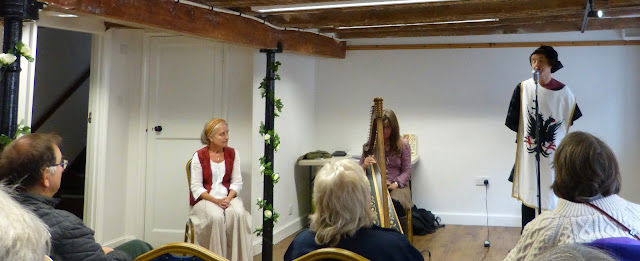
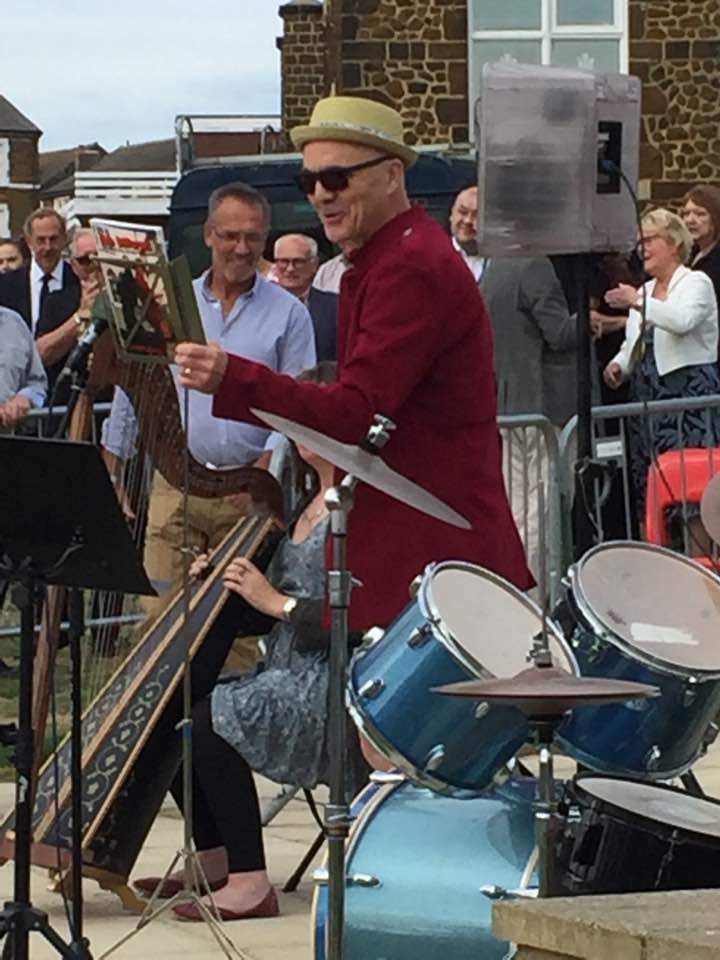
Historian Tim Snelling and Poet Gareth Calway came across it during separate village searches in the British Library and compiled it in their respective ways - Snelling in a historical record, Calway in "The Ballad of Susan Nobes" since set to music by folk-harpist Vanessa Wood-Davies, his bandmate in the four strong folk/storytelling band The Penland Phezants, (featuring veterans folkie Andy Wall on guitar and vocals and Maz Calway, vocals, alongside poet/drummer and harpist/vocal harmonies) who will perform The Storm at Sedgeford in 1819 and Other Stories at the Sedgeford Archaeological Dig on Friday July 5.
Tickets - https://www.sharp.org.uk/events-1/the-penland-phezants
Words and music of "The Ballad of Susan Nobes" were published in "Doin' Different- New Ballads From the East of England" (Poppyland 2016.) A recording has since passed a thousand plays worldwide on Soundcloud; a bi-centenary film got a hundred views on You Tube in its two weeks. But it was only when the poet contacted Snelling to ask if he could perform a private memorial for Susan on his farmland adjacent the church - at the Ladywell, a probable Saxon holy site - that each realised the other had plans to remember July 5 1819.
How we think about such natural events seems a world apart from then. Not many now would view Susan's death as an Act of God, at any rate not a Christian fire-and-brimstone kind of God. We might be more inclined to interrogate the Sunday School's Health and Safety Policy and the actions of the teacher in loco parentis and feel the father's tragic loss of a beloved daughter cut off in her prime before we made a moral lesson of it. We also might worry more about climate change and how well our fire and rescue service is funded than we might about our children's 'sinfulness' (playing around in the graveyard before school rather than saying her prayers.)
1819 was no stranger to climate change, however. In 1816, the eruption of Mount Tambora in Indonesia sent thick volcanic dust across the whole of Europe and America, causing massive crop failure, floods, hailstones and 'orange snow in July." (The early industrial revolution and the unprecendeted amount and power of sustained artillery fire released during the decades of Napoleonic Wars were also key factors.) Lord Byron famously described a gothic "darkness at noon" in Switzerland and his fellow author Mary Shelley's stormy 'Frankenstein' was also partly written in response to that dismal "year without a summer". The volcanic turbulence and wintry summer was also generally interpreted then as God's wrath rather than as Man-created climate change.
A comparable event in recent years would be the May 2007 deluge day when the entire village of Sedgeford (pop. 613) was cut off after a sudden, once-in-a-lifetime downpour that, within 15 minutes, brought the village to a standstill with roads cut off by hillwash and mud slides and all access roads flooded with waters amassing at the lowest point of Cole Green, submerging the ground floors of roadside cottages. Four fire engines spent hours at the scene and some cottages were still being restored a year later.
But in July1819 the villagers were dealing with something even more ferocious. Calway's ballad sets the tragedy in the still feudal village society of the time and keeps to the facts, only framing these as a ghost story and adding a contemporary slant by identifying Susan's former cottage as a modern holiday home. "Come out in the dark lane" - experience the 'real' Norfolk - calls Susan's ghost to the holidaying teenager within. She then relates the events leading up to the storm and her being struck by lightning.
The following detail is drawn from the two known contemporary sources:
1. A short newspaper report in the Ipswich Journal dated July 24th 1819. (In an age before local and regional newspapers, Ipswich - a distant county away from West Norfolk - was the nearest 'local' coverage.)

2. a religious tract written shortly after the event for and published by the Religious Tract Society. (1819) 'The Thunderstorm That Took Place in Sedgeford in the County of Norfolk on Fifth July 1819 with Remarks and Observations for the use of Sunday Scholars, and other young persons.'
The Ballad of Susan Nobes (video of bicentenary performance) was based on a critical reading of these 1819 primary sources (notably a questioning of the religious tract's fire and brimstone assumptions) which slightly disagree.
Harpist Vanessa Wood-Davies and Poet Gareth Calway, composer/ writers of "The Ballad of Susan Nobes": a screenshot from the film of their January 2019 performance.
Any smugness at my apparent scholarly 'exclusive' (an accidental one, while searching the British Library's Sedgeford annals for the construction date of our cottage) was conditioned by an anxiety that I had imagined it. So I was actually relieved when Tim mentioned his own plans to feature the 1819 Thunderstorm in the village newsletter this summer; then proceeded to share a wealth of documents (including copies of BL and county records pertaining to the storm and local evidence of where Susan lived, names of parents, siblings, classmates etc which I had only half established in my own researches.) He also unearthed some verses his mother Janet had written about the storm and Susan's demise which long predate mine.


Tim also had hard evidence (which I hadn't been able to find) of where Susan lived - in the village's Town House (Poor Housing) a row of four tiny houses opposite 'the Washpit'.
The Town House of Sedgeford (extract from)
Janet Hammond
In 1960, in pursuance of a Closing Order, the greater part of what were then known as Numbers 3 and 4 Washpit Cottages, Sedgeford were demolished. The remaining part was retained because the west gable of the condemned cottages was the east gable of the adjoining pair of cottages. These were not tied into the gable just butted onto it. For this reason planning permission was applied for, and obtained, to leave sufficient of the walls under a sloping lean-to roof, in which to house a garage and downstairs bathroom; these would act as buttresses to the gable end. So by chance about a quarter of the seventeenth century Town House was saved.
History
Towards the end of the reign of Elizabeth the problem of the poor was becoming urgent and in 1601 a law was passed which remained the basis for administration of Poor Relief until the nineteenth century. One of the provisions of the act was the encouragement to build a Poor house where indigent parishioners could be housed and work found for them to do. These Town or Alms houses were frequently built by wealthy philanthropic landowners. The Town house of Sedgeford was built by Richard Stubbs just before 1617, as in his will dated 1617 he leaves money to the poor of Sedgeford living in his alms house newly built. This house remained the Town House until 1837 when it and the Pest House (formerly standing on Goodmins next to the cottages opposite the church gate) were sold to defray Sedgeford's expenses in providing the new Docking Union Workhouse at Burntstalk1. At this time the Town House was described as being two cottages and the Pest House as four cottages. Looking at early maps it would appear the latter was still standing until the early part of the twentieth century.
During the two centuries of its existence as a Town House odd glimpses can be
found of it in the manuscripts of the Le Strange and Rolfe families and the Parish. One is
a copy of a letter to Sir Nicholas LeStrange - a great grandson of Richard Stubbs - as
follows:-
May the 29th day 1687
"We the Minister, Churchwardens, Overseers and Chief Inhabitants of the Towne
of Sedgford in the County of Norff whose names are hereunder written doe humbly
testifie unto the Right Worshipfull Sir Nicholas LeStrange of Hunstanton in the
County aforesaid Baronet that we have placed in your Almes howse in Sedgford
aforesayd during you worships pleasure theise persons whose names are hereunder
specified as followeth
Alexander Pawle and his familie; wid(ow) Robinson and her cripple; Anne
Bullocke and Alice (? ); Elizabeth (Tusnt?) Wid(ow) Minne: Alice Minne and
Mary Rice
Willi~ Waters, Vic(ar) Will Palmer ) Churchwardens
Edw. Smith ) Overseers Robt Collen )
Adam Roythorn ) Tho. Rose, ffra Holland. 2
Another was a small book made by Neville Rolfe in 1829, which, although called
a Census of the Poor, 3 seems to have listed all the inhabitants of Sedgeford except the
larger freehold and tenant farmers. In this several households are described as living in the town's houses rent free.
This gave me a clearer context for the rapid swelling of floodwater along the valley coming off Dove Hill in my Ballad (as well as down the steep slope of what is now Goodminns estate). (A context still current; notably in the storm of 2007.) Susan's father is unnamed in the tract but is called Robert (Nobbs) in the news report. Janet's copy of the records has him as Henry, Susan as Susannah and her mother as Mary.

Janet Hammond's copy of the Sedgeford Church baptism records.
Tim Snelling, Sedgeford Village Historian, with some of Janet's many documents pertaining the storm and Susan Nobes.
The backdrop for the private bicentenary performance The Ballad of Susan Nobes scheduled for July 5 2019. The church tower is to the left of the picture, mostly concealed by trees. Note the spooky shadow-cross!
An Elegy for Susan Nobes, written in 2019 and based on the verse form of Janet Hammond's poem (see above), will also be performed at the location photographed below, the Ladywell
The Ladywell in March (GC)
I also asked Tim if there was any evidence that the Ladywell had a sacred function in pagan Saxon times.
"there is no evidence as such, but I think Mum assumed it would have been
regarded in such light given that the Well spring was marked by an erratic
boulder that must have been hauled and brought over from some nearby ice-age
glacial deposition site. But the Ladywell as we know it today would not have
been the pond it is now - that has been widened out both in the past and in
more recent times. It would have originally been a little spring fed rivulet
meandering down to the main river course. Mum also wrote a poem about the
Erratic Boulder in the vein of Beowulf." (Tim Snelling)
The Ladywell and Erratic Boulder in April (Tim Snelling)
South view of Sedgeford Church and the tower. Susan died in the vestry below it.

The most significant divergence between Religious Tract and 1819 news report is that the Tract describes Susan's death as "there were black zig-zag lines on her side where the lightning had stuck her" and the newspaper suggests she died of fear. Either has the elemental implacability (death, fate, wild weather, human littleness in a vast universe) of the ballad form but I, like Janet, followed the (locally written?) religious tract. A lightning strike fits better the tract's sense of a vengeful God - Tim is more inclined to trust the 'detached' news report than a polemic - but I'm not sure the local Curate Dr Bacon (assuming it was he who wrote it) would get away with falsifying a detail that bereaved and grieving (albeit low born and unnamed) parents among his parishioners might dispute; whereas the Ipswich Journal was then an awfully long way away. But let Tim now summarise the complete story with all the documentary evidence and different possibilities we have-
Storm 200 by Tim Snelling
The 5th of July 2019 will mark the 200th anniversary of a catastrophic event that all but brought the village to its knees and sorely tested their faith.
The following detail is drawn from four known sources:
1. A short newspaper report in the Ipswich Journal dated July 24th 1819.
2. 'The Thunderstorm That Took Place in Sedgeford in the County of Norfolk on Fifth July 1819 with Remarks & Observations for the use of Sunday Scholars, and other young persons', a religious tract written shortly after the event for and published by the Religious Tract Society.(1819)
3. Sedgefordiana' - a brief history of Sedgeford by Rev. A. Ogle, (c.1895).
4. Rolfe Family Records Vol.II - compiled by RT & A Gunther (1914)
These four accounts in general agree, but with the odd glaring discrepancy. For the most part the tract must be seen for what it was, promoting the ideology of Christian beliefs and dogma re. 'cometh the day', whilst Ogle's account written some 76 years after the event, is drawn from the tract which, though author unknown, Ogle believes to have been 'written by Dr. Bacon, who was Curate at the time'. Ogle's entry in his Sedgefordiana will have inevitably been based on the already heavily slanted Christian dogma of the tract and hearsay tales that will have expanded and embellished the event over the ensuing 75 years. Gunther merely provides a much abridged version of Ogle's account. It would seem the truth of it lies closer to the event recorded in the short news item in the Ipswich Journal. There were no local newspapers at that time.
It is interesting to note that in neither the news item nor the tract, the two main characters are named, they are simply the lady teacher and the master. The Rev. Ogle however puts a name to these people after a leading preamble. The known copy of the tract is in the British Library, but a recent archive research reveals that another copy of the tract is in the Norwich Record Office under a reference title 'Life and Stewardship of Eustace Neville Rolfe, 1845 - 1908' (Ref. GUN 32 363 x 1) along with other 'notes' belonging to Mrs Catherine Frances Rolfe, Eustace's great-great-aunt who, as it happens, is the lady teacher so named by the Rev. Ogle. When Mrs. Rolfe died in 1837, such was her religious calling and devotion, she left relatively large bequests to many religious societies; indeed, one might wonder if it wasn't actually the 'lady teacher' who was the author of the tract. The master was named as William Harrison.
Monday the 5th July 1819 had been a typical mild warm summers day. Come the evening, folk were going about their daily tasks, working in the fields while birds sweetly sang. The teacher sat in the porch waiting for the schoolmaster to appear before Bible reading class could begin, meanwhile the attending children happily played, running up and down the churchyard, little knowing the impending doom that was to befall them. The schoolmaster duly arrived, readings began and when done was followed with a final hymn, 'Oh let me, heavenly Lord extend, My view to lif's approaching end... .'which, in view of what was about to happen, was very timely sung! Sometime before flashes of lightning had been seen through the church window. A warm summer storm was not unusual and nothing was to be feared of it, so the teacher continued to the end of the class and even as the lightning grew closer the master continued in prayer. Then at 9pm a thunderstorm was unleashed, the magnitude of which had never been witnessed in living memory.
The Ipswich Journal: "During the dreadful thunderstorm on the Evening of July 5th the electric fluid struck the top of Sedgeford Church Steeple on the West Side, and precipitated to the ground several stones of considerable magnitude making a breach in the wall of about a yard square. The lightning also passed through the Church entering in at a window near the porch on the South side; and after crossing in a North East direction, it made its escape at two places in an upper window near the Chancel on the North side".The Rev. A. Ogle later recorded in his 'Sedgefordiana'that "The Church was struck by lightning, whilst a water-spout was falling upon it';
This catastrophic event was worthy enough for the newspaper report to find its way into the Annual Register of World Events 1819-20. A comparable event in recent years would be the May 2007 deluge day when the entire village was cut off after a sudden and unprecedented downpour that within the space of 15 minutes, had brought the village to a standstill with roads cut off by hillwash and mud slides and all access roads flooded with waters amassing at the lowest point of Cole Green, submerging the ground floors of roadside cottages. In July1819 the villagers were dealing with something far more ferocious.
Such was the force of the lightning strike that stones from the tower were dislodged and thrown down to the ground and "the water poured in almost deep enough to drown, forcing its way into the graves within the Church."That would have been bad enough, but this occurred at the same time Mrs Catherine Frances Rolfe, the village squires wife, and the Master, William Harrison, were holding a Bible reading class for the young children, in the vestry which was situated immediately below and between the tower and the south porch where the lightning first entered the church. The news report continues: "An Evening School was being held previous to the occurrence, which happened about 9.p.m. The dismay may be better conceived than described. The children, nearly in a state of distraction, uttering the most dreadful shrieks; parents in search of their children, incessant lightning with peals of thunder, and torrents of rain such as had never been remembered, formed a scene truly terrific."
"Now some time before this they had seen flashes of lightning through the church window. It was very awful, but the lady thought that they were well enough employed, and she did not wish that they should go away before they had done. When the singing was over they all knelt down to pray. The lightning rapidly increased and seemed to fill the window with a blaze of light. But the master went on praying in a very earnest manner. He is one who loves Christ, and I dare say he thought that if he, or any of his little flock were to be struck dead, they could not do better than die on their knees, seeking mercy from Jesus. So he did not pray less because of the storm, but longer; though it was so very dreadful that all present really thought they should soon be killed. You may fancy how awful it was, when I tell you thata thunderbolt struck the steeple and forced down a beam from the roof just over the door of the vestry where they all were. Large stones were also broken off the steeple. The noise was like the sound of a great gun close by, and there was a strong smell of brimstone. The lady, the master and two girls were struck down by the lightning. One of the girls, Catherine Frary, was in an agony of terror, crying out "Indeed, I will strive to sin no more." The children were so frightened that they began to scream and ran about as if they were beside themselves. The lady begged them not to run away from her... but they all ran away, except the master and the children who stayed with the lady in a corner of the church."
The Rev Ogle tells us that " A beam was displaced, large stones were displaced and fell down from the steeple, and Mrs Rolfe, the Master, and two children were struck down... Whereas the tract states that"By and by it gave over thundering and lightning. The lady and the master, and the children who had stayed with them, then knelt down and thanked God for having kept them safe among so much danger... the father of Susan Nobes came to inquire after his daughter. He had been waiting at home for some time, anxiously expecting her return for he was a man who dearly loved his children, and though he could not keep them from the dangers of such a dreadful storm, yet it was natural for him to wish to have them about him at such an awful time. So after looking for her in vain, he went to the church and not finding her, he went with the lady and the schoolmaster into the vestry, and, after looking about, they found poor Susan lying in a corner behind the door and would fain have persuaded himself she was only in a fit; but her head hung back, there were black zig-zag lines on her side where the lightning had struck her, and he soon found that he was only embracing her dead body and that the soul had gone".
The news report makes no mention of 'zig-zag lines' or any other scorch marks, in fact it clearly states that "Fear is supposed to have been the cause of death, as there was no appearance of the electric fluid having entered the room. A few pieces of mortar were detached from the ceiling, which in all probability was effected by the shock communicated to the steeple, or by the concussion of the stones falling to the ground."Susan father is named as Robert in the news report but parish records reveal that her father was a Henry Nobes, husband to Mary (nee Creed). Henry was a farm labourer and the family lived at "the little cottage called the Town House, at the foot of Corner Stone hill, pulled down and rebuilt by Mr Herbert Binks in 1888."The Town House was Sedgeford's Poor House for the most needy. In 1960, the site was a row of 4 cottages called Washpit of which the two nearest to the main road were condemned but partly saved under new ownership. In due course the remaining 2½ cottages were knocked into one.


 T
T