Showing posts with label Ely. Show all posts
Showing posts with label Ely. Show all posts
August 05, 2022


November 30, 2019
Ruby Wedding; revisiting the scene of the crime
Not ours, my love, the teen-dream green-screen songs
And films n’ soaps n’ mills n' boons n’ ads
Of 'hunters' living with their mums and dads,
The twenty-something dramas, dinging-dongs,
The sizzling catalogues of straps and thongs,
The Darcys, Juliets and golden lads
In modern strip from tales in which the cads
Are sixty-odd like us and cause all wrongs.
Our story didn't end like these above
In frozen celebrations, wedding dress;
We raised a daughter into Phase and Next,
We're grownups grown together, more or less,
Our romance is a realistic text:
A dangerous, married, grail-quest of true love.
And films n’ soaps n’ mills n' boons n’ ads
Of 'hunters' living with their mums and dads,
The twenty-something dramas, dinging-dongs,
The sizzling catalogues of straps and thongs,
The Darcys, Juliets and golden lads
In modern strip from tales in which the cads
Are sixty-odd like us and cause all wrongs.
Our story didn't end like these above
In frozen celebrations, wedding dress;
We raised a daughter into Phase and Next,
We're grownups grown together, more or less,
Our romance is a realistic text:
A dangerous, married, grail-quest of true love.
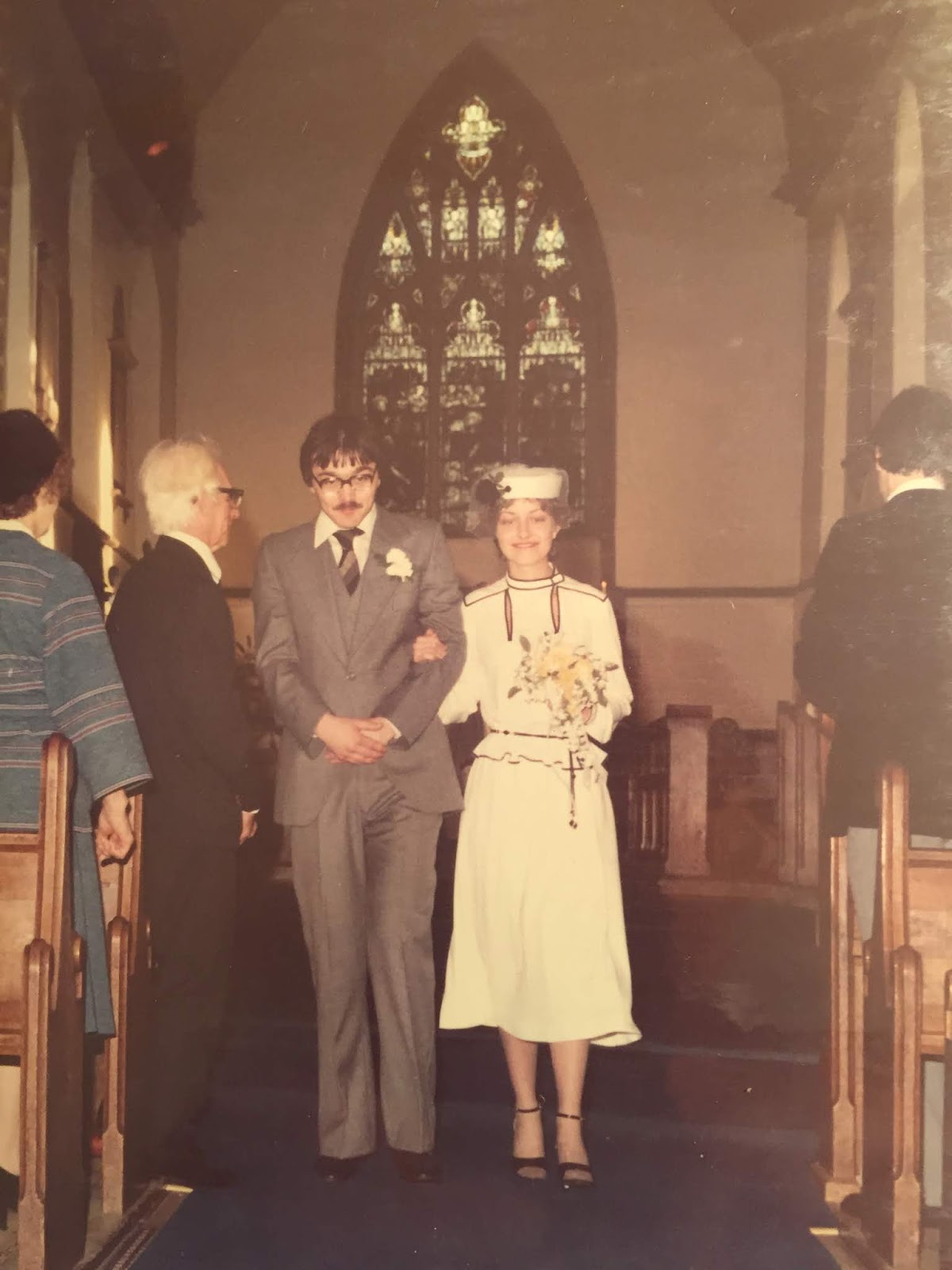


Shortly before our 40th wedding anniversary I finally worked out my wedding music, that requiem for the single man. It's embodied in the fourth movement of my 'symphony No 1 in Coal Minor . Why it has taken so long (and so many books - two novels, several volumes of poems, countless albums and a couple of decades of plays and shows) to lay in art the ghost of that 1970s decade or so I was looking for m' lady wife is one of life's mysteries. If I'd died in the classroom at 50 that life would have been my definitive - in truth only - material. Now it feels like someone else's. (I may even be able to finish my UEA degree now, the one I was awarded in 1979). Anyway, those 'golden years' youth are all there at last and all the better for featuring the lady herself on some rather lovely harmony vocals.


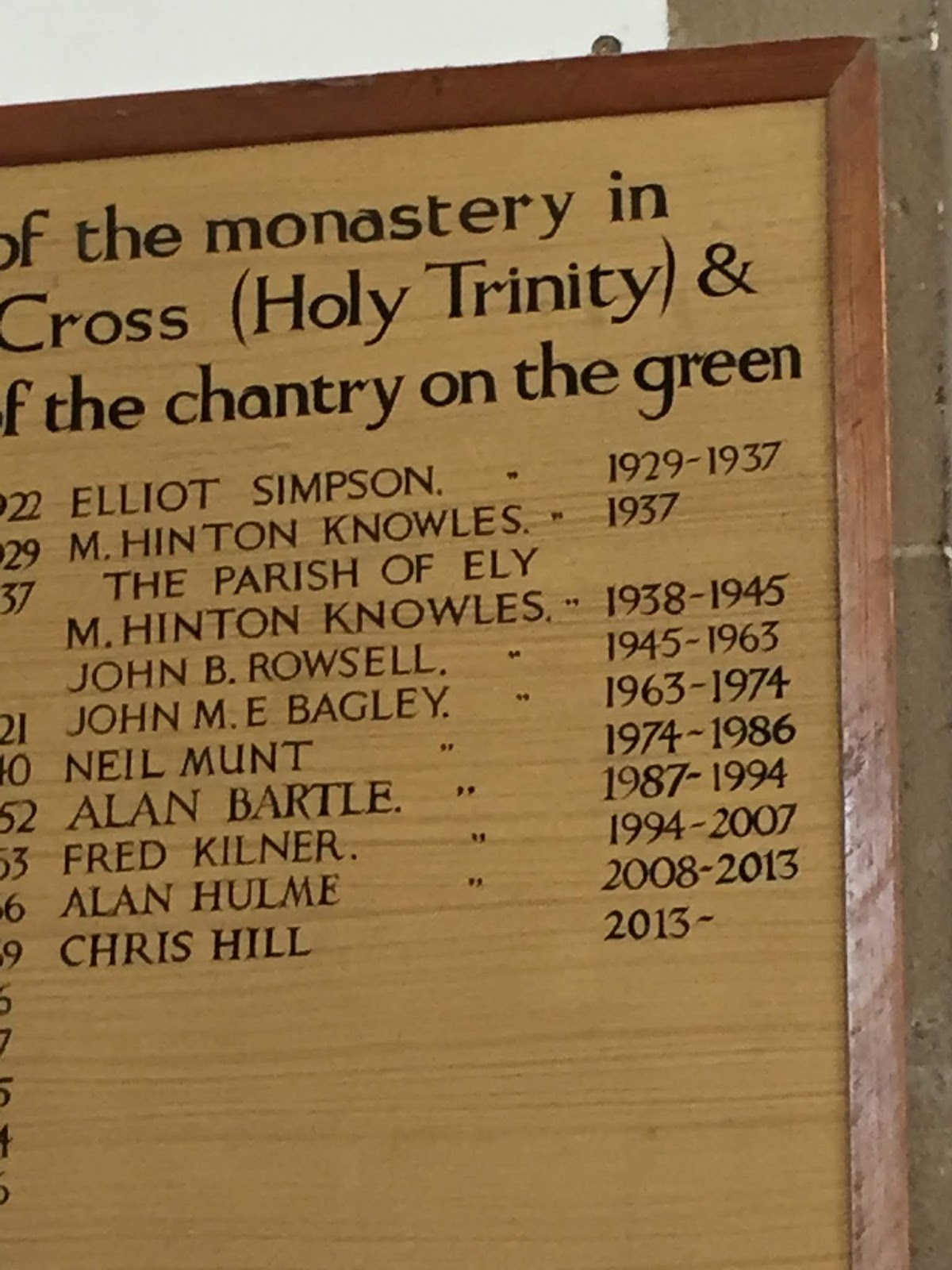
Canon Munt married us on Dec 1 1979, bless him. We got exactly the same brilliant wintry weather for our revisit to the scene of the crime 40 years later.


Champagne and that glorious wedding sunshine 40 years after in Oliver Cromwell House.
Above Rubies
(A metaphysical postulation on the occasion of our 40th wedding anniversary)
The price of wisdom is above rubies:
Our love’s transparent red corundum,
Our heart’s-blood oxidised aluminium,
Our mind-reacts-on-mind A2O3s,
Our rock whose mineral battle agrees,
Of very limited distribution
(Volcanic Burma) and weak dispersion,
More cut and polished brilliance than blaze.
A Proverb to God-worsted, broke, sick, Job
Though unknown to his ancient Hebrew scribe,
A mistranslated jewel in wisdom’s praise
And red by virtue of one atom change in five
Thousand (to chromium) yet by love’s deep ways,
Our granite wedding beds his heart-cut globe.
Note: the first line is from AV Job 28:18 and Pro 8:11, the mistranslation ‘rubies’ re-translated in RSV as ‘gems.’ Genuine rubies are only found in bands of crystalline limestone associated with the granitic and gneissic rocks of Upper Burma, northeast of Mandalay, so it is about as unlikely that Job’s Ancient Hebrew scribe would have seen one as that anyone stays (increasingly) married for 40 years.
May 07, 2018
1068 and All That - first stop Bury Saint Edmunds Arts Festival May 23

The Penland Phezants bring you "As Free As The Waters That Flow Through The Fen; A Very English Resistance: The True Story of Hereward The Wake."
950 years ago, Hereward the Wake came home (from outlawry, exile and a gallery of bold and magical adventures in Cornwall, Ireland and Flanders) as a famous warrior and the leading military genius of his age. He was no Little Englander, speaking several European languages and with experience of leading several foreign armies, and as at home with Danes as with Saxons: his name means 'Head of the army' in both Danish and English. But he did not come home to rest on his laurels. He came home to lead the growing English Resistance against the Norman Conquest. Hereward first avenged the Norman murder of his brother and theft of his manor in his home town of Bourne in Lincolnshire, then established himself in the Isle of Ely alongside the Earl of Morcar (the dead King Harold's brother) and King Sweyn of Denmark, repeatedly outwitting a desperate siege of the Isle personally led by William the Conqueror himself.

So successful was Hereward's defence that William, incredibly, was on the point of offering peace terms when Hereward was betrayed by his erstwhile military allies, the Abbot and monks of Ely Abbey. The ever-elusive Hereward escaped to further historic triumphs against William's armies at Burgh (Peterborough) and the later rearguard victories against all odds in Fenland, Lincolnshire Greenwood and the ancient Saxon forests of Northamptonshire.

Gareth Calway's 90 minute narrative tells the full story, from the magical folk tales of Hereward's early continental career to his historic defence of Saxon England. Based closely on the honest Latin chronicles compiled by 12C monks, this historically-based narrative gives full rein to the Freeborn English humour and derring do of a real life Robin Hood. (The Robin Hood legend borrows much of the spirit and many of Hereward's real-life adventures.)

The compelling narrative is given a period flavour by harp music composed and performed by Welsh Romany-influenced harpist Vanessa Wood-Davies and a folk perspective by a sequence of new ballads written by poet Gareth Calway and folk musician Andy Wall. The Penland Phezants' stirring performance of these is a particular highlight of and perfect fit for this great English folk tale.

Starts: 8pm
Tickets: £10, £2 discount off top price band for Festival Friends, purchase ten or more tickets in one transaction and save £1 per ticket
Venue: Station Hill Social Club, Bury St Edmunds


December 13, 2017
JINGLE JINGLE THE PENLAND PHEZANTS CHRISTMAS SINGLE!

The recently formed East
Anglian folk trio the Penland Phezants have released an online Christmas single
inspired by the Lynn mystic Margery Kempe. The song, 'A Lynn Carol' has a happy Christmas message
and a strong local connection.
Margery Kempe of Lynn was
not your average mediaeval woman. She wrote the first autobiography in English,
'The Book of Margery Kempe.' It begins with an account of her traumatic first pregnancy
(she went on to have 14 children) and what we would call a 'post-partum
psychosis' during which she received visions of heaven and hell. Her 'Book'
describes visions of devils, Jesus, God, the Holy Ghost and the Virgin Mary and
how her spiritual experiences were regarded by the authorities of the time. In
a revolutionary (and at the time heretical) direct personal address to God, she
requested that the Holy Spirit she heard like thunder in her right ear be
changed to something more homely, merry and English: a robin singing. God
obliged!
The idea behind the lyric is that while 'Mystic Margery' and a young modern Lynn shopgirl would probably gape at each other's lives in astonishment, they would both understand and share the experience of love. The moment in the song where the girl falls in love is as much a vision as Margery's.
Now starry angels on the tree
Grow larger in the dusk
To heaven-blue and Eden-green
And gold and reindeer-musk.
And what was heard by Margery,
The Visionary of Lynn,
Rings out on tills for checkout girls
Who hear that robin sing.
The only gift left on the shelf
That nothing else can rise above
Includes all treasure, lasts forever,
And grows when shared with others: love.
The Penland Phezants are a
combination of Ely folk musician Andy Wall and Waywood, the Sedgeford storytelling
duo made up of harpist Vanessa Wood Davies and poet Gareth Calway. They are currently
seeking to add further engagements to their Hereward the Wake tour next year,
which already includes two nationally acclaimed folk festivals. The Phezants' Christmas single may be heard
via the trio's Bandcamp site, from which listeners can add it to their
Christmas playlists or purchase a digital download. https://thepenlandphezants.bandcamp.com


And a little robin also tells
us that Margery Kempe's extraordinary story may be coming home to Lynn in 2018,
600 years after she wrote her Book there, with some musical assistance from The
Phezants. Watch this space.
The Phezants' next appearance is at Wisbech Library in February, where they will perform "Bread or Blood" the story of the Littleport and Ely Riots of 1816. (part of the Cambridgeshire Library Presents series) Album sampler here
Phezant photoshoot by Bhas Allan
Phezant photoshoot by Bhas Allan
November 26, 2017
A Very English Resistance - The True Story of Hereward The Wake

As Free As The Waters That Flow Through The Fen - The True Story
of Hereward The Wake
(Composed,
written and performed by the Penland Phezants)
This is a new project
being developed by a new combination - a poet, a folk musician and a harpist. The Penland Phezants. We are seeking dates to add to our existing 2018 festival, folk club, library,
theatre and arts centre engagements.

950 years ago, in 1067, Hereward the Wake returned
from outlawry, exile and a gallery of bold and magical adventures in Cornwall,
Ireland and Flanders which had established him as a famous warrior and the
leading military genius of his age. But he did not come home to rest on his laurels.
He came home to join, and quickly to lead, the growing English Resistance
against the Norman Conquest, which then was at a critical stage. Hereward first
avenged the Norman murder of his brother and theft of his manor in his home
town of Bourne in Lincolnshire, then established himself in the Isle of Ely
alongside the Earl of Morcar (the dead King Harold's brother) and King Sweyn of
Denmark, repeatedly outwitting a desperate siege of the Isle personally led by
William the Conqueror himself. So successful was Hereward's defence that William,
incredibly, was on the point of offering peace terms when Hereward was betrayed
by his erstwhile military allies, the fighting Abbot and monks of Ely Abbey.
Thanks to the early warning of one brave monk, the ever-elusive Hereward
escaped to further historic triumphs against William's armies in Fenland, at
Burgh (Peterborough) and the Bruneswald and Saxon greenwoods of Lincolnshire and
Northamptonshire.
 Gareth Calway's 90 minute narrative tells the full
story, from the magical folk tales of Hereward's early career, to the historic
defence of Ely and the glittering later rearguard victories against all odds in
fenland and greenwood. Based closely on the honest Latin chronicles compiled by
12C monks, this historically-based narrative gives full rein to the Freeborn
English humour and derring do of a real life Robin Hood. (The Robin Hood legend
borrows much of the spirit and many of Hereward's real-life adventures.) The compelling
narrative is given a period flavour by harp music composed and performed by
Welsh Romany-influenced harpist Vanessa Wood-Davies and a folk perspective by interweaving
a sequence of new real life Robin Hood ballads (written by Bread and Blood team
Gareth Calway and Andy Wall.) Andy
Wall's classic and authentic folk performance of these is a particular highlight
of and perfect fit for this great English folk tale. A 30 minute showcase will also be available.
Gareth Calway's 90 minute narrative tells the full
story, from the magical folk tales of Hereward's early career, to the historic
defence of Ely and the glittering later rearguard victories against all odds in
fenland and greenwood. Based closely on the honest Latin chronicles compiled by
12C monks, this historically-based narrative gives full rein to the Freeborn
English humour and derring do of a real life Robin Hood. (The Robin Hood legend
borrows much of the spirit and many of Hereward's real-life adventures.) The compelling
narrative is given a period flavour by harp music composed and performed by
Welsh Romany-influenced harpist Vanessa Wood-Davies and a folk perspective by interweaving
a sequence of new real life Robin Hood ballads (written by Bread and Blood team
Gareth Calway and Andy Wall.) Andy
Wall's classic and authentic folk performance of these is a particular highlight
of and perfect fit for this great English folk tale. A 30 minute showcase will also be available.

The Penland Phezants are:
Gareth Calway (narrative, backing vocals, drum)
Andy Wall (acoustic guitar, lead vocals)
Vanessa Wood-Davies (harp, harmony vocals)
Andy Wall (acoustic guitar, lead vocals)
Vanessa Wood-Davies (harp, harmony vocals)

http://www.elystandard.co.uk/what-s-on/music/fen-trio-form-new-folk-band-1-5297836
http://www.wisbechstandard.co.uk/what-s-on/music/fen-trio-form-new-folk-band-1-5297836
https://www.lynnnews.co.uk/news/hereward-the-wake-is-brought-back-to-life-1-8271354
https://www.musicglue.com/the-penland-phezants/
http://www.wisbechstandard.co.uk/what-s-on/music/fen-trio-form-new-folk-band-1-5297836
https://www.lynnnews.co.uk/news/hereward-the-wake-is-brought-back-to-life-1-8271354
https://www.musicglue.com/the-penland-phezants/
Phezant photoshoot (above) by Bhas Allan
The picture at the top of this blog has been described as follows: "The fen, the belligerent battered tree, the Robin Hood, the elf, the stubborn Freeborn Dane, the moat, the sublime light, the understated majesty: it is the complete realisation of the title of our project: A Very English Resistance, the True Story of Hereward The Wake. Genius."

The following two didn't make the official photographer's cut but I like 'em!


Ely Cathedral through train window by Bhas.
"Hereward led a wolfish defence of an England before the Normans sank their giant Cathedral-Castles like ring of steel in our land, when that magnificent Norman power bloc of holy terror (pictured) holding a previously unconquerable native fen and first in thrall, was a thinner-walled but better founded Saxon Abbey."


Screen grab


Ely Cathedral through train window by Bhas.
"Hereward led a wolfish defence of an England before the Normans sank their giant Cathedral-Castles like ring of steel in our land, when that magnificent Norman power bloc of holy terror (pictured) holding a previously unconquerable native fen and first in thrall, was a thinner-walled but better founded Saxon Abbey."

Fenland photoshoot of the late 1060s Norman-Saxon front line (below) by A Mateur. Pic 2 is an Ouse bank shot along the old Littleport Road; the rest are just above Ely itself (with a new invader - pennywort!)


September 16, 2017
The Ballad of Hereward The Wake by Waywood - World Premiere
Welcome -you are the 100+ reader of this post.

Published below for the first time the full text of our new ballad "Hereward The Wake."
SPOKEN INTRO…
Twilight in the
greenwood, is Hereward awake?
Grey and ghostly
shadows are gliding through the brake,
Shadows of the dappled
deer, dreaming of the morn,
Dreaming of a hooded
man that winds a shadowy horn.
HARP MUSIC STARTS
In the Lincoln greenwood,
In the Bruneswald,
Yellow-haired, sky-eyed,
Great-hearted and bold,
For the soul of England;
For your own spirit's sake,
Lift your heart and voice up
For Hereward the Wake!
A wild swan, a curlew,
A fen-son, a tiger;
His high blood-tide exiled
By Edward the Confessor.
Performs magic deeds
In Cornwall and Ireland;
Fights fearless and feared
For Flanders, his wife-land.
Family home 'Normaned'
With his brother's severed head;
Returns, puts the murderers'
14 heads there instead.
In the Lincoln
greenwood,
In the Bruneswald,
Yellow-haired,
sky-eyed,
Great-hearted and
bold,
For the soul of England;
For your own spirit's
sake,
Lift your heart and
voice up
For Hereward the Wake!
As free as the waters
That flow through the fen,
As the wide heaven-skies
In the eyes of good men,
To the Saxon Abbot
Of Ely he speeds;
Lords, with King Sweyn of Denmark,
Its marsh, mere and reeds.
Raids Peterborough Abbey,
Frees God's Saxon gold
From the thief-Norman grip
Of the tyrant monk Turold.
In the Lincoln
greenwood,
In the Bruneswald,
Yellow-haired,
sky-eyed,
Great-hearted and
bold,
For the soul of England;
For your own spirit's
sake,
Lift your heart and
voice up
For Hereward the Wake!
From the Normans learns war,
From Flems love, bonds with Danes
But when King Sweyn makes peace,
Stays true to the thanes.
With Saxon Earl Morca
Defends Ely Isle
Fights war-craft and witch-fire
With fire, bow and guile.
The Norman machine
Cannot conquer that fastness;
Greed's causeway sinks
In full armour and harness.
In the Lincoln
greenwood,
In the Bruneswald,
Yellow-haired,
sky-eyed,
Great-hearted and
bold,
For the soul of
England;
For your own spirit's
sake,
Lift your heart and
voice up
For Hereward the Wake!
His wood-spirit leaves-drops
The Conqueror's hush-biz
Then is gone like a breeze
Through the secret rushes.
Though our monks will give up,
Afraid for their lands,
Their arms and his paths,
He will slip through their hands.
As free as the waters
That flow through the fens,
As the wide heaven-skies
In the eyes of good men.
In the Lincoln
greenwood,
In the Bruneswald,
Yellow-haired,
sky-eyed,
Great-hearted and
bold,
For the soul of
England;
For your own spirit's
sake,
Lift your heart and
voice up
For Hereward the Wake!
© Gareth Calway 2017
This celebration of Hereward is folk duo Waywood's latest. The world premiere as performed by the poet with harpist Vanessa Wood-Davies' latest melody was performed at Hereward's birth-place of Bourne, Lincolnshire on Thursday 7 September, the 950th anniversary of the great Saxon's homecoming. It tells the famous (and truer than you might think) story of how Hereward - delinquent son of Leofric Lord of Bourne and (some say) Lady Godiva - came to lead the English resistance to William the Conqueror from the woods and the fens, with star turns in the years 1067-72 for Bourne, Peterborough and Ely. The timeless style of Waywood's performance art - ballad verse and harp as the days of the mead hall - is a perfect fit for this hero tale. Waywood will also be performing homages to Robin Hood and Wicken Fen. And that's only our bit - there's a Bayeux tapestry to see, Hereward scholarship for a popular audience, storytelling, film and much else besides.

Waywood harpist Vanessa Wood-Davie spreparing for action in Hunstanton last June,
paying homage to a local Norfolk hero. Pic by Elaine Bird.
December 21, 2015
The Puritans' Christmas Party
(published in the EDP 19 Dec 2015)

And here I am talking baubles on Dec 23 2015 on BBC Radio Berkshire, 24 minutes in-
What would a Christmas Party at Oliver Cromwell’s house be like? It sounds like one of those oxymorons the great Puritan epic poet John Milton (Cromwell’s Latin Secretary) favoured – the ‘darkness visible’ of hell for instance. Oliver Cromwell’s House in Ely is inviting visitors to find out.
There would be poetry and music – Cromwell was a generous patron of the arts. There would even be minced pies and mulled wine – Cromwell, contrary to popular misconception, banned neither. But this is not really the issue. The issue is what would Cromwell celebrate.
Milton’s famous Ode ‘ On the Morning of Christ’s Nativity tells us.
In it Nature is represented as an Eve figure, a fallen woman. At Christ Tide, the dead of winter, she is nervous about meeting her Maker. Though naked of her ‘gawdy trim' – her flowers and foliage - her ‘guilty front’ is shameful.
Nature needs a December covering of virgin snow. In such wise, eyes downward, she is able to meet Christ’s gaze.
So far so anti-festive and anti-fun. The party-pooping killjoy Puritan, fearing life and the female, which some less spartan strands of Christianity, embellished with millenniums of solstice festival imported from pagan traditions - comparatively - embrace.
But hold you hard there. Milton’s poem is called ‘ON the morning of Christ’s Nativity.’ Eternity has entered Time; there is a deeper magic afoot. Every Christmas day is still the first. And on it, all evil and all pagan gods are banished.
Milton describes himself at the Nativity running ahead to offer his gift – the poem - ahead of the three ‘wisards’ bringing the newborn Christ their pagan gold, frankincense and myrrh.
It is this Eternity that the Puritans sought to enter at ‘Christ Tide’ behind closed doors and in quiet reflection with their families.
And though Cromwell never sought personally to impose such peace on the wassailing revellers whom Puritans would see as worshipping Mammon, his fundamentalist government did and it has rankled ever since.
There is nothing in the Bible telling Christians to celebrate Christ’s birth on 25 December (Mithras’s birthday and the Roman Saturnalia) nor to observe our chilly season of gifts, ghost stories, gluwein, or even the robin – a bird sacred to Thor. Pagans worshipping the sunrise at Stonehenge would recognise our 'Christ'mas before Jesus of Nazareth would.
But English Protestants defending the Reformation from what they saw as a sneaky Stuart slide back towards the excesses of Rome felt the same about the Stuart ‘Mass'. So even the mild Anglican Midnight service we attend as a concession to a half-forgotten faith in the midst of a month of shopping, feasting and boozing would have offended Cromwell let alone some of his more extreme supporters.

Cromwell bitterly divides opinion. As a board in Oliver Cromwell House asks, is he hero or villain?
His hero status is as a pioneer of Parliamentary government and constitutional monarchy. Modern Britons might admire his combination of strong progressive leadership with ‘warts and all' lack of vanity and personal ambition; the way a humble inspired Fen farmer rose to lead cavalry charges, then a new model army he founded with Sir Thomas Fairfax and finally the Greater England which conquered and constitutionally modernised (in Ireland, alas, brutally though no more brutally than the Tudors and Stuarts) the home nations.
AUDIO. The Ballad of Cromwell's Head, sung live in the Civil War Room at Oliver Cromwell's House, Ely.
Much – not all - of the Cromwellian project was reversed at the Restoration. But The Glorious Revolution of 1688 and subsequent progressive legislation restored it and revealed a man centuries ahead of his time. We admire too his Protestant non-sectarianism, his principles, the lack of corruption in his regime.
We don’t like him very much though. And much of that comes out in the popular myth that he cancelled Christmas.
I blame The Good King Charles interpretation of history which starts in the children’s fairy tales about the period: Charles I a martyred Christ figure, as painted by Van Dyke, rather than the tyrant and ‘Man of blood’ who broke treaties and perpetuated civil wars that wiped out one in four of the English population (more than both world wars put together). Paint is where the resemblance ends – there is a Miltonic cosmos between Charles’ absolutism and the Sermon on the Mount.
And but for the grace of Cromwell’s victory at Dunbar, Charles’ son, the “Merry Monarch,’ would have handed over Britain to Covenant-bashing Scottish Calvinists – they’d have cancelled a lot more than Christmas. This is forgotten. Instead, children hear about Charles II’s attractively indulgent (and self-centred) lifestyle and the romance of his royal escape to France from ‘Cromwell’s preachies.’
Neither Charles was a Good King Wencelas. All those fun-loving Cavalier Christmases in stately homes were of little use to the poor and homeless Christ inconveniently emphasises.
To me, the real folk song romantics of the English Civil War are not wealthy cavaliers hiding up trees, in drag, or down the priest holes of stately homes but the levelling redcoats who fought for a new England they could believe in. An England challenging the ‘divine right of kings’ to reverse the Reformation by stealth and to rule without Parliament.
Unlike fellow East Anglian people’s champion Robert Kett, Cromwell had the misfortune not to die for the cause – he lived to implement it. How does the romantic reputation of ‘God’s Englishman’ (Cromwell) endure success? How did he use the power he won?
Cromwell believed in oligarchy, not democracy, though for the first time in English history, one not based on class. The Rule of the Saints meant any Protestant man with a stake in the country, not just by owning property in it (Cromwell was himself never a great landowner) but by fighting for it. The Parliamentary army was drawn from a much wider and more democratic franchise than Parliament.
To Cromwell, Protestantism meant the individual conscience guided by God. (‘God not Man is King’ was the epitaph on his tomb.) And God could speak through anybody.
This made him (contrary to propaganda) unusually tolerant as (against the Puritan stereotype) he claimed no special divination over other Protestants. And Catholic historians agree that even Catholics, except (alas) in Ireland, were better treated under his regime than was the norm under the Stuarts and Tudors.
‘Puritans’ did not see themselves through our modern eyes as killjoys but as mainstream Protestants defending the Reformation and the Protestant England of Good Queen Bess. Cromwell is popularly misrepresented as smashing all the stained glass out of the Lady Chapel of Ely Cathedral (that was Thomas Cromwell) and as draining all the colour and cheer out of Christmas.
But Oliver was defending the deep magic of Christ Tide. Of Eternity entering Time. Not just from the heathen paganism of pre-Christian times but from the ‘Roman’ festival the Stuart Church would make of it, the country and Christianity.

The Christmas trail at Oliver Cromwell House in Ely visitely.eastcambs.gov.uk runs until twelfth night. It guides visitors around Cromwell’s house and asks them to identify objects alien to genuine Christmas tradition.
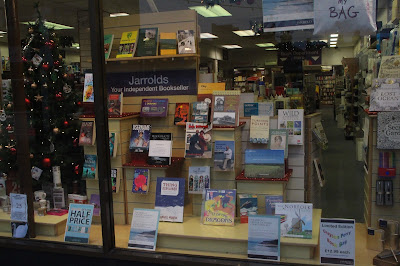
Gareth Calway has just published ‘Doin different – new ballads from the East of England’ - on sale in bookshops throughout East Anglia or from www.poppyland.co.uk . 'Doin different' includes ballads on Cromwell, Cavaliers, Roundheads, Robert Kett and the proto-Protestant martyr William Sawtrey of Lynn.

Anto Morra’s new CD ‘Boudicca’s Country’ (12 ballads from ‘Doin different) includes ‘A Lynn Carol’ inspired by Margery Kempe - you can hear it live tomorrow at Fring Church Carol Service or on www.poppyland.co.uk - and ‘The Ballad of Cromwell’s Head’.

Read Gareth's EDP feature on The Meaning of Christmas: Santa and Saturnalia at the Solstice
For an opposing view see ‘William Winstanley- The Man Who Saved Christmas’ by Alison Barnes (www.poppyland.co.uk)

And here I am talking baubles on Dec 23 2015 on BBC Radio Berkshire, 24 minutes in-
What would a Christmas Party at Oliver Cromwell’s house be like? It sounds like one of those oxymorons the great Puritan epic poet John Milton (Cromwell’s Latin Secretary) favoured – the ‘darkness visible’ of hell for instance. Oliver Cromwell’s House in Ely is inviting visitors to find out.
There would be poetry and music – Cromwell was a generous patron of the arts. There would even be minced pies and mulled wine – Cromwell, contrary to popular misconception, banned neither. But this is not really the issue. The issue is what would Cromwell celebrate.
Milton’s famous Ode ‘ On the Morning of Christ’s Nativity tells us.
In it Nature is represented as an Eve figure, a fallen woman. At Christ Tide, the dead of winter, she is nervous about meeting her Maker. Though naked of her ‘gawdy trim' – her flowers and foliage - her ‘guilty front’ is shameful.
Nature needs a December covering of virgin snow. In such wise, eyes downward, she is able to meet Christ’s gaze.
So far so anti-festive and anti-fun. The party-pooping killjoy Puritan, fearing life and the female, which some less spartan strands of Christianity, embellished with millenniums of solstice festival imported from pagan traditions - comparatively - embrace.
But hold you hard there. Milton’s poem is called ‘ON the morning of Christ’s Nativity.’ Eternity has entered Time; there is a deeper magic afoot. Every Christmas day is still the first. And on it, all evil and all pagan gods are banished.
Milton describes himself at the Nativity running ahead to offer his gift – the poem - ahead of the three ‘wisards’ bringing the newborn Christ their pagan gold, frankincense and myrrh.
It is this Eternity that the Puritans sought to enter at ‘Christ Tide’ behind closed doors and in quiet reflection with their families.
And though Cromwell never sought personally to impose such peace on the wassailing revellers whom Puritans would see as worshipping Mammon, his fundamentalist government did and it has rankled ever since.
There is nothing in the Bible telling Christians to celebrate Christ’s birth on 25 December (Mithras’s birthday and the Roman Saturnalia) nor to observe our chilly season of gifts, ghost stories, gluwein, or even the robin – a bird sacred to Thor. Pagans worshipping the sunrise at Stonehenge would recognise our 'Christ'mas before Jesus of Nazareth would.
But English Protestants defending the Reformation from what they saw as a sneaky Stuart slide back towards the excesses of Rome felt the same about the Stuart ‘Mass'. So even the mild Anglican Midnight service we attend as a concession to a half-forgotten faith in the midst of a month of shopping, feasting and boozing would have offended Cromwell let alone some of his more extreme supporters.

Cromwell bitterly divides opinion. As a board in Oliver Cromwell House asks, is he hero or villain?
His hero status is as a pioneer of Parliamentary government and constitutional monarchy. Modern Britons might admire his combination of strong progressive leadership with ‘warts and all' lack of vanity and personal ambition; the way a humble inspired Fen farmer rose to lead cavalry charges, then a new model army he founded with Sir Thomas Fairfax and finally the Greater England which conquered and constitutionally modernised (in Ireland, alas, brutally though no more brutally than the Tudors and Stuarts) the home nations.
AUDIO. The Ballad of Cromwell's Head, sung live in the Civil War Room at Oliver Cromwell's House, Ely.
Much – not all - of the Cromwellian project was reversed at the Restoration. But The Glorious Revolution of 1688 and subsequent progressive legislation restored it and revealed a man centuries ahead of his time. We admire too his Protestant non-sectarianism, his principles, the lack of corruption in his regime.
We don’t like him very much though. And much of that comes out in the popular myth that he cancelled Christmas.
I blame The Good King Charles interpretation of history which starts in the children’s fairy tales about the period: Charles I a martyred Christ figure, as painted by Van Dyke, rather than the tyrant and ‘Man of blood’ who broke treaties and perpetuated civil wars that wiped out one in four of the English population (more than both world wars put together). Paint is where the resemblance ends – there is a Miltonic cosmos between Charles’ absolutism and the Sermon on the Mount.
And but for the grace of Cromwell’s victory at Dunbar, Charles’ son, the “Merry Monarch,’ would have handed over Britain to Covenant-bashing Scottish Calvinists – they’d have cancelled a lot more than Christmas. This is forgotten. Instead, children hear about Charles II’s attractively indulgent (and self-centred) lifestyle and the romance of his royal escape to France from ‘Cromwell’s preachies.’
Neither Charles was a Good King Wencelas. All those fun-loving Cavalier Christmases in stately homes were of little use to the poor and homeless Christ inconveniently emphasises.
To me, the real folk song romantics of the English Civil War are not wealthy cavaliers hiding up trees, in drag, or down the priest holes of stately homes but the levelling redcoats who fought for a new England they could believe in. An England challenging the ‘divine right of kings’ to reverse the Reformation by stealth and to rule without Parliament.
Unlike fellow East Anglian people’s champion Robert Kett, Cromwell had the misfortune not to die for the cause – he lived to implement it. How does the romantic reputation of ‘God’s Englishman’ (Cromwell) endure success? How did he use the power he won?
Cromwell believed in oligarchy, not democracy, though for the first time in English history, one not based on class. The Rule of the Saints meant any Protestant man with a stake in the country, not just by owning property in it (Cromwell was himself never a great landowner) but by fighting for it. The Parliamentary army was drawn from a much wider and more democratic franchise than Parliament.
To Cromwell, Protestantism meant the individual conscience guided by God. (‘God not Man is King’ was the epitaph on his tomb.) And God could speak through anybody.
This made him (contrary to propaganda) unusually tolerant as (against the Puritan stereotype) he claimed no special divination over other Protestants. And Catholic historians agree that even Catholics, except (alas) in Ireland, were better treated under his regime than was the norm under the Stuarts and Tudors.
‘Puritans’ did not see themselves through our modern eyes as killjoys but as mainstream Protestants defending the Reformation and the Protestant England of Good Queen Bess. Cromwell is popularly misrepresented as smashing all the stained glass out of the Lady Chapel of Ely Cathedral (that was Thomas Cromwell) and as draining all the colour and cheer out of Christmas.
But Oliver was defending the deep magic of Christ Tide. Of Eternity entering Time. Not just from the heathen paganism of pre-Christian times but from the ‘Roman’ festival the Stuart Church would make of it, the country and Christianity.


The only gift....There it is, in the Jarrolds' Christmas window.


Read Gareth's EDP feature on The Meaning of Christmas: Santa and Saturnalia at the Solstice
For an opposing view see ‘William Winstanley- The Man Who Saved Christmas’ by Alison Barnes (www.poppyland.co.uk)
Subscribe to:
Posts (Atom)